
Hanwha C8012 vs i-PRO S22500-V3LG: Specification Comparison
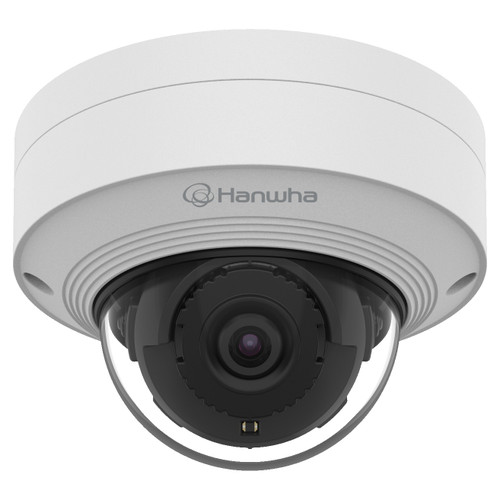
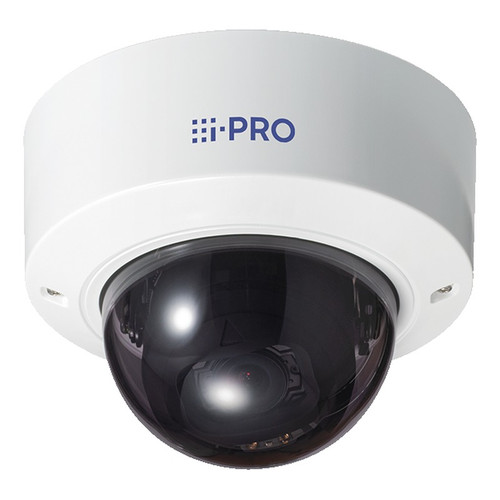
Both the Hanwha QNV-C8012 and the i-PRO WV-S22500-V3LG are 5MP wired dome cameras targeting commercial surveillance deployments. The Hanwha is specified for outdoor use with a fixed wide-angle lens, while the i-PRO is an indoor-rated unit with a motorized varifocal lens. Despite the indoor/outdoor split, both share the same resolution class, dome form factor, IK10 vandal resistance, PoE power, and ONVIF compliance — making them a legitimate cross-shop for covered-area or indoor perimeter installations where lens flexibility vs. environmental hardening is the deciding trade-off.
In This Guide
How do the imaging specs compare?
Both cameras use an approximately 1/2.8-inch CMOS sensor at 5MP and deliver 30 fps. The Hanwha QNV-C8012 uses a fixed 2.4mm F2.0 lens producing a very wide 123° horizontal field of view, suited to short-range, wide-area coverage such as retail floors or building entrances. The i-PRO WV-S22500-V3LG pairs its sensor with a motorized 2.9–9mm varifocal lens (3.1× optical zoom, F1.3–F2.5), yielding a 33°–105° adjustable horizontal field of view — offering far greater scene framing flexibility without physical lens changes. The i-PRO's maximum resolution output is 3072×2304 (4:3) versus the Hanwha's 2592×1944.
In low-light performance the cameras diverge significantly. The Hanwha QNV-C8012 specifies 0.05 Lux color and 0.005 Lux B/W minimum illumination with Auto ICR day/night switching and 120dB WDR. The i-PRO WV-S22500-V3LG specifies 0.15 Lux color and 0.12 Lux B/W at F1.3, and claims a maximum 132dB Super Dynamic WDR range (at level 31). The i-PRO's built-in IR LED is rated to 25m; the Hanwha's IR is noted only in the context of 0.005 Lux B/W mode with IR, and its DORI Detect distance (fixed lens) is 28.1m. The i-PRO DORI Detect range extends from 47.1m (wide) to 207.4m (tele), a direct benefit of its zoom capability.
What about installation and environment?
The Hanwha QNV-C8012 is rated IP66 and IK10 with NEMA 4X certification, supporting outdoor deployment in rain, dust, and jet-water conditions. Its operating temperature spans -40°C to +55°C, making it suitable for harsh climates including sub-zero environments. The i-PRO WV-S22500-V3LG carries an IK10 impact rating but has no IP ingress rating listed in the supplied specifications and is designated as indoor-rated, with an operating temperature of -10°C to +50°C (power-on: 0°C to +50°C). The Hanwha's aluminum housing with hard-coated dome is RAL9003 white; the i-PRO uses aluminum die-cast construction with a polycarbonate dome, also white.
Both cameras are powered by PoE IEEE 802.3af. The Hanwha is PoE Class 3 with a maximum draw of 7W (typical 4.9W). The i-PRO is listed as PoE Class 0 with a maximum draw of 12W, which may affect switch budget planning. The Hanwha also accepts DC12V. The i-PRO offers an analog monitor output (1.0Vp-p composite) for installer focus alignment. The Hanwha provides a Micro USB Type B video output (1280×720) for the same purpose. The Hanwha pan/tilt/rotate range is 0°–350° / -35°–70° / 0°–355°; the i-PRO adjusting angle is horizontal -240° to +120°, vertical -30° to +85°, yaw ±100°.
Which fits your VMS and analytics better?
Both cameras support ONVIF Profile G/M/S/T and H.265/H.264/MJPEG compression. The Hanwha QNV-C8012 supports up to 5 simultaneous stream profiles and up to 20 unicast users; the i-PRO WV-S22500-V3LG supports up to 14 simultaneous users. The Hanwha's smart codec is WiseStream III (AI-based); the i-PRO uses GOP-control smart coding. The Hanwha protocol stack includes FTP, SMTP, DDNS, SRTP, Bonjour, CDP, LLDP, UPnP, and SNMPv1/v2c/v3; the i-PRO adds SFTP and MQTT to a similar base set. The Hanwha lists 802.1X with EAP-TLS, EAP-LEAP, and EAP-PEAP; the i-PRO also supports 802.1X. The i-PRO's security stack includes FIPS 140-2 Level 3 certification and an NXP EdgeLock SE050F secure element; the Hanwha relies on a Hanwha Private Root CA device certificate, secure boot, signed firmware, and SD card partition encryption.
On-board analytics differ in scope. The Hanwha QNV-C8012 provides AI-based person/vehicle detection with vehicle type classification (car/bus/truck/motorcycle/bicycle), virtual line and area crossing, people counting, vehicle counting, queue management, and heatmap generation. The i-PRO WV-S22500-V3LG offers AI motion detection, face detection, vehicle detection, AI sound classification (gunshot, yell, vehicle horn, glass break), scene change detection, and audio detection. The i-PRO also includes built-in audio I/O (3.5mm mic input and line output, G.711/G.726 compression, half/full duplex), alarm input/output terminals (3× alarm IN/OUT, 1× AUX OUT), and audio-triggered alarms. The Hanwha has no audio I/O listed in the provided specifications. Both support microSD/SDHC/SDXC up to 256GB for edge recording. The Hanwha carries a 3-year warranty; the i-PRO carries a 5-year warranty.
Which should you choose: the C8012 or the S22500-V3LG?
Our take: The QNV-C8012 is the stronger choice when you need outdoor deployment, broad temperature tolerance, or widest-possible fixed-lens coverage in a compact PoE budget. Its IP66/NEMA 4X rating and -40°C to +55°C operating range let it operate in environments the i-PRO cannot. Its 123° fixed FOV and WiseStream III AI codec with heatmap and people/vehicle counting suit high-footfall retail analytics without VMS-side license cost. The WV-S22500-V3LG is the stronger choice for indoor installations where lens flexibility matters: its 3.1× motorized zoom spans 105° to 33°, its DORI Tele Detect extends to 207.4m versus the C8012's fixed 28.1m, and its 132dB Super Dynamic WDR (at level 31) exceeds the C8012's 120dB. Add FIPS 140-2 Level 3 hardware security, built-in audio I/O with AI sound classification, physical alarm terminals, and a 5-year warranty for environments where those capabilities justify its 12W PoE Class 0 draw.
Side-by-Side Comparison
Spec-for-spec, from manufacturer data.
| Specification | Hanwha C8012 | i-PRO S22500-V3LG |
|---|---|---|
| Resolution | 2592×1944 (5MP) | 3072×2304 (5MP, 4:3) / 3072×1728 (16:9) |
| Image Sensor | 1/2.8" CMOS | Approx. 1/2.8-type CMOS |
| Lens / Focal Length | Fixed 2.4mm, F2.0 | Motorized varifocal 2.9–9mm, F1.3–F2.5 |
| Optical Zoom | — | 3.1× |
| Horizontal FOV | 123° | 33°–105° |
| Min. Illumination (Color) | 0.05 Lux | 0.15 Lux (30IRE) |
| Min. Illumination (B/W) | 0.005 Lux | 0.12 Lux (F1.3) |
| IR Range | Not independently specified (0.005 Lux B/W w/ IR) | 25m |
| WDR | 120dB | Max. 132dB (Super Dynamic, level 31) |
| Max. Frame Rate | 30fps @ 5MP | 30fps @ 5MP |
| Video Compression | H.265, H.264, MJPEG | H.265, H.264, MJPEG |
| IP Rating | IP66 / NEMA 4X | — (indoor-rated; no IP rating listed) |
| IK / Impact Rating | IK10 | IK10 |
| Operating Temperature | -40°C to +55°C | -10°C to +50°C (power-on: 0°C to +50°C) |
| Power Input / PoE Class | PoE IEEE 802.3af, Class 3, max 7W | PoE IEEE 802.3af, Class 0, max 12W |
| Edge Storage | microSD/SDHC/SDXC, 1 slot, up to 256GB | microSD/SDHC/SDXC, up to 512GB |
| Audio | — | 3.5mm mic in + line out; G.711/G.726; AI sound classification |
| Alarm I/O Terminals | — | 3× Alarm IN/OUT, 1× AUX OUT |
| ONVIF Profiles | S / G / T / M | G / M / S / T |
| Security Certification | Secure boot, signed firmware, SD partition encrypt, 802.1X (EAP-TLS/LEAP/PEAP) | FIPS 140-2 Level 3, NXP EdgeLock SE050F, 802.1X |
| Dimensions | ø110×77mm (ø4.33×3.03") | ø129.5×102.5mm (ø5-3/32"×4-1/32") |
| Weight | 522g (1.15 lb) | 800g (1.77 lb) |
| Warranty | 3 years | 5 years |
Frequently Asked Questions
Which should you choose: the C8012 or the S22500-V3LG?
The QNV-C8012 is the stronger choice when you need outdoor deployment, broad temperature tolerance, or widest-possible fixed-lens coverage in a compact PoE budget. Its IP66/NEMA 4X rating and -40°C to +55°C operating range let it operate in environments the i-PRO cannot. Its 123° fixed FOV and WiseStream III AI codec with heatmap and people/vehicle counting suit high-footfall retail analytics without VMS-side license cost. The WV-S22500-V3LG is the stronger choice for indoor installations where lens flexibility matters: its 3.1× motorized zoom spans 105° to 33°, its DORI Tele Detect extends to 207.4m versus the C8012's fixed 28.1m, and its 132dB Super Dynamic WDR (at level 31) exceeds the C8012's 120dB. Add FIPS 140-2 Level 3 hardware security, built-in audio I/O with AI sound classification, physical alarm terminals, and a 5-year warranty for environments where those capabilities justify its 12W PoE Class 0 draw.
Is the QNV-C8012 or the WV-S22500-V3LG better for low-light performance?
Based on the supplied specifications, the Hanwha QNV-C8012 has a lower minimum illumination floor: 0.005 Lux in B/W mode with IR versus 0.12 Lux B/W (F1.3) for the i-PRO WV-S22500-V3LG. The i-PRO has a wider maximum aperture (F1.3 at wide end vs. F2.0 fixed on the Hanwha) and a specified 25m IR range, while the i-PRO claims a higher peak WDR of 132dB at maximum Super Dynamic level compared to the Hanwha's 120dB. Both include Auto ICR day/night switching.
Can the WV-S22500-V3LG be used outdoors?
Based on the specifications provided, the i-PRO WV-S22500-V3LG is designated as an indoor camera with an operating temperature of -10°C to +50°C. No IP ingress protection rating is listed for this model in the supplied specs. The Hanwha QNV-C8012, by contrast, carries IP66 and NEMA 4X ratings and an operating range of -40°C to +55°C, making it the outdoor-capable option between the two.
Which camera includes built-in audio support?
The i-PRO WV-S22500-V3LG includes a 3.5mm stereo mic input, a 3.5mm line output, and supports G.711 and G.726 audio compression in half or full duplex mode, along with AI sound classification for gunshot, yelling, vehicle horn, and glass break events. It also has 3 alarm input/output terminals and 1 AUX output. The Hanwha QNV-C8012's supplied specifications do not list any audio input, audio output, or audio compression capability.
Get a Second Opinion on Your Camera Choice
Share your site layout, coverage goals, and budget. Our team will validate the camera selection, flag anything we would change, and recommend products that match the use case.