
Hanwha C8011R vs i-PRO X22500-V3L: Specification Comparison
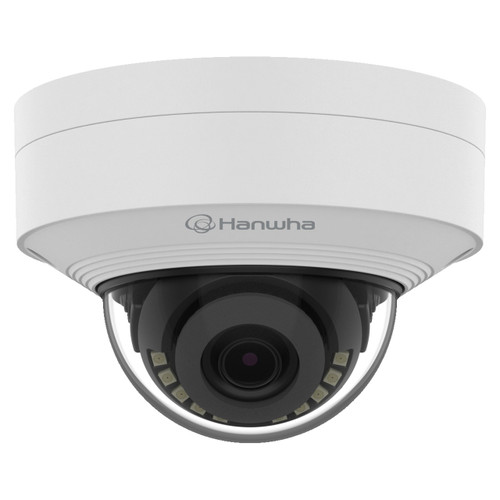
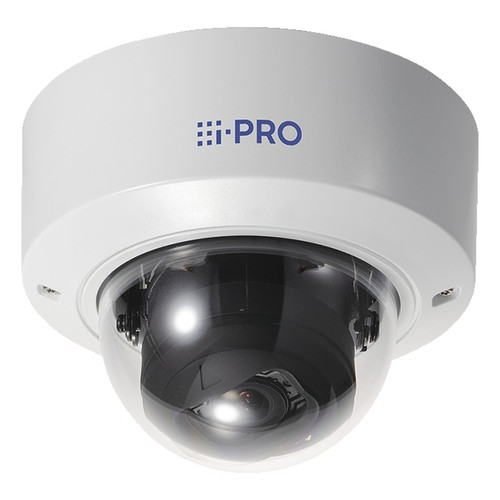
Both the Hanwha QNV-C8011R and i-PRO WV-X22500-V3L are wired, dome-form-factor, 5MP AI cameras targeting commercial surveillance deployments. The C8011R is rated for outdoor use (IP66/IK10) with a fixed 3mm lens, while the X22500-V3L is an indoor-only IK10 unit with a 3.1× motorized varifocal lens. Buyers cross-shopping these two are typically weighing outdoor durability and retail AI analytics against indoor varifocal flexibility and extended IR reach. This comparison examines imaging specs, installation fit, and VMS/analytics integration using only the provided specifications.
In This Guide
How do the imaging specs compare?
The C8011R delivers 2592×1944 (5MP 4:3) at 30fps through a fixed 3.0mm F1.6 lens yielding a 100° horizontal field of view, with minimum illumination of 0.03 lux color / 0 lux IR and 20m IR range at 850nm. Its WDR is rated at 120dB. DORI detect range is 43.5m. The X22500-V3L outputs 3072×1728 (5MP 16:9) also at 30fps, but through a motorized varifocal 2.9–9mm lens (F1.3 wide / F2.5 tele) covering 105° to 33° horizontal field of view. Minimum illumination is listed at 0.02 lux (B&W with IR LED), and IR range extends to 70m — 3.5× the C8011R. WDR on the X22500-V3L reaches 132dB with Super Dynamic enabled at level 31.
On DORI performance, the X22500-V3L's tele end significantly outreaches the C8011R: detect at 207.4m (tele) vs 43.5m; recognize at 41.5m (tele) vs 8.7m. At wide end the two are closer — X22500-V3L detect is 47.1m vs C8011R's 43.5m. The X22500-V3L also specifies an image stabilizer (available in 30fps mode) and an Ambarella CV52 SoC. The C8011R does not list a stabilizer or SoC model. Low-light advantage belongs to the X22500-V3L (0.02 lux vs 0.03 lux) and its 70m IR range dominates the C8011R's 20m.
What about installation and environment?
The C8011R is rated IP66 and IK10, certified NEMA 4X, and carries UL 62368-1 and CE/UKCA safety marks. It operates from −40°C to +55°C, making it suitable for harsh outdoor environments including cold-climate installations. It is powered by PoE IEEE 802.3af (Class 3, max 8.5W) and weighs 522g with a ø110×77mm footprint. A Micro USB Type-B port supports 1280×720 local video output for installation alignment. Compatible accessory mounts (SBP-120HMW hanging mount, SBV-140BW backbox, SBD-110GP1 conduit/gangbox) are sold separately.
The X22500-V3L carries only an IK10 impact rating — no IP ingress-protection rating is listed in the provided specifications, and the product is explicitly designated indoor. It operates from −10°C to +50°C (power-on minimum 0°C), a narrower range than the C8011R on both ends. Power input is DC 12V or PoE+ (802.3at, Class 4, 14W) — higher draw than the C8011R's 8.5W max. It is larger and heavier at ø129.5×102.5mm and approximately 820g. No installation-video USB port is listed. Buyers must verify their PoE switch supports 802.3at (Class 4) for the X22500-V3L; the C8011R works on any 802.3af Class 3 port.
Which fits your VMS and analytics better?
Both cameras support ONVIF Profile S/G/T/M and H.265/H.264/MJPEG compression with CBR/VBR bitrate control. The C8011R streams up to 5 simultaneous profiles to 20 unicast or multicast users. The X22500-V3L supports up to 14 simultaneous users. The C8011R's smart codec (WiseStream III, AI-based) and the X22500-V3L's CBR/VBR/Frame-rate/Best-effort transmission modes both address bandwidth management. The X22500-V3L additionally specifies audio compression (G.726, G.711, AAC-LC), a 3.5mm audio input/output jack, 4 alarm I/O terminals (2 IN / 1 OUT / 1 AUX), and AI Sound Classification (gunshot, yell, vehicle horn, glass break) — none of which appear in the C8011R's provided specifications.
Edge analytics differ in emphasis. The C8011R provides AI-classified people/vehicle detection, virtual line/area crossing with direction, heatmap, queue management, and people/vehicle counting — oriented toward retail business intelligence. The X22500-V3L lists AI motion, face, people, and vehicle detection plus AI Sound Classification, with Scene Change Detection and fog compensation. The C8011R supports up to 256GB microSD (1 slot); the X22500-V3L supports microSDXC up to 512GB. The X22500-V3L holds FIPS 140-2 Level 3 certification; the C8011R lists secure boot, signed firmware, firmware encryption, 802.1X (EAP-TLS/LEAP/PEAP), and SD card partition encryption, but FIPS 140-2 is not mentioned in the provided specs. The C8011R specifies a 3-year warranty; the X22500-V3L specifies 5 years.
Which should you choose: the C8011R or the X22500-V3L?
Our take: The C8011R is the stronger choice when the deployment is outdoor, budget-constrained on PoE infrastructure, or requires retail business-intelligence analytics out of the box. It operates down to −40°C (versus the X22500-V3L's −10°C floor), carries IP66/NEMA 4X weatherproofing the X22500-V3L does not list, and runs on a standard 802.3af Class 3 switch port (max 8.5W) versus the X22500-V3L's 802.3at Class 4 requirement (14W). The X22500-V3L is the stronger choice for indoor scenes requiring flexible coverage: its 3.1× motorized varifocal lens (2.9–9mm, 105°–33° FOV) eliminates the fixed-lens blind spots of the C8011R's 3mm optic, its IR reach is 70m versus 20m, and its 132dB WDR exceeds the C8011R's 120dB. The X22500-V3L also adds audio I/O, 4 alarm terminals, FIPS 140-2 Level 3 security, and a 5-year warranty. Choose the C8011R for outdoor AI analytics deployments on standard PoE; choose the X22500-V3L for indoor varifocal, long-range IR, and audio-integrated security applications.
Side-by-Side Comparison
Spec-for-spec, from manufacturer data.
| Specification | Hanwha C8011R | i-PRO X22500-V3L |
|---|---|---|
| Resolution | 2592×1944 (5MP 4:3) | 3072×1728 (5MP 16:9) |
| Image Sensor | 1/2.8" CMOS | Approx. 1/2.8" CMOS |
| Lens / Focal Length | 3.0mm fixed, F1.6 | 2.9–9mm motorized varifocal, F1.3–F2.5 |
| Horizontal FOV | 100° | 105° (wide) – 33° (tele) |
| Min. Illumination | 0.03 lux color / 0 lux IR | 0.02 lux (B&W with IR LED) |
| IR Range | 20m (850nm) | 70m |
| WDR | 120dB | 132dB (Super Dynamic On, Level 31) |
| Max Frame Rate | 30fps @ 5MP | 30fps |
| Video Compression | H.265, H.264, MJPEG | H.265, H.264, MJPEG |
| IP Rating | IP66 / NEMA 4X | — (indoor; not listed) |
| IK / Impact Rating | IK10 | IK10 |
| Operating Temperature | −40°C to +55°C | −10°C to +50°C (power-on min 0°C) |
| Power Input / PoE Class | PoE 802.3af, Class 3, max 8.5W | PoE+ 802.3at, Class 4, 14W (or DC 12V) |
| Edge Storage | microSD/SDHC/SDXC up to 256GB | microSDXC up to 512GB |
| Audio I/O | — | 3.5mm input & output; G.726/G.711/AAC-LC |
| Alarm I/O Terminals | — | 4 terminals (2 IN, 1 OUT, 1 AUX) |
| ONVIF Profiles | S/G/T/M | G/S/T/M |
| Warranty | 3 years | 5 years |
Frequently Asked Questions
Which should you choose: the C8011R or the X22500-V3L?
The C8011R is the stronger choice when the deployment is outdoor, budget-constrained on PoE infrastructure, or requires retail business-intelligence analytics out of the box. It operates down to −40°C (versus the X22500-V3L's −10°C floor), carries IP66/NEMA 4X weatherproofing the X22500-V3L does not list, and runs on a standard 802.3af Class 3 switch port (max 8.5W) versus the X22500-V3L's 802.3at Class 4 requirement (14W). The X22500-V3L is the stronger choice for indoor scenes requiring flexible coverage: its 3.1× motorized varifocal lens (2.9–9mm, 105°–33° FOV) eliminates the fixed-lens blind spots of the C8011R's 3mm optic, its IR reach is 70m versus 20m, and its 132dB WDR exceeds the C8011R's 120dB. The X22500-V3L also adds audio I/O, 4 alarm terminals, FIPS 140-2 Level 3 security, and a 5-year warranty. Choose the C8011R for outdoor AI analytics deployments on standard PoE; choose the X22500-V3L for indoor varifocal, long-range IR, and audio-integrated security applications.
Is the C8011R or X22500-V3L better for low-light performance?
Based on provided specs, the X22500-V3L has a slight edge in minimum illumination (0.02 lux B&W with IR vs 0.03 lux color for the C8011R), and its IR range of 70m far exceeds the C8011R's 20m. However, the C8011R reaches 0 lux with IR active. For longer-range night coverage the X22500-V3L's 70m IR is a clear advantage; for outdoor zero-lux close-range use, both cameras achieve it via IR.
Can I power the C8011R and X22500-V3L from the same PoE switch?
Not necessarily. The C8011R requires PoE IEEE 802.3af (Class 3, max 8.5W), which any standard PoE switch supports. The X22500-V3L requires PoE+ (802.3at) at 14W — a Class 4 budget. If your switch only supplies 802.3af (15.4W per port budget, Class 3 max 6.49W allocated), the X22500-V3L will not power up correctly. Verify each switch port's 802.3at capability before deploying the X22500-V3L.
Which camera supports audio recording and alarm I/O terminals?
The X22500-V3L specifies a 3.5mm audio input and output jack, 4 alarm I/O terminals (2 IN, 1 OUT, 1 AUX), and AI Sound Classification for events like gunshot and glass break. The provided specifications for the C8011R do not list audio input/output or hard-wired alarm I/O terminals. If audio integration or dry-contact alarm wiring is required, the X22500-V3L is the only option of the two based on the provided data.
Get a Second Opinion on Your Camera Choice
Share your site layout, coverage goals, and budget. Our team will validate the camera selection, flag anything we would change, and recommend products that match the use case.