
Hanwha C7083R vs Pelco SRXE4-2X33-EBT-IR1: Specification Comparison
Both the Hanwha XNO-C7083R and the Pelco SRXE4-2X33-EBT-IR1 are outdoor-rated, fixed 4MP IP bullet cameras with motorized varifocal lenses, 60 fps capability, and built-in IR illumination—a configuration commonly cross-shopped by integrators designing perimeter and parking-lot systems. This comparison evaluates imaging performance, environmental and installation characteristics, and VMS/analytics integration using only the published specifications for each model, without endorsing either as a categorical winner.
In This Guide
How do the imaging specs compare?
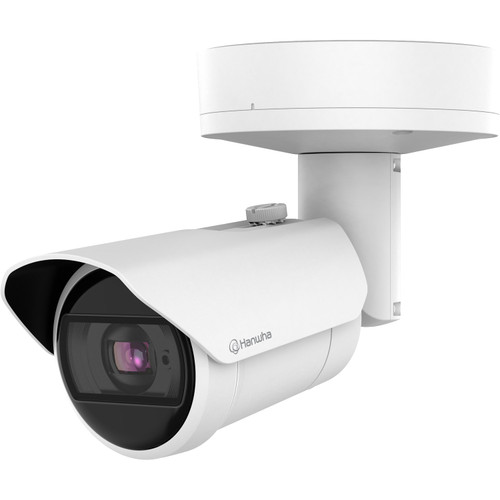
The Hanwha XNO-C7083R uses a 1/2.8-inch progressive CMOS sensor producing 2592×1520 at up to 60 fps, paired with a 2.8–10 mm (3.6×) motorized varifocal lens offering a horizontal field of view of 110° at wide end. Its minimum illumination is 0.038 lux in color and 0 lux with IR active, with WiseIR illumination rated to 40 m (131 ft). Wide dynamic range is specified at 120 dB via Hanwha's extremeWDR processing. Maximum aperture is F1.4 at wide and F3.0 at tele. DORI detection distances reach 36.3 m wide / 193.5 m tele at 25 PPM, providing a concrete operational range reference.
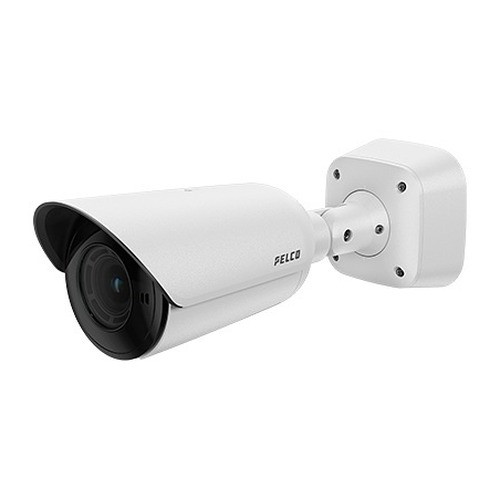
The Pelco SRXE4-2X33-EBT-IR1 uses a larger 1/1.8-inch progressive scan CMOS sensor at 2560×1440 and also runs 60 fps. Its motorized varifocal lens spans 4.4–9.3 mm with a wider zoom-end HFOV of 32–109°. Minimum illumination is specified at 0.003 lux in color and 0 lux with IR—approximately 12× more sensitive in color than the Hanwha at rated lux. The Pelco's WDR is rated at 130 dB via SureVision, 10 dB higher than the Hanwha's 120 dB. The integrated IR1 module is rated to approximately 70 m per card-bullet data, and aperture is listed as F1.4. No DORI distances are provided in the available Pelco spec data.
What about installation and environment?
The Hanwha XNO-C7083R is rated IP66/IP67 and NEMA 4X, with IK10 vandal resistance, and operates from -40°C to +55°C. It accepts PoE (IEEE 802.3af, Class 3) or 12 VDC, draws a maximum of 12.95 W, and weighs 1,640 g (3.62 lb) in an aluminum-plus-PC housing. A backbox is included. The unit supports single-gang, double-gang, 4-inch octagon, and 4-inch square conduit knockout configurations. Built-in digital image stabilization via a gyro sensor reduces vibration artifacts in pole or parapet installations. The lens uses DC auto-iris with a hall sensor and simple/manual focus control.
The Pelco SRXE4-2X33-EBT-IR1 carries a substantially broader ingress rating: IP66, IP67, IP68 (2 m for 2 hours), and IPX9K, as well as NEMA 4X—making it suitable for direct wash-down environments. Its impact rating is IK11, one tier above the Hanwha's IK10. Operating temperature extends from -50°C to +65°C with PoE+ or external power, a 10°C wider cold tolerance and 10°C wider heat tolerance than the Hanwha. Power is PoE+ (802.3at, Class 3 noted in spec but PoE+ is an 802.3at-class supply). Exact weight and conduit knockout configurations are not listed in the available Pelco spec data.
Which fits your VMS and analytics better?
Both cameras support ONVIF Profile S, G, T, and M. The Hanwha XNO-C7083R additionally exposes Wisenet SUNAPI, broadening compatibility with Hanwha's own VMS ecosystem and third-party platforms that have implemented SUNAPI drivers. On-board analytics include AI-based object classification (person, face, vehicle, license plate), vehicle-type sub-classification (car, bus, truck, motorcycle, bicycle), virtual line crossing with direction, virtual area, and business-intelligence functions: people counting, queue management, and heatmap—all specified as AI-engine-driven. Edge storage is 1× micro SD/SDHC/SDXC slot supporting up to 512 GB. Audio includes a selectable mic/line input and a line output. The camera exposes MQTT for event subscription and publishes 2 configurable alarm I/O ports.
The Pelco SRXE4-2X33-EBT-IR1's analytics include person/vehicle detection, direction violation, loitering, beam crossing, crowd detection, audio analytics, and tamper alert under the Smart Analytics label. It also lists 4 GB RAM and 4 GB Flash (versus 2 GB RAM / 512 MB Flash on the Hanwha), which may support heavier on-camera workloads. On-board storage support (microSD) is noted in spec attributes. Audio support is listed as microphone-supported. On the cybersecurity side, Pelco specifies FIPS 140-3 Level 3, TPM, and Secure Boot—none of which appear in the Hanwha's published spec set—along with NDAA Section 889 and TAA compliance, which are mandatory for U.S. federal and many state/municipal procurements.
Which should you choose: the C7083R or the SRXE4-2X33-EBT-IR1?
Our take: The SRXE4-2X33-EBT-IR1 is the stronger choice when federal compliance, extreme-environment durability, or cyber-assurance requirements govern the selection. Its 1/1.8-inch sensor and 0.003 lux minimum illumination deliver measurably better low-light color performance than the Hanwha's 0.038 lux, its 130 dB WDR exceeds the Hanwha's 120 dB by 10 dB, and IP68/IPX9K/IK11 ratings cover wash-down and hard-impact scenarios the Hanwha's IP67/IK10 does not. FIPS 140-3 Level 3 and TAA/NDAA compliance are decisive for government-funded projects. The XNO-C7083R is the stronger choice when budget, Hanwha VMS ecosystem integration, SUNAPI driver availability, or the dual-voltage (PoE or 12 VDC) power flexibility are priorities—and its 40 m IR range, 120 dB WDR, AI license-plate detection, and five-year lower warranty (3-year vs. Pelco's 5-year) remain meaningful. Installers on standard 802.3af infrastructure should note the Pelco may require 802.3at PoE+ switch ports.
Side-by-Side Comparison
Spec-for-spec, from manufacturer data.
| Specification | Hanwha C7083R | Pelco SRXE4-2X33-EBT-IR1 |
|---|---|---|
| Resolution | 2592×1520 (4MP) | 2560×1440 (4MP) |
| Image Sensor Size | 1/2.8" progressive CMOS | 1/1.8" progressive scan CMOS |
| Lens / Focal Length | 2.8–10 mm motorized varifocal (3.6×) | 4.4–9.3 mm motorized varifocal |
| Horizontal FOV | 110° (wide) — tele not specified | 32°–109° |
| Max Frame Rate | 60 fps @ 4MP | 60 fps |
| Min Illumination (Color) | 0.038 lux | 0.003 lux |
| Min Illumination (IR) | 0 lux | 0 lux |
| IR Range | 40 m (131 ft) WiseIR | ~70 m (IR1 module, 850 nm) |
| Wide Dynamic Range | 120 dB extremeWDR | 130 dB SureVision |
| Video Compression | H.265 / H.264 / MJPEG | H.265 / H.264 / Motion JPEG |
| IP Rating | IP66 / IP67 / NEMA 4X | IP66 / IP67 / IP68 (2 m / 2 hr) / IPX9K / NEMA 4X |
| Impact Rating | IK10 | IK11 |
| Operating Temperature | -40°C to +55°C | -50°C to +65°C |
| Power Input / PoE Class | PoE 802.3af Class 3 / 12 VDC; max 12.95 W | PoE+ 802.3at Class 3 |
| Edge Storage | Micro SD/SDHC/SDXC up to 512 GB (1 slot) | microSD (capacity not specified in available data) |
| Audio | Mic/line input (selectable); line output | Microphone supported |
| Cybersecurity | HTTPS, 802.1X (EAP-TLS/LEAP/PEAP), Digest auth | FIPS 140-3 Level 3, TPM, Secure Boot, HTTPS, 802.1X |
| NDAA / TAA | — | NDAA Section 889; TAA Compliant |
| Alarm I/O | 2 configurable I/O ports | — |
| Warranty | 3-year | 5-year |
Frequently Asked Questions
Which should you choose: the C7083R or the SRXE4-2X33-EBT-IR1?
The SRXE4-2X33-EBT-IR1 is the stronger choice when federal compliance, extreme-environment durability, or cyber-assurance requirements govern the selection. Its 1/1.8-inch sensor and 0.003 lux minimum illumination deliver measurably better low-light color performance than the Hanwha's 0.038 lux, its 130 dB WDR exceeds the Hanwha's 120 dB by 10 dB, and IP68/IPX9K/IK11 ratings cover wash-down and hard-impact scenarios the Hanwha's IP67/IK10 does not. FIPS 140-3 Level 3 and TAA/NDAA compliance are decisive for government-funded projects. The XNO-C7083R is the stronger choice when budget, Hanwha VMS ecosystem integration, SUNAPI driver availability, or the dual-voltage (PoE or 12 VDC) power flexibility are priorities—and its 40 m IR range, 120 dB WDR, AI license-plate detection, and five-year lower warranty (3-year vs. Pelco's 5-year) remain meaningful. Installers on standard 802.3af infrastructure should note the Pelco may require 802.3at PoE+ switch ports.
Is the XNO-C7083R or the SRXE4-2X33-EBT-IR1 better for low-light performance?
Based on published specs, the Pelco SRXE4-2X33-EBT-IR1 has a lower minimum illumination at 0.003 lux color versus the Hanwha XNO-C7083R's 0.038 lux color—approximately 12× more sensitive in color mode. Both reach 0 lux with IR active. The Pelco also uses a larger 1/1.8-inch sensor compared to the Hanwha's 1/2.8-inch sensor, which generally supports better light gathering. The Hanwha's IR is rated to 40 m; the Pelco's IR1 module is rated to approximately 70 m.
Which camera is required for U.S. federal or government projects?
The Pelco SRXE4-2X33-EBT-IR1 specifies NDAA Section 889 compliance and TAA compliance in its published approvals. The Hanwha XNO-C7083R does not list either designation in the provided spec data. For federally funded deployments or contracts requiring NDAA/TAA adherence, the Pelco meets those published requirements; the Hanwha's compliance status for those regulations is not confirmed by the available specifications.
Can both cameras run on a standard 802.3af PoE switch?
The Hanwha XNO-C7083R is specified for PoE IEEE 802.3af Class 3 (maximum 15.4 W budget, camera draws 12.95 W), so it operates on any standard 802.3af switch port. The Pelco SRXE4-2X33-EBT-IR1 lists PoE+ (802.3at) as its power type in the spec data, which requires an 802.3at-capable switch port delivering up to 30 W. Installers using legacy or budget 802.3af-only switches should confirm Pelco's power requirement before deployment.
Get a Second Opinion on Your Camera Choice
Share your site layout, coverage goals, and budget. Our team will validate the camera selection, flag anything we would change, and recommend products that match the use case.