
Hanwha C6083R vs Hanwha L6082R: Specification Comparison
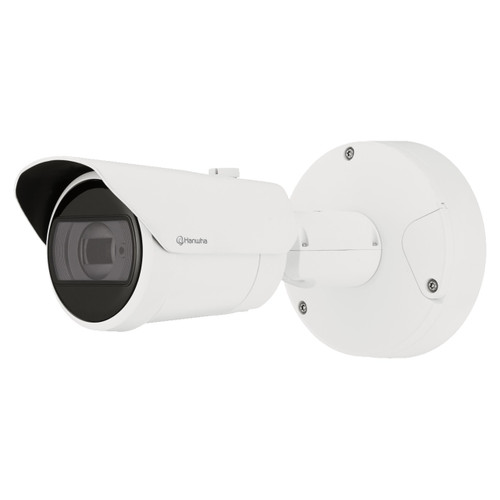
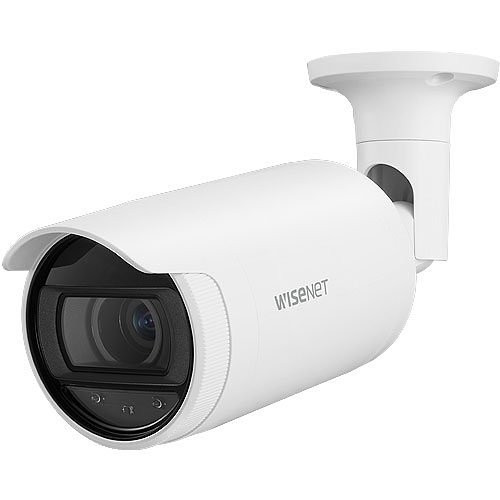
Both the Hanwha XNO-C6083R and ANO-L6082R are 2MP (1920×1080) outdoor wired bullet cameras sharing the same PoE Class 3 power input and ONVIF Profile S/G/T compatibility. They occupy the same resolution class and form factor, making them a legitimate cross-shop for integrators selecting an outdoor varifocal bullet. The comparison focuses on where they diverge: frame rate, WDR capability, AI analytics depth, environmental ratings, storage, audio, and physical construction.
In This Guide
How do the imaging specs compare?
The XNO-C6083R delivers 60 fps at 1920×1080 versus the ANO-L6082R's 30 fps ceiling — a meaningful difference for capturing fast-moving subjects or reducing motion blur in license-plate capture. Both use a 1/2.8" CMOS sensor, but the C6083R specifies a progressive scan device while the L6082R lists only 'CMOS' with no progressive-scan call-out. Wide dynamic range separates them substantially: the C6083R is rated at extremeWDR 150 dB, while the L6082R is rated at 120 dB. Minimum illumination also favors the C6083R at 0.01 Lux color versus 0.03 Lux color for the L6082R; both reach 0 Lux with IR active.
On the lens side the C6083R spans 2.8–12 mm at 4.3× motorized varifocal with a maximum aperture of F1.4 wide, providing a wider horizontal field of view of 120°. The L6082R covers 3.3–10.3 mm at 3.1× motorized varifocal with F1.6 wide, yielding a maximum horizontal FOV of 106°. The C6083R's wider aperture (F1.4 vs F1.6) admits more light in low-illumination conditions. IR throw is 40 m (131 ft) on the C6083R versus 30 m (98 ft) on the L6082R. At tele detection range (25 PPM), the L6082R reaches 140.4 m versus 159.9 m for the C6083R, driven by the longer focal length. Noise reduction on the C6083R is WiseNR II (AI-based) plus SSNR V; the L6082R provides SSNR only. The C6083R also adds WiseStream III alongside WiseStream II, while the L6082R supports WiseStream II only.
What about installation and environment?
The XNO-C6083R carries IP66/IP67 and NEMA 4X ratings plus IK10 vandal resistance; its body is aluminum and PC with a hard-coated window. The ANO-L6082R is rated IP66 only with no IK impact rating listed and is constructed from plastic. The C6083R also includes a backbox and lists compatibility with single/double/4" octagon/4" square conduit holes and gang boxes. The L6082R requires a separately specified backbox (SBV-A14B) and does not list conduit/gang-box compatibility in its specs.
Operating temperature range is broader on the C6083R: −40 °C to +55 °C versus −30 °C to +55 °C for the L6082R, a 10 °C cold-end advantage relevant to northern or unheated enclosure installs. Both draw PoE IEEE 802.3af Class 3 power, but maximum power consumption differs: the C6083R draws up to 12.95 W while the L6082R draws a maximum of 7.0 W (typical 5.0 W). Physical size and weight differ meaningfully: the C6083R is ø93.4×276.6 mm at 1,640 g (3.62 lb) versus the L6082R at ø78.0×262.0 mm and only 390 g (0.86 lb), which affects mounting hardware selection.
Which fits your VMS and analytics better?
Both cameras are ONVIF Profile S/G/T compliant and support SUNAPI. The XNO-C6083R additionally declares ONVIF Profile M and G, relevant for metadata and analytics-aware VMS integrations. Analytics depth diverges significantly: the C6083R offers AI-engine object detection with classified types (person, face, vehicle, license plate), vehicle attribute classification (car/bus/truck/motorcycle/bicycle), virtual line and virtual area crossing with direction, business intelligence functions (people counting, queue management, heatmap), and DetectionShot. The L6082R provides motion detection, tampering, virtual area (intrusion/enter/exit), and virtual line (crossing/direction) — no AI object classification or BI functions are specified.
Audio is present on the C6083R (selectable mic/line in with 2.5 VDC supply, plus line out at max 1 Vrms) and supports G.711 and G.726 compression; the L6082R has no audio input or output listed in its specs. Edge storage on the C6083R supports Micro SD/SDHC/SDXC up to 512 GB; the L6082R supports Micro SD/SDHC up to 32 GB only. Unicast streaming is supported for up to 20 users on the C6083R versus 6 users on the L6082R; the C6083R also supports up to 10 stream profiles with 3 virtual channels versus 3 profiles on the L6082R. The C6083R adds MQTT protocol, SRTP, LLDP, and CDP; the L6082R's protocol list does not include these. Security features also differ: the C6083R adds HTTPS digest login, IP filtering, user access logging, and a pre-installed Hanwha Techwin Root CA device certificate, while the L6082R offers firmware encryption, digest authentication, brute-force attack prevention, AES encryption, ZIP compression, SD card partition encryption, and a Hanwha Private Root CA certificate — both robust but with different emphases.
Which should you choose: the C6083R or the L6082R?
Our take: The XNO-C6083R is the stronger choice when frame rate, WDR performance, AI analytics, or harsh-environment durability are priorities. Concretely: it captures at 60 fps versus the L6082R's 30 fps, delivers 150 dB extremeWDR versus 120 dB, and extends IR range to 40 m versus 30 m. It additionally adds AI object classification, people counting, audio I/O, 512 GB edge storage versus 32 GB, and IK10 vandal resistance that the L6082R does not provide. The L6082R is a viable fit for budget-sensitive or weight-constrained installations — at 390 g and 7 W max draw it is substantially lighter and more power-efficient than the C6083R's 1,640 g and 12.95 W, and its plastic housing may be acceptable in lower-risk indoor-perimeter or light commercial sites. If the deployment requires AI-driven forensic search, audio, expanded storage, higher frame rates, or IK10 impact protection, the C6083R is the appropriate selection.
Side-by-Side Comparison
Spec-for-spec, from manufacturer data.
| Specification | Hanwha C6083R | Hanwha L6082R |
|---|---|---|
| Resolution | 1920×1080 (2MP) | 1920×1080 (2MP) |
| Image Sensor | 1/2.8" progressive scan CMOS | 1/2.8" CMOS |
| Max Frame Rate | 60 fps | 30 fps |
| Lens / Focal Length | 2.8–12mm motorized varifocal (4.3×) | 3.3–10.3mm motorized varifocal (3.1×) |
| Max Aperture (Wide) | F1.4 | F1.6 |
| Horizontal FOV (Wide) | 120° | 106° |
| Min. Illumination (Color) | 0.01 Lux | 0.03 Lux |
| IR Range | 40m (131ft) WiseIR | 30m (98ft) |
| Wide Dynamic Range | 150dB extremeWDR | 120dB |
| Video Compression | H.265 / H.264 (Main/Baseline/High) / MJPEG | H.265 / H.264 (Main/High) / MJPEG |
| IP Rating | IP66 / IP67 / NEMA 4X | IP66 |
| IK / Impact Rating | IK10 | — |
| Operating Temperature | −40°C to +55°C | −30°C to +55°C |
| Power Input / PoE Class | PoE IEEE 802.3af Class 3 / 12VDC; max 12.95W | PoE IEEE 802.3af Class 3; max 7.0W |
| Edge Storage | Micro SD/SDHC/SDXC up to 512GB | Micro SD/SDHC up to 32GB |
| Audio | Mic/line in + line out | — |
| AI Analytics | Object detection (person/face/vehicle/LP), people counting, queue mgmt, heatmap | Motion detection, tampering, virtual line/area |
| ONVIF Profiles | S / G / T / M | S / G / T |
| Housing Material | Aluminum + PC (hard-coated window) | Plastic |
| Dimensions / Weight | ø93.4×276.6mm / 1,640g (3.62 lb) | ø78.0×262.0mm / 390g (0.86 lb) |
| Warranty | 3-year | 3-year |
Frequently Asked Questions
Which should you choose: the C6083R or the L6082R?
The XNO-C6083R is the stronger choice when frame rate, WDR performance, AI analytics, or harsh-environment durability are priorities. Concretely: it captures at 60 fps versus the L6082R's 30 fps, delivers 150 dB extremeWDR versus 120 dB, and extends IR range to 40 m versus 30 m. It additionally adds AI object classification, people counting, audio I/O, 512 GB edge storage versus 32 GB, and IK10 vandal resistance that the L6082R does not provide. The L6082R is a viable fit for budget-sensitive or weight-constrained installations — at 390 g and 7 W max draw it is substantially lighter and more power-efficient than the C6083R's 1,640 g and 12.95 W, and its plastic housing may be acceptable in lower-risk indoor-perimeter or light commercial sites. If the deployment requires AI-driven forensic search, audio, expanded storage, higher frame rates, or IK10 impact protection, the C6083R is the appropriate selection.
Is the C6083R or L6082R better for low-light and night vision?
The C6083R has the edge in low light: its minimum color illumination is 0.01 Lux versus 0.03 Lux for the L6082R, its aperture is F1.4 wide versus F1.6, and its IR throw reaches 40 m versus the L6082R's 30 m. Both cameras reach 0 Lux with IR active. The C6083R also applies an AI-based noise reduction engine (WiseNR II) in addition to SSNR V, while the L6082R uses SSNR only.
Can either camera do license plate recognition or people counting?
Only the XNO-C6083R specifies AI-based analytics including classified object detection for persons, vehicles, and license plates, vehicle attribute classification, people counting, queue management, and heatmap. The ANO-L6082R's analytics are limited to motion detection, tampering, and virtual line/area crossing events; no object classification or business intelligence functions are listed in its specifications.
Which camera is easier to install in a conduit-fed junction box, and which handles colder climates better?
The XNO-C6083R lists compatibility with single, double, 4" octagon, and 4" square gang boxes and includes a backbox. The ANO-L6082R requires a separately purchased backbox (SBV-A14B) and does not list gang-box or conduit-hole compatibility in its specs. For cold climates, the C6083R operates down to −40 °C versus the L6082R's −30 °C lower limit, a 10 °C advantage for unheated outdoor enclosures in northern or high-altitude deployments.
Get a Second Opinion on Your Camera Choice
Share your site layout, coverage goals, and budget. Our team will validate the camera selection, flag anything we would change, and recommend products that match the use case.