
Hanwha ARN-810S vs Hanwha QRN-830S: Specification Comparison
Both the Hanwha ARN-810S and QRN-830S are 8-channel, 8MP network video recorders from Hanwha's Wisenet lineup, targeting small-to-midsize installations that require PoE-powered camera connectivity and local display output. This comparison evaluates the two units across recording throughput and codec support, storage and physical build, and integration and remote management capabilities—three dimensions that most directly drive purchasing decisions in this product class.
In This Guide
- Which NVR delivers higher recording bandwidth and broader codec support?
- How do the two units compare on storage capacity, physical build, and operating environment?
- Which unit offers stronger integration, remote access, and security management features?
- Which should you choose: the ARN-810S or the QRN-830S?
- Side-by-Side Specs
- FAQ
Which NVR delivers higher recording bandwidth and broader codec support?
The QRN-830S holds a measurable throughput advantage, supporting a maximum recording bandwidth of 80Mbps versus the ARN-810S's 60Mbps—a 33% increase that becomes relevant when deploying higher-bitrate cameras or enabling dual-stream recording simultaneously across all 8 channels. Playback bandwidth on the QRN-830S is specified at up to 32Mbps.
On codec support, the QRN-830S explicitly lists H.265, H.264, and MJPEG, and separately specifies audio compression of G.711, G.726, and AAC at 16/48kHz. The ARN-810S lists WiseStream II, H.264, and H.265 under compression—WiseStream II is Hanwha's bitrate-reduction technology layered on top of standard codecs, but the ARN-810S spec does not list MJPEG support.
For local display, the QRN-830S specifies a 4K HDMI output at 3840×2160 at 30Hz with up to 9 simultaneous screen layouts (1/2H/2V/3V/4/6/8/9). The ARN-810S datasheet reference and card bullets confirm HDMI output but do not specify output resolution. The QRN-830S also documents decoding performance of 8MP at 60fps and 1080p at 240fps; the ARN-810S spec states 30fps at 8MP but does not provide a multi-resolution decoding matrix.
How do the two units compare on storage capacity, physical build, and operating environment?
Storage architecture is a clear differentiator. The QRN-830S ships with one SATA HDD bay supporting drives up to 6TB—conventional spinning or SSD media installed internally. The ARN-810S lists only microSD as its local storage medium; no internal HDD bay is specified in the provided data. For any deployment requiring continuous, long-retention recording measured in days or weeks, the QRN-830S's HDD-based storage is substantially more practical.
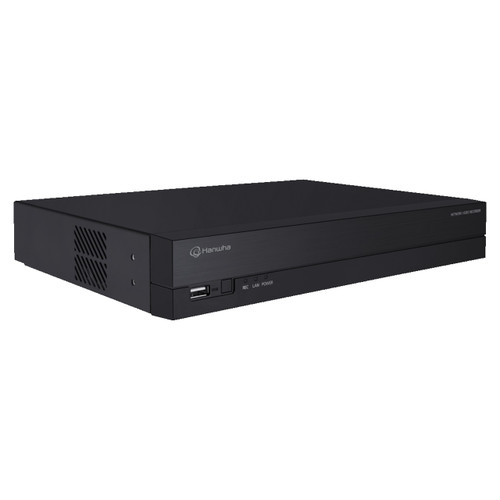
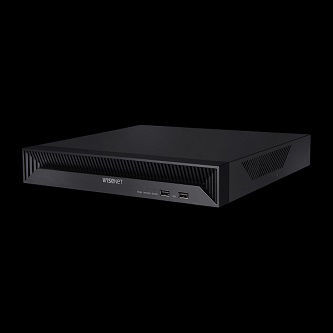
Physically, the QRN-830S is documented as 300 × 47.6 × 238.9 mm and 1.32 kg, with a black metal enclosure. The ARN-810S spec lists housing color as white but does not provide dimensions or weight. The QRN-830S's metal construction is confirmed; the ARN-810S material is unspecified.
Operating environment data is provided only for the QRN-830S: 0°C to +40°C (32°F to 104°F), 20–85% RH, input voltage of 54VDC/1.55A, and maximum power draw of 84W (with 1 HDD and PoE active). The ARN-810S provides no operating temperature, humidity, or input voltage specification in the supplied data.
Which unit offers stronger integration, remote access, and security management features?
The QRN-830S carries a detailed protocol stack: IPv4/IPv6, TCP/IP, UDP/IP, RTP (UDP and TCP), RTSP, NTP, HTTP, DHCP (server and client), SMTP, ICMP, IGMP, ARP, DNS, DDNS, uPnP, HTTPS, SNMP, ONVIF Profile-S, and Hanwha SUNAPI (both server and client). It also documents N+1 failover redundancy and ARB (Auto Recovery Backup) support. Remote user limits are explicitly stated: up to 3 search users, 10 live unicast users, and 20 multicast users simultaneously.
Security features on the QRN-830S include IP address filtering, user access logging, 802.1x port authentication, data encryption, device certificate via Hanwha Techwin Root CA, and signed firmware. The ARN-810S spec confirms ONVIF compatibility and VMS support (Wisenet Viewer, mobile app, ONVIF-compatible VMS) but does not enumerate specific protocols, remote user limits, failover capabilities, or security features such as 802.1x or signed firmware.
PTZ support is confirmed on both units. The QRN-830S documents 300 presets and control via GUI and webviewer. The ARN-810S notes PTZ controller connectivity via USB but does not quantify preset count. Event handling on the QRN-830S is fully specified (alarm input, video loss, camera analytics, defocus, audio triggers; e-mail, FTP, PTZ preset, buzzer, and SUNAPI command actions); the ARN-810S describes analytics as 'edge-configurable intelligent video analytics' without listing discrete trigger or action types.
Which should you choose: the ARN-810S or the QRN-830S?
Our take: The QRN-830S is the stronger choice when storage longevity, higher recording throughput, and documented enterprise integration are priorities. Three concrete spec deltas drive this conclusion: the QRN-830S supports 80Mbps recording bandwidth versus the ARN-810S's 60Mbps; it houses a SATA HDD bay accommodating up to 6TB of internal storage while the ARN-810S is limited to microSD; and it documents 4K HDMI output at 3840×2160 while the ARN-810S's HDMI resolution is unspecified. The QRN-830S also details N+1 failover, 802.1x authentication, signed firmware, and a full protocol stack—none of which appear in the ARN-810S spec. The ARN-810S may suit compact or retrofit deployments where a smaller footprint and white enclosure matter and microSD-based storage is acceptable. Buyers standardizing on Hanwha SUNAPI or requiring multi-user concurrent remote access should select the QRN-830S; those with minimal retention needs and space constraints should confirm the ARN-810S's microSD capacity against their retention requirements before committing.
Side-by-Side Comparison
Spec-for-spec, from manufacturer data.
| Specification | Hanwha ARN-810S | Hanwha QRN-830S |
|---|---|---|
| Product Type | NVR | NVR |
| Channels | 8 | 8 |
| Max Camera Resolution | 8MP | 8MP |
| Max Recording Bandwidth | 60Mbps | 80Mbps |
| Max Playback Bandwidth | — | 32Mbps |
| Video Compression | H.265, H.264, WiseStream II | H.265, H.264, MJPEG |
| Local Display Output | HDMI (resolution unspecified) | HDMI: 3840×2160 (30Hz) |
| Multi-Screen Layouts | — | 1/2H/2V/3V/4/6/8/9 screens |
| Internal HDD Bay | — | SATA 1× (up to 6TB) |
| Local Storage (Other) | microSD | — |
| PoE Ports | 8× PoE | 8× PoE RJ-45 (10/100) |
| PoE Budget | 65W total | 65W total |
| Uplink Port | — | RJ-45 1× (1Gbps LAN/WAN) |
| ONVIF | Yes | ONVIF Profile-S |
| Max Remote Users (Live) | — | Unicast 10, Multicast 20 |
| Failover / Redundancy | — | N+1 Failover, ARB |
| Security Features | — | IP filtering, 802.1x, signed firmware, device certificate |
| PTZ Presets | — | 300 |
| OS (Embedded) | — | Linux |
| Operating Temperature | — | 0°C to +40°C |
| Max Power Draw | — | 84W (with 1 HDD, PoE ON) |
| Enclosure Material | — | Metal |
| Housing Color | White | Black |
| Weight | — | 1.32 kg (2.91 lb) |
| Dimensions (W×H×D) | — | 300 × 47.6 × 238.9 mm |
| Warranty | 3 years | — |
Frequently Asked Questions
Which should you choose: the ARN-810S or the QRN-830S?
The QRN-830S is the stronger choice when storage longevity, higher recording throughput, and documented enterprise integration are priorities. Three concrete spec deltas drive this conclusion: the QRN-830S supports 80Mbps recording bandwidth versus the ARN-810S's 60Mbps; it houses a SATA HDD bay accommodating up to 6TB of internal storage while the ARN-810S is limited to microSD; and it documents 4K HDMI output at 3840×2160 while the ARN-810S's HDMI resolution is unspecified. The QRN-830S also details N+1 failover, 802.1x authentication, signed firmware, and a full protocol stack—none of which appear in the ARN-810S spec. The ARN-810S may suit compact or retrofit deployments where a smaller footprint and white enclosure matter and microSD-based storage is acceptable. Buyers standardizing on Hanwha SUNAPI or requiring multi-user concurrent remote access should select the QRN-830S; those with minimal retention needs and space constraints should confirm the ARN-810S's microSD capacity against their retention requirements before committing.
Is the ARN-810S or QRN-830S better for larger deployments?
The QRN-830S is better suited to larger or more demanding deployments. It supports up to 80Mbps recording bandwidth (vs. 60Mbps on the ARN-810S), allows up to 10 simultaneous live unicast remote users and 20 multicast users (remote user limits are not specified for the ARN-810S), and includes N+1 failover and ARB redundancy—features absent from the ARN-810S spec. Its 6TB internal HDD bay also supports longer retention periods than the ARN-810S's microSD-only storage.
Can both NVRs record and display 4K footage?
Both units support 8MP (approximately 4K) camera inputs across 8 channels. The QRN-830S explicitly specifies a 4K HDMI output at 3840×2160 (30Hz) and documents 8MP decoding at 60fps. The ARN-810S confirms HDMI output and 8MP recording at 30fps but does not specify the HDMI output resolution in the provided spec data. Buyers requiring confirmed 4K monitor output should note this distinction.
Which NVR has more flexible storage options?
The QRN-830S provides significantly more flexible storage: one internal SATA HDD bay supporting drives up to 6TB, enabling continuous multi-day recording. The ARN-810S lists only microSD as its local storage medium; no internal drive bay is specified in the supplied data. If long on-site retention without frequent card management is required, the QRN-830S's HDD-based storage is more practical.
Get a Second Opinion on Your Camera Choice
Share your site layout, coverage goals, and budget. Our team will validate the camera selection, flag anything we would change, and recommend products that match the use case.