
Geovision TDR2700 vs Geovision VD25000-001U: Specification Comparison
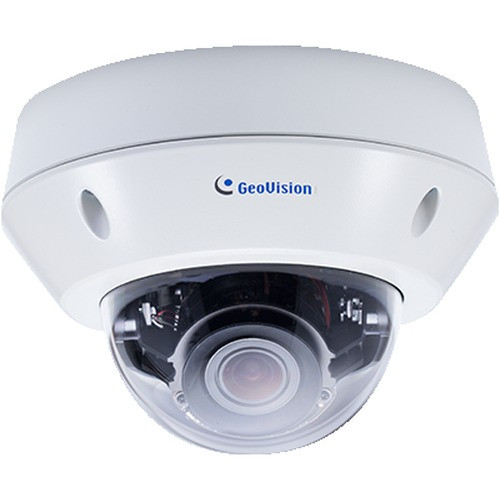
Both the Geovision TDR2700 and Geovision VD25000-001U are 2MP fixed dome cameras from the same manufacturer, targeting IP video surveillance installations. The TDR2700 is positioned as a mini rugged dome with fixed optics, while the VD25000-001U is a vandal-rated dome with varifocal lens and full environmental ratings. Installers and IT buyers choosing between them will weigh fixed vs. varifocal lens flexibility, compression efficiency, environmental protection, power delivery, and VMS integration depth.
In This Guide
How do the imaging specs compare?
Both cameras deliver 2MP resolution. The TDR2700 specifies a native 1920×1080 output and uses H.265 compression, which reduces bandwidth and storage requirements compared to H.264. It carries a fixed 2.8mm lens and is rated for Low Lux performance with IR night vision and WDR. The VD25000-001U also resolves at 2MP with IR night vision, but its datasheet does not specify a compression codec in the provided specs. Its low-light credentials are listed as IR, Day/Night, and Super Low Lux — a more detailed illumination characterization than the TDR2700's 'Low Lux' label.
On lens flexibility, the VD25000-001U holds a clear advantage: its varifocal 3–9mm lens allows field-of-view adjustment at installation without swapping optics, covering a 3× zoom range. The TDR2700's fixed 2.8mm lens locks in a wide angle at commissioning. WDR is specified for the TDR2700; the VD25000-001U's provided specs do not list WDR. Minimum illumination figures in lux are not provided for either model in the supplied specifications.
What about installation and environment?
The VD25000-001U carries an IP66 ingress-protection rating, confirming resistance to dust and high-pressure water jets, and an operating temperature range of -40°C to 60°C — suitable for outdoor and harsh-environment deployment. It is powered via PoE (802.3af/at), enabling single-cable runs from a standard PoE switch or injector, and connects over Ethernet. The TDR2700's provided specifications do not include an IP rating, IK impact rating, operating temperature range, or PoE/power input details, which limits direct environmental comparison.
Both cameras support ceiling and wall mounting in a dome form factor. The VD25000-001U is explicitly described as vandal-resistant. The TDR2700 is described as a 'rugged mini dome,' implying physical robustness, but no IK rating or formal ruggedization standard is cited in the provided specs. Connectivity and power source for the TDR2700 are not specified in the supplied data.
Which fits your VMS and analytics better?
The TDR2700 supports both Geovision VMS and ONVIF, making it a natural fit for Geovision-native deployments while remaining interoperable on third-party platforms. The VD25000-001U supports ONVIF Profile S/T, providing a more precisely defined interoperability level (Profile S for streaming, Profile T for advanced video including H.265 and metadata), and does not list proprietary VMS lock-in. Neither camera's provided specifications include edge analytics, audio input/output, or onboard SD card storage details, so those capabilities cannot be compared from the supplied data.
Which should you choose: the TDR2700 or the VD25000-001U?
Our take: The VD25000-001U is the stronger choice when the installation demands verified outdoor or harsh-environment deployment, field-adjustable framing, or broad NVR/VMS interoperability with defined ONVIF profiles. Three concrete spec advantages support this: first, its IP66 rating and -40°C to 60°C operating range versus no equivalent data for the TDR2700; second, its varifocal 3–9mm lens versus the TDR2700's fixed 2.8mm, giving installers a 3× focal range without optic changes; and third, ONVIF Profile S/T versus the TDR2700's unversioned ONVIF claim. The TDR2700 is the preferable option for Geovision-native VMS environments where H.265 compression is a confirmed requirement, WDR is needed, and a compact fixed-angle mini dome form factor suits the scene — provided its missing environmental and power specs are confirmed against project requirements before procurement.
Side-by-Side Comparison
Spec-for-spec, from manufacturer data.
| Specification | Geovision TDR2700 | Geovision VD25000-001U |
|---|---|---|
| Resolution | 2 MP (1920×1080) | 2 MP |
| Lens / Focal Length | Fixed 2.8mm | Varifocal 3–9mm |
| Form Factor | Dome | Dome |
| Mount Type | Ceiling / Wall | Ceiling / Wall |
| IR Night Vision | IR | IR / Day/Night / Super Low Lux |
| Min Illumination | Low Lux | Super Low Lux |
| WDR | Yes | — |
| Video Compression | H.265 | — |
| IP Rating | — | IP66 |
| Operating Temperature | — | -40°C to 60°C |
| Power Input / PoE | — | PoE (802.3af/at) |
| Connectivity | — | Ethernet |
| ONVIF | Yes (unversioned) | ONVIF Profile S/T |
| VMS Compatibility | Geovision VMS; ONVIF | ONVIF Profile S/T |
Frequently Asked Questions
Which should you choose: the TDR2700 or the VD25000-001U?
The VD25000-001U is the stronger choice when the installation demands verified outdoor or harsh-environment deployment, field-adjustable framing, or broad NVR/VMS interoperability with defined ONVIF profiles. Three concrete spec advantages support this: first, its IP66 rating and -40°C to 60°C operating range versus no equivalent data for the TDR2700; second, its varifocal 3–9mm lens versus the TDR2700's fixed 2.8mm, giving installers a 3× focal range without optic changes; and third, ONVIF Profile S/T versus the TDR2700's unversioned ONVIF claim. The TDR2700 is the preferable option for Geovision-native VMS environments where H.265 compression is a confirmed requirement, WDR is needed, and a compact fixed-angle mini dome form factor suits the scene — provided its missing environmental and power specs are confirmed against project requirements before procurement.
Is the TDR2700 or VD25000-001U better for low-light performance?
Based on the provided specs, the VD25000-001U lists a more detailed low-light characterization — IR, Day/Night, and Super Low Lux — compared to the TDR2700's 'Low Lux' and IR notation. Neither model's actual minimum illumination figure in lux is provided in the supplied specifications, so a definitive numerical comparison is not possible from the available data.
Can the VD25000-001U be installed outdoors where the TDR2700 cannot?
The VD25000-001U carries an IP66 rating and is rated from -40°C to 60°C, confirming suitability for outdoor and harsh-environment use. The TDR2700's provided specifications include no IP rating or operating temperature range, so its outdoor suitability cannot be confirmed from the supplied data alone. Verify TDR2700 environmental ratings with Geovision's full datasheet before specifying it for outdoor use.
Which camera gives more flexibility when framing a scene during installation?
The VD25000-001U's varifocal 3–9mm lens allows the installer to adjust the field of view across a 3× focal range at commissioning without swapping optics. The TDR2700 uses a fixed 2.8mm lens, locking in the angle of view at installation. For sites where the camera-to-subject distance is uncertain or may change, the VD25000-001U offers meaningfully more flexibility.
Get a Second Opinion on Your Camera Choice
Share your site layout, coverage goals, and budget. Our team will validate the camera selection, flag anything we would change, and recommend products that match the use case.