
Geovision MFD2401-1F1U vs Geovision MFD2700-2F10: Specification Comparison
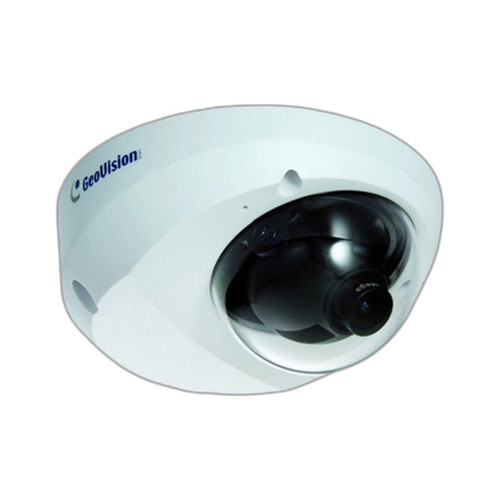
The Geovision MFD2401-1F1U and MFD2700-2F10 are both 2MP fixed-lens mini dome cameras from Geovision's IP camera lineup, designed for ceiling or corridor deployment with 802.3af PoE and ONVIF compatibility. Both share the same sensor resolution class and fixed dome form factor, making them legitimate cross-shop candidates for indoor commercial and light-duty installations. The key differentiators surfacing from the provided specifications are video compression generation, IR low-light capability, lens focal length, and cable category classification.
In This Guide
How do the imaging specs compare?
Both cameras deliver 2MP resolution with WDR Pro for handling mixed-lighting scenes. The MFD2401-1F1U is equipped with a 4mm fixed lens, while the MFD2700-2F10 uses a slightly wider 3.8mm fixed lens — the narrower field of the 4mm variant gives marginally more reach, while the 3.8mm offers a slightly broader angle of view for tighter lobbies or corridors. Neither specification sheet provides minimum illumination (lux) values or sensor size details, so a direct low-light sensitivity comparison beyond feature labels is not possible from the data provided.
The most significant imaging distinction is low-light architecture. The MFD2700-2F10 lists IR and Night Vision (IR) as explicit specs, indicating on-board infrared illumination for 24/7 operation in darkness. IR range in meters is not specified. The MFD2401-1F1U has no IR or Night Vision spec listed, suggesting it is a day-only or ambient-light camera without integrated IR illumination. Compression also diverges: the MFD2401-1F1U encodes in H.264, whereas the MFD2700-2F10 uses H.265, which typically yields comparable image quality at lower bitrates — though no bitrate or frame-rate figures are provided for either model.
What about installation and environment?
Both cameras are powered via 802.3af PoE, simplifying single-cable runs to standard PoE switches or injectors. The MFD2401-1F1U additionally lists a 5V DC voltage specification, suggesting it may support an alternate DC power input, though no power adapter specs are detailed. Both use an RJ-45 connector — the MFD2401-1F1U explicitly names RJ-45; the MFD2700-2F10 lists Ethernet connectivity, implying the same. Neither product's provided specifications include an IP ingress-protection rating, IK impact rating, or operating temperature range, so environment suitability (outdoor-rated, vandal-resistant) cannot be confirmed from the data given.
For mounting, the MFD2401-1F1U supports both ceiling and wall mounting per its specs, while the MFD2700-2F10 is listed for ceiling mount only. The MFD2401-1F1U is explicitly described as compatible with indoor environments. The MFD2700-2F10's 'Compatible With' field lists 'cost-effective' — not an environmental descriptor — so indoor/outdoor suitability for that model is unspecified in the provided data. The MFD2700-2F10's cable category is listed as IPPTZCam, versus IPCAM for the MFD2401-1F1U; this classification difference likely reflects catalog taxonomy rather than a hardware distinction.
Which fits your VMS and analytics better?
Both cameras are ONVIF-compliant, ensuring baseline interoperability with any ONVIF Profile S or Profile T NVR and VMS. The MFD2401-1F1U specifies 'ONVIF' under VMS compatibility; the MFD2700-2F10 specifies 'ONVIF-compliant systems' — both convey the same integration posture. H.265 compression on the MFD2700-2F10 may ease storage and bandwidth constraints on VMS platforms that support HEVC ingest, while the MFD2401-1F1U's H.264 output is universally accepted across legacy and current NVR hardware without decoder license concerns.
Neither model's provided specifications include edge analytics (motion detection configuration, face detection, line crossing, etc.), on-board SD card or edge storage, audio input/output, or alarm I/O. These features cannot be confirmed or differentiated from the data as supplied. Buyers requiring edge analytics, local storage, or two-way audio must consult full Geovision product datasheets — a datasheet URL is provided only for the MFD2700-2F10 (/content/product-datasheets/84-MFD2700-2F10.pdf).
Which should you choose: the MFD2401-1F1U or the MFD2700-2F10?
Our take: The MFD2700-2F10 is the stronger choice when 24/7 operation in low- or zero-light conditions is required, because it includes integrated IR illumination while the MFD2401-1F1U lists no IR capability whatsoever. The MFD2700-2F10 also encodes in H.265 versus the MFD2401-1F1U's H.264, reducing storage and bandwidth demands at equivalent resolution. The MFD2401-1F1U's 4mm lens provides a marginally tighter angle of view than the MFD2700-2F10's 3.8mm lens, which may benefit identification-grade framing over wider surveillance coverage. The MFD2401-1F1U also explicitly supports both ceiling and wall mounting, while the MFD2700-2F10 is ceiling-only per specs. If the installation is daytime-only or has adequate ambient lighting and requires wall-mount flexibility, the MFD2401-1F1U is viable; for any around-the-clock or variable-light deployment, the MFD2700-2F10 is the functionally superior option based on the specifications provided.
Side-by-Side Comparison
Spec-for-spec, from manufacturer data.
| Specification | Geovision MFD2401-1F1U | Geovision MFD2700-2F10 |
|---|---|---|
| Resolution | 2 MP | 2 MP |
| Lens / Focal Length | 4mm fixed | 3.8mm fixed |
| WDR | WDR Pro | WDR Pro |
| IR / Night Vision | — | IR (range not specified) |
| Video Compression | H.264 | H.265 |
| ONVIF | Yes | Yes |
| Power Input | PoE (802.3af); 5V DC | PoE (802.3af) |
| Connector | RJ-45 | Ethernet (RJ-45 implied) |
| Form Factor | Mini Fixed Dome | Mini Dome |
| Mount Type | Ceiling; Wall | Ceiling |
| Compatible Environment | Indoor | Not specified |
Frequently Asked Questions
Which should you choose: the MFD2401-1F1U or the MFD2700-2F10?
The MFD2700-2F10 is the stronger choice when 24/7 operation in low- or zero-light conditions is required, because it includes integrated IR illumination while the MFD2401-1F1U lists no IR capability whatsoever. The MFD2700-2F10 also encodes in H.265 versus the MFD2401-1F1U's H.264, reducing storage and bandwidth demands at equivalent resolution. The MFD2401-1F1U's 4mm lens provides a marginally tighter angle of view than the MFD2700-2F10's 3.8mm lens, which may benefit identification-grade framing over wider surveillance coverage. The MFD2401-1F1U also explicitly supports both ceiling and wall mounting, while the MFD2700-2F10 is ceiling-only per specs. If the installation is daytime-only or has adequate ambient lighting and requires wall-mount flexibility, the MFD2401-1F1U is viable; for any around-the-clock or variable-light deployment, the MFD2700-2F10 is the functionally superior option based on the specifications provided.
Is the MFD2401-1F1U or MFD2700-2F10 better for low-light or night use?
The MFD2700-2F10 is the only model of the two with IR night vision listed in its specifications, making it suitable for low-light or complete darkness scenarios. The MFD2401-1F1U has no IR capability listed, so it should not be relied upon for unlit or poorly lit environments without supplemental lighting.
Will either camera work with my existing H.264-based NVR?
The MFD2401-1F1U outputs H.264 and will integrate directly with any H.264-capable NVR or VMS. The MFD2700-2F10 uses H.265 (HEVC); verify that your NVR or VMS license supports H.265 decode before deploying it. Both cameras are ONVIF-compliant, so protocol-level integration is supported on either platform.
Can I mount either camera on a wall instead of the ceiling?
The MFD2401-1F1U explicitly lists both ceiling and wall mounting as supported options. The MFD2700-2F10 lists ceiling mount only in the provided specifications. If wall mounting is required, the MFD2401-1F1U is the confirmed choice based on available data; consult the MFD2700-2F10 datasheet to verify whether wall accessories are separately available.
Get a Second Opinion on Your Camera Choice
Share your site layout, coverage goals, and budget. Our team will validate the camera selection, flag anything we would change, and recommend products that match the use case.