
Geovision FD220-D02U vs Geovision MFD2700-2F10: Specification Comparison
Both the Geovision FD220-D02U and the Geovision MFD2700-2F10 are 2MP IP dome cameras targeting indoor ceiling-mount deployments with PoE power and ONVIF integration. The comparison is meaningful for installers evaluating lens flexibility against WDR performance, or H.264 versus H.265 compression efficiency, within the same resolution class and fixed-dome form factor.
In This Guide
How do the imaging specs compare?
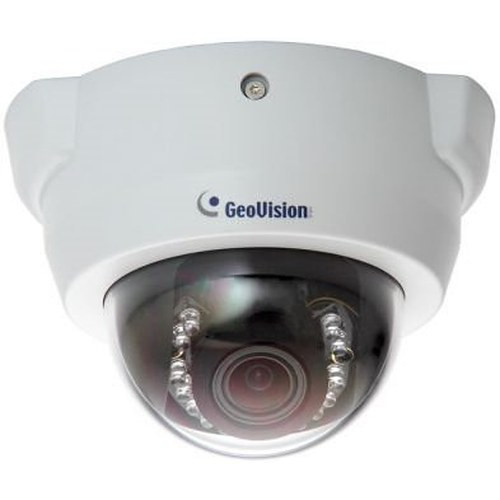
The FD220-D02U is specified as a varifocal unit with a 2.7–9mm adjustable lens, giving installers the ability to tune the field of view at commissioning without swapping hardware. Resolution is listed as 2MP. No WDR specification is provided in the available specs, and minimum illumination figures are not stated for either unit. IR low-light capability is confirmed for both cameras.
The MFD2700-2F10 ships with a fixed 3.8mm lens, which simplifies the optical assembly but locks the field of view at install time. It carries a stated WDR Pro rating—a meaningful differentiator for scenes with mixed bright and dim zones such as lobbies or entry vestibules. Compression is H.265, which typically reduces bandwidth and storage consumption compared to the FD220-D02U's H.264. Neither camera's IR range, minimum illumination value, frame rate, nor sensor size is disclosed in the provided specifications.
What about installation and environment?
Both cameras are powered by 802.3af PoE, eliminating the need for a separate power feed over existing Cat5e or Cat6 infrastructure. The FD220-D02U supports ceiling and wall mounting, providing more installation flexibility. The MFD2700-2F10 is specified for ceiling mount only. Neither camera's IP ingress protection rating, IK impact rating, operating temperature range, nor physical dimensions are provided in the supplied specifications, so suitability for outdoor, harsh-environment, or vandal-resistant applications cannot be assessed from the available data.
Which fits your VMS and analytics better?
Both cameras are ONVIF-compliant, ensuring compatibility with the broad ecosystem of ONVIF-conformant NVR and VMS platforms. The FD220-D02U is classified under cable category IPCAM; the MFD2700-2F10 is listed under IPPTZCam, though its lens and form factor are fixed-dome rather than PTZ—this may reflect a catalog classification artifact rather than a functional PTZ capability, and buyers should verify with the datasheet. Edge analytics, audio input or output, and onboard SD card storage are not specified for either model in the provided data.
Which should you choose: the FD220-D02U or the MFD2700-2F10?
Our take: The MFD2700-2F10 is the stronger choice when compression efficiency and WDR performance are the deciding factors. It encodes in H.265 versus the FD220-D02U's H.264, reducing storage and bandwidth demand on the same 2MP output. It also carries a stated WDR Pro rating that the FD220-D02U lacks entirely in its provided specs, making it better suited for mixed-lighting scenes. Conversely, the FD220-D02U's varifocal 2.7–9mm lens—against the MFD2700-2F10's fixed 3.8mm—is the correct call when field-of-view adjustment at commissioning is required or when a single SKU must serve variable mounting distances. Both units share 802.3af PoE and ONVIF compliance. Where IP rating, operating temperature, IR range, or audio are decision criteria, neither camera's specifications supply those values, and the respective datasheets must be consulted before finalizing a specification.
Side-by-Side Comparison
Spec-for-spec, from manufacturer data.
| Specification | Geovision FD220-D02U | Geovision MFD2700-2F10 |
|---|---|---|
| Resolution | 2MP | 2MP |
| Form Factor | Fixed Dome | Dome |
| Lens Type | Varifocal | Fixed |
| Focal Length | 2.7–9mm | 3.8mm |
| Video Compression | H.264 | H.265 |
| WDR | — | WDR Pro |
| IR / Low Light | IR Low Lux | IR |
| Power Input | PoE 802.3af | PoE 802.3af |
| Mount Type | Ceiling; Wall | Ceiling |
| ONVIF | Yes | Yes |
Frequently Asked Questions
Which should you choose: the FD220-D02U or the MFD2700-2F10?
The MFD2700-2F10 is the stronger choice when compression efficiency and WDR performance are the deciding factors. It encodes in H.265 versus the FD220-D02U's H.264, reducing storage and bandwidth demand on the same 2MP output. It also carries a stated WDR Pro rating that the FD220-D02U lacks entirely in its provided specs, making it better suited for mixed-lighting scenes. Conversely, the FD220-D02U's varifocal 2.7–9mm lens—against the MFD2700-2F10's fixed 3.8mm—is the correct call when field-of-view adjustment at commissioning is required or when a single SKU must serve variable mounting distances. Both units share 802.3af PoE and ONVIF compliance. Where IP rating, operating temperature, IR range, or audio are decision criteria, neither camera's specifications supply those values, and the respective datasheets must be consulted before finalizing a specification.
Is the FD220-D02U or MFD2700-2F10 better for low light?
Both cameras are specified with IR low-light capability, but neither unit's minimum illumination value or IR range is disclosed in the provided specifications. A definitive low-light comparison requires reviewing each model's datasheet directly.
Which camera will use less storage and bandwidth on my NVR?
The MFD2700-2F10 uses H.265 compression, which typically delivers meaningful bitrate reductions compared to the H.264 used by the FD220-D02U at equivalent image quality and resolution. Exact bitrate figures are not stated in the available specs.
Can I mount either camera outdoors or in a high-vandalism area?
Neither camera's IP ingress protection rating, IK impact rating, nor operating temperature range is provided in the available specifications. Suitability for outdoor or vandal-resistant installations cannot be confirmed without consulting the manufacturer datasheets.
Get a Second Opinion on Your Camera Choice
Share your site layout, coverage goals, and budget. Our team will validate the camera selection, flag anything we would change, and recommend products that match the use case.