
Digital Watchdog DWC-VSTB04Bi vs Speco Technologies O4TDD2: Specification Comparison
Both the Digital Watchdog DWC-VSTB04Bi and the Speco Technologies O4TDD2 are 4MP fixed-lens outdoor IP turret cameras targeting similar surveillance deployments—perimeter coverage, access points, and general outdoor monitoring. This comparison examines how their imaging capabilities, environmental and installation specs, and VMS/analytics integration stack up for installers and IT buyers weighing a like-for-like purchase decision at the same resolution class and form factor.
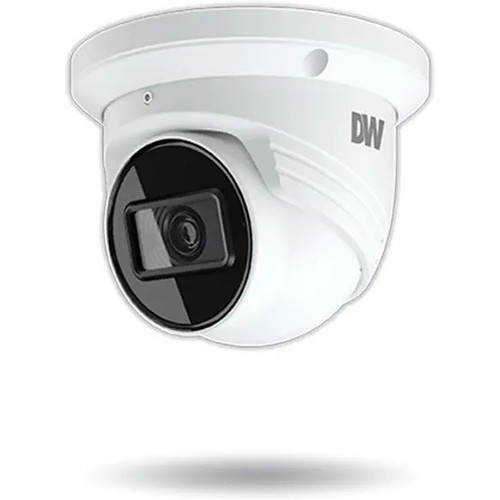
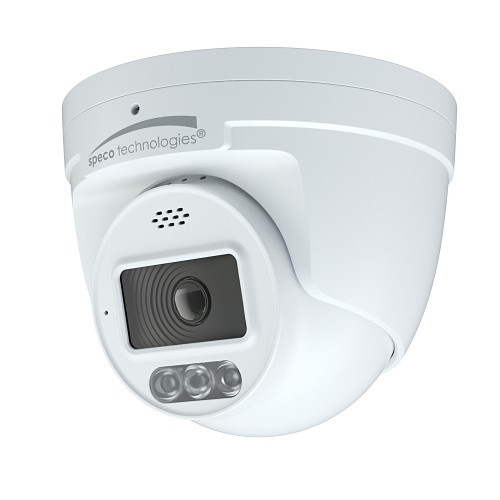
In This Guide
How do the imaging specs compare?
Both cameras share a 1/3" CMOS sensor at 4MP resolution, but their pixel arrays differ slightly: the DWC-VSTB04Bi outputs 2560×1440 while the O4TDD2 outputs 2592×1520, a marginal advantage for the Speco unit in raw pixel count. Both specify a 2.8mm fixed lens. The DW model publishes a horizontal FOV of 94°; Speco does not specify FOV in the provided specs. The DW unit's minimum illumination is explicitly rated at 0.005 lux (color) and 0.0 lux (B/W), while Speco provides no minimum illumination figure. WDR is listed as 120dB True WDR on the DW model; the O4TDD2 states True WDR without a dB rating.
IR night vision range is a clear differentiator: the O4TDD2 is rated at 164 ft (50 m), versus 100 ft (30 m) for the DWC-VSTB04Bi—a 64% reach advantage for the Speco unit. Both cameras support 30fps at their maximum resolution. The DW model offers multiple selectable sub-resolutions (4MP, 3MP, 2.1MP, 1080P, 720P, D1, CIF) with dual-stream capability; Speco does not enumerate sub-resolutions in the provided specs. Video compression on the DW unit is H.264/H.265/MJPEG; the Speco unit adds H.265+ and H.264+ for improved compression efficiency.
What about installation and environment?
The DWC-VSTB04Bi carries an IP67 ingress rating and IK10 impact/vandal resistance, housed in aluminum die-casting. The O4TDD2 is rated IP66 and does not list an IK impact rating in the provided specs—a meaningful gap for deployments exposed to deliberate or accidental physical impact. Both cameras are white in color and designed for outdoor use.
Operating temperature range is -40°F to 140°F for the O4TDD2 and -22°F to 140°F for the DWC-VSTB04Bi, giving Speco an 18°F cold-weather advantage relevant to northern or cold-storage installations. Power consumption also differs notably: the DW unit is rated at a maximum of 5W (PoE only, no DC adapter included), while the O4TDD2 consumes up to 12W and supports both PoE and DC 12V—the higher draw likely supports its extended IR range. Both are PoE-powered per 802.3af; the Speco's 12W consumption approaches the 802.3af 15.4W ceiling, while the DW unit's 5W draw is well within budget and switch-port friendly. Both mount as turret form factors; the DW unit specifies mounting accessories sold separately.
Which fits your VMS and analytics better?
The DWC-VSTB04Bi declares ONVIF conformance and is explicitly compatible with DW Spectrum IPVMS and any ONVIF-conformant CMS. The O4TDD2 is listed as ONVIF Profile G compliant, which adds on-board recording/playback capability to base ONVIF interoperability—a relevant distinction for edge-recording workflows. The DW unit supports a broad protocol stack including 802.1x, DDNS, DHCP, FTP, HTTP/HTTPS, ICMP, IGMP, NTP, PPPoE, QoS, RTCP, RTP, RTSP, SMTP, SNMP, UDP, and UPnP; Speco's protocol support is not enumerated in the provided specs.
Analytics differ in scope: the DWC-VSTB04Bi lists Line Crossing, Perimeter Intrusion, and Tampering Detection. The O4TDD2 adds Face Detection and Vehicle Detection, which can reduce server-side load for access-point or parking applications. Both cameras include a built-in microphone; the DW unit further specifies 1 audio in, 1 audio out with G.711A/U compression, supporting two-way audio. Speco lists microphone and speaker support but does not specify audio compression codec. For on-board storage, the DW unit supports Micro SD/SDHC/SDXC up to 1TB; Speco storage support is not specified in the provided specs. The DW unit also provides 8 programmable privacy masks, de-fog, and 3D DNR (Smart DNR); equivalent features are not listed for the O4TDD2.
Which should you choose: the DWC-VSTB04Bi or the O4TDD2?
Our take: The DWC-VSTB04Bi is the stronger choice when vandal resistance, low power draw, and a broad feature set—including audio I/O, privacy masks, and de-fog—are priorities on a constrained PoE budget. Its IK10 aluminum housing and IP67 rating outclass the O4TDD2's IP66 / no-IK-rating profile for exposed or high-risk mounting locations, and its 5W maximum draw vs. the O4TDD2's 12W means more cameras per PoE switch without a midspan injector. The O4TDD2 is the stronger choice when IR range, cold-weather performance, or object-classification analytics matter most: it reaches 164 ft vs. 100 ft, operates from -40°F vs. -22°F, adds Face Detection and Vehicle Detection, and delivers H.265+ compression. Buyers on DW Spectrum IPVMS or needing two-way audio will favor the DWC-VSTB04Bi; those integrating ONVIF Profile G edge recorders or deploying in extreme cold should evaluate the O4TDD2.
Side-by-Side Comparison
Spec-for-spec, from manufacturer data.
| Specification | Digital Watchdog DWC-VSTB04Bi | Speco Technologies O4TDD2 |
|---|---|---|
| Resolution | 4MP (2560×1440) | 4MP (2592×1520) |
| Image Sensor | 1/3" CMOS | 1/3" CMOS |
| Lens / Focal Length | 2.8mm Fixed | 2.8mm Fixed |
| Horizontal FOV | 94° | — |
| Min. Illumination (Color / B&W) | 0.005 lux (color) / 0.0 lux (B/W) | — |
| IR Range | 100 ft (30 m) | 164 ft (50 m) |
| Wide Dynamic Range | True WDR 120dB | True WDR (dB not specified) |
| Max Frame Rate | 30fps at all resolutions | 30fps |
| Video Compression | H.265, H.264, MJPEG | H.265+, H.264+, MJPEG |
| IP Rating | IP67 | IP66 |
| IK / Impact Rating | IK10 | — |
| Operating Temperature | -22°F to 140°F (-30°C to 60°C) | -40°F to 140°F |
| Power Input / Consumption | PoE (max 5W) | PoE or DC 12V (max 12W) |
| Edge Storage | Micro SD/SDHC/SDXC up to 1TB | — |
| Audio | 1 in / 1 out, built-in mic, G.711A/U | Built-in mic + speaker (codec not specified) |
| Analytics | Line Crossing, Perimeter Intrusion, Tampering | Motion Detection, Line Crossing, Intrusion, Face Detection, Vehicle Detection |
| ONVIF | ONVIF conformant | ONVIF Profile G |
| Housing Material | Aluminum die-casting | — |
| Weight | 1.01 lbs (0.46 kg) | 1.48 lbs |
| Warranty | 5 years | 3 years |
Frequently Asked Questions
Which should you choose: the DWC-VSTB04Bi or the O4TDD2?
The DWC-VSTB04Bi is the stronger choice when vandal resistance, low power draw, and a broad feature set—including audio I/O, privacy masks, and de-fog—are priorities on a constrained PoE budget. Its IK10 aluminum housing and IP67 rating outclass the O4TDD2's IP66 / no-IK-rating profile for exposed or high-risk mounting locations, and its 5W maximum draw vs. the O4TDD2's 12W means more cameras per PoE switch without a midspan injector. The O4TDD2 is the stronger choice when IR range, cold-weather performance, or object-classification analytics matter most: it reaches 164 ft vs. 100 ft, operates from -40°F vs. -22°F, adds Face Detection and Vehicle Detection, and delivers H.265+ compression. Buyers on DW Spectrum IPVMS or needing two-way audio will favor the DWC-VSTB04Bi; those integrating ONVIF Profile G edge recorders or deploying in extreme cold should evaluate the O4TDD2.
Is the DWC-VSTB04Bi or O4TDD2 better for low-light performance?
The DWC-VSTB04Bi publishes a minimum illumination of 0.005 lux (color) and 0.0 lux (B/W) with 120dB True WDR. The O4TDD2 does not specify a minimum illumination value or a WDR dB rating in the available specs, so a direct lux comparison cannot be made. The O4TDD2's IR range of 164 ft does, however, extend night coverage significantly farther than the DW unit's 100 ft Smart IR.
Which camera is better suited for extreme cold installations?
The O4TDD2 is rated to -40°F, giving it an 18°F cold-weather advantage over the DWC-VSTB04Bi's lower limit of -22°F. For installations in northern climates, unheated parking structures, or cold-storage facilities, the O4TDD2's broader temperature range is the relevant differentiator.
Does either camera support two-way audio out of the box?
The DWC-VSTB04Bi specifies 1 audio input, 1 audio output, and a built-in microphone with G.711A/U compression, confirming two-way audio capability. The O4TDD2 lists a built-in microphone and speaker, which also suggests two-way audio, but the audio compression codec and I/O configuration are not specified in the provided specs.
More IP Camera Comparisons
Get a Second Opinion on Your Camera Choice
Share your site layout, coverage goals, and budget. Our team will validate the camera selection, flag anything we would change, and recommend products that match the use case.