
Digital Watchdog DWC-MB95Wi28TW vs Hanwha XNO-8080R: Specification Comparison
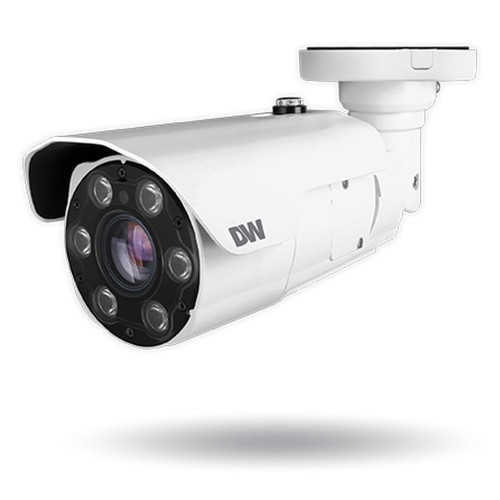
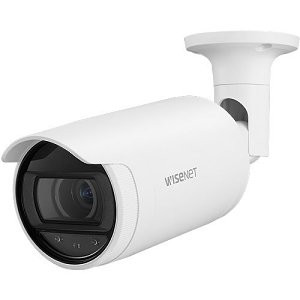
Both the Digital Watchdog DWC-MB95Wi28TW and the Hanwha XNO-8080R are 5MP outdoor bullet IP cameras aimed at perimeter and general-purpose surveillance installations. They share the same nominal resolution class, bullet form factor, IR illumination, 120dB WDR, IP67 weatherproofing, IK10 vandal resistance, and PoE power—making them genuine cross-shop candidates. Key differentiators include sensor size, lens type (fixed vs. motorized varifocal), analytics depth, edge storage capacity, and operating temperature floor.
In This Guide
How do the imaging specs compare?
Both cameras resolve 5MP, but they differ meaningfully at the sensor level. The DWC-MB95Wi28TW uses a 1/2.7" CMOS sensor, while the XNO-8080R uses a physically larger 1/1.8" 6MP CMOS sensor (downscaled to 5MP output). The larger sensor in the Hanwha typically captures more light per pixel. The DW model specifies 0.02 lux in color and 0.0 lux in B/W; the Hanwha specifies 0.07 lux in color and 0 lux with IR active. On paper, the DW model claims a lower color lux floor (0.02 vs 0.07), though the Hanwha's F1.2 maximum aperture on its varifocal lens is notably fast. Both cameras deliver 164 ft (50 m) of IR range and 120dB WDR.
Lens choice is the sharpest dividing line. The DWC-MB95Wi28TW ships with a fixed 2.8mm lens (98.5° HFOV) or a 3.6mm variant (81.4° HFOV)—no optical zoom. The XNO-8080R offers a motorized varifocal 3.7–9.4mm (2.5× zoom) with DC auto iris and P-iris control, covering roughly 100.2° at the wide end. An installer can remotely adjust field of view on the Hanwha without climbing a ladder; the DW requires a lens swap or repositioning. Both support H.265, H.264, and MJPEG compression, and both cap frame rate at 30fps across supported resolutions.
What about installation and environment?
Both cameras are rated IP67 and IK10. The Hanwha XNO-8080R additionally carries IP66 and NEMA 4X certifications, providing a broader set of verified ingress and corrosion-protection ratings useful for coastal or chemical-exposure environments. The DW spec does not list NEMA 4X or IP66. Both accept 12VDC and PoE; the Hanwha also accepts 24VAC, giving installers a third power option. The Hanwha draws up to 12.95W; the DW draws up to 9.0W, making the DW a PoE Class 2 candidate while the Hanwha is explicitly listed as PoE Class 3 (IEEE 802.3af).
Temperature range is a decisive factor in cold-climate deployments. The DWC-MB95Wi28TW is rated –30°C to +60°C (–22°F to +140°F). The XNO-8080R is rated –40°C to +55°C (–40°F to +131°F), offering a 10°C lower cold-weather floor. The Hanwha is heavier and longer: 4.81 lb / 368.6mm vs. 1.52 lb / 220.8mm for the DW—relevant when selecting brackets and conduit. The DW spec lists mounting accessories as optional and sold separately; the Hanwha spec does not detail included mounting hardware either.
Which fits your VMS and analytics better?
Both cameras are ONVIF conformant, enabling integration with any ONVIF-compliant VMS. The Hanwha XNO-8080R additionally exposes SUNAPI (HTTP API) and the Wisenet open platform, providing a richer native SDK path for Wisenet-ecosystem integrators. The DW model lists compatibility with any ONVIF CMS; no proprietary SDK is specified. Protocol stacks are comparable—both support IPv4/IPv6, RTSP, HTTPS, DHCP, FTP, SMTP, SNMP, QoS, and UPnP. The Hanwha adds SRTP, Bonjour, LLDP, and 802.1X with EAP-TLS/EAP-LEAP; the DW lists 802.1X and MAC filtering but does not specify EAP method.
Analytics differ in breadth and naming. The DW provides object classification (human vs. object), line crossing, perimeter intrusion, and video tampering (scene change, blur, abnormal color). The Hanwha lists defocus detection, directional detection, fog detection, face detection, motion detection (8-zone polygonal), digital auto tracking, appear/disappear, enter/exit, loitering, tampering, virtual line, audio detection, and sound classification—a materially larger on-camera analytics suite. Audio I/O: the DW provides one audio input (line level) with G.711 A/U; the Hanwha provides selectable mic/line input plus a line output, with G.711 u-law, G.726, and additional codecs. Edge storage: the DW supports a single microSD slot up to 1TB; the Hanwha provides two microSD/SDHC/SDXC slots up to 512GB total and adds NAS recording at event triggers. The Hanwha also specifies 1024MB RAM and 256MB Flash onboard.
Which should you choose: the DWC-MB95Wi28TW or the XNO-8080R?
Our take: The XNO-8080R is the stronger choice when lens flexibility, analytics depth, extreme cold-weather operation, or Wisenet-ecosystem integration is a priority. Its motorized varifocal 3.7–9.4mm lens allows remote focus adjustment the fixed-lens DW cannot match; its –40°C cold floor beats the DW's –30°C by 10°C; and its on-camera analytics suite (14+ event types including face detection, loitering, and sound classification) substantially outpaces the DW's four analytics functions. The DWC-MB95Wi28TW is the stronger choice when lower PoE power budget (9.0W vs. 12.95W), a single higher-capacity microSD slot (up to 1TB vs. 512GB), a lower specified color lux floor (0.02 vs. 0.07 lux), a lighter and shorter physical footprint (1.52 lb / 220.8mm vs. 4.81 lb / 368.6mm), or a longer warranty (5-year vs. 3-year) is the deciding factor. Buyers on ONVIF-only VMS platforms will find either camera compatible; buyers on Wisenet VMS or requiring SUNAPI access should select the Hanwha.
Side-by-Side Comparison
Spec-for-spec, from manufacturer data.
| Specification | Digital Watchdog DWC-MB95Wi28TW | Hanwha XNO-8080R |
|---|---|---|
| Resolution | 5MP (2592 × 1944) | 5MP |
| Image Sensor | 1/2.7" CMOS | 1/1.8" 6MP CMOS |
| Lens / Focal Length | Fixed 2.8mm (98.5° HFOV) or 3.6mm (81.4° HFOV) | Motorized varifocal 3.7–9.4mm (2.5×); H: 100.2° |
| Max Aperture | Not specified | F1.2 |
| Min. Illumination (Color / IR) | 0.02 lux color / 0.0 lux B/W | 0.07 lux color / 0 lux IR |
| IR Range | 164 ft (50 m) Smart IR | 164 ft (50 m) |
| Wide Dynamic Range | 120dB True WDR | 120dB WDR |
| Max Frame Rate | 30fps at all resolutions | 30fps |
| Video Compression | H.265, H.264, MJPEG | H.265, H.264, MJPEG |
| IP Rating | IP67 | IP67 / IP66 / NEMA 4X |
| IK / Impact Rating | IK10 | IK10 |
| Operating Temperature | –30°C ~ +60°C (–22°F ~ +140°F) | –40°C ~ +55°C (–40°F ~ +131°F) |
| Power Input / PoE Class | PoE / 12VDC (max 9.0W) | PoE IEEE 802.3af Class 3 / 12VDC / 24VAC (max 12.95W) |
| Edge Storage | 1× microSD/SDHC/SDXC up to 1TB | 2× microSD/SDHC/SDXC up to 512GB; NAS recording |
| Audio | 1 audio input (line level); G.711 A/U | Mic/line input + line output; G.711, G.726 |
| Alarm I/O | Not specified in provided specs | 1 input / 1 output |
| On-Camera Analytics | Object classification, line crossing, perimeter intrusion, tampering (4 types) | 14+ types incl. face detection, loitering, sound classification, auto tracking |
| ONVIF / API | ONVIF | ONVIF Profile S/G/T; SUNAPI; Wisenet open platform |
| Dimensions | 220.8 × 80.5 × 70.6 mm (8.69" × 3.16" × 2.77") | Ø91 × 368.6 mm (Ø3.58" × 14.51") without sunshield |
| Weight | 0.69 kg (1.52 lb) | 2.18 kg (4.81 lb) |
| Warranty | 5 years | 3 years |
Frequently Asked Questions
Which should you choose: the DWC-MB95Wi28TW or the XNO-8080R?
The XNO-8080R is the stronger choice when lens flexibility, analytics depth, extreme cold-weather operation, or Wisenet-ecosystem integration is a priority. Its motorized varifocal 3.7–9.4mm lens allows remote focus adjustment the fixed-lens DW cannot match; its –40°C cold floor beats the DW's –30°C by 10°C; and its on-camera analytics suite (14+ event types including face detection, loitering, and sound classification) substantially outpaces the DW's four analytics functions. The DWC-MB95Wi28TW is the stronger choice when lower PoE power budget (9.0W vs. 12.95W), a single higher-capacity microSD slot (up to 1TB vs. 512GB), a lower specified color lux floor (0.02 vs. 0.07 lux), a lighter and shorter physical footprint (1.52 lb / 220.8mm vs. 4.81 lb / 368.6mm), or a longer warranty (5-year vs. 3-year) is the deciding factor. Buyers on ONVIF-only VMS platforms will find either camera compatible; buyers on Wisenet VMS or requiring SUNAPI access should select the Hanwha.
Is the DWC-MB95Wi28TW or XNO-8080R better for low-light performance?
The DWC-MB95Wi28TW specifies a lower color lux floor (0.02 lux vs. 0.07 lux for the XNO-8080R), suggesting better sensitivity in near-darkness color mode. However, the XNO-8080R uses a physically larger 1/1.8" sensor and an F1.2 maximum aperture lens—both of which favor light collection—and reaches 0 lux with IR active, matching the DW's 0.0 lux B/W figure. Both deliver 164 ft of IR range. Neither manufacturer has provided third-party test results in the supplied specs, so real-world low-light performance should be validated on-site.
Which camera is easier to aim and focus during installation?
The XNO-8080R is significantly easier to fine-tune on-site. Its motorized varifocal lens (3.7–9.4mm, 2.5× zoom) supports remote focus control via Simple Focus, so installers can adjust the field of view and focus from a laptop or mobile device without repositioning the camera. The DWC-MB95Wi28TW uses a fixed 2.8mm or 3.6mm lens; once mounted, changing the field of view requires a physical lens change or camera repositioning.
Can either camera operate in extreme cold, such as an unheated outdoor enclosure in northern climates?
The XNO-8080R is rated to –40°C (–40°F), making it suitable for harsh northern climates and unheated enclosures. The DWC-MB95Wi28TW is rated to –30°C (–22°F), which covers most temperate and moderate cold-climate installations but may fall short in the most extreme winter environments. If your site regularly sees temperatures below –30°C, the Hanwha XNO-8080R is the specified choice based on the provided data.
Get a Second Opinion on Your Camera Choice
Share your site layout, coverage goals, and budget. Our team will validate the camera selection, flag anything we would change, and recommend products that match the use case.