
Digital Watchdog DWC-MB95Wi28TW vs Hanwha XNO-8020R: Specification Comparison
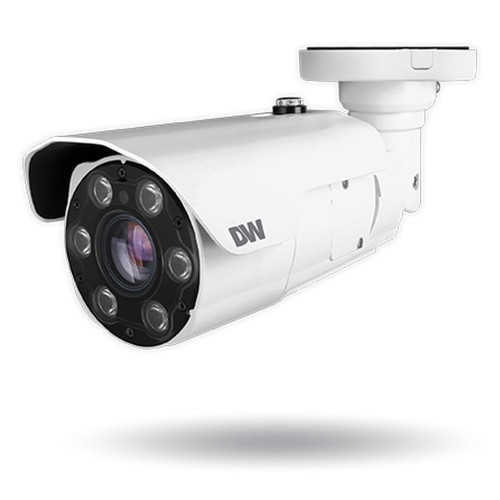
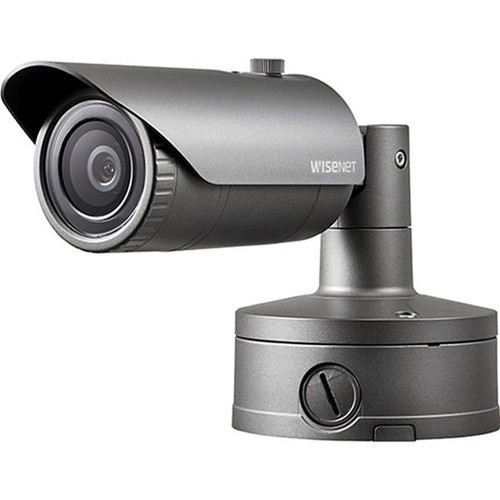
Both the Digital Watchdog DWC-MB95Wi28TW and the Hanwha XNO-8020R are 5MP fixed outdoor bullet IP cameras aimed at perimeter and area surveillance installations. They share the same resolution class, bullet form factor, IR night vision, IP67 and IK10 ratings, PoE power, and H.265/H.264/MJPEG compression. A buyer evaluating either would be weighing sensor size, IR range, low-light sensitivity, analytics depth, edge storage capacity, and VMS ecosystem fit.
In This Guide
How do the imaging specs compare?
The most significant imaging difference is sensor size: the Hanwha XNO-8020R uses a 1/1.8" CMOS sensor while the Digital Watchdog DWC-MB95Wi28TW uses a 1/2.7" CMOS sensor. The larger 1/1.8" sensor in the XNO-8020R gathers more light per pixel, which correlates with its F1.6 aperture and a specified minimum color illumination of 0.16 lux versus 0.02 lux (color) for the DWC-MB95Wi28TW. Both deliver 5MP at 2592×1944 and 30fps, and both rate WDR at 120dB. The DWC-MB95Wi28TW specifies 0.0 lux in B/W mode; the XNO-8020R specifies 0 lux IR mode, indicating active IR cutoff with no ambient light required.
On IR range, the DWC-MB95Wi28TW specifies 164 feet (approximately 50m) with its Smart IR system, while the XNO-8020R specifies 30m (98.4 feet). For the 2.8mm focal length variant of the DWC-MB95Wi28TW, the horizontal field of view is 98.5°; the XNO-8020R's 3.7mm fixed lens yields a horizontal FOV of 97.5°, making them effectively equivalent in coverage angle. The XNO-8020R adds lens distortion correction (LDC), digital image stabilization, and hallway view (90°/270° rotation) — none of which are listed in the DWC-MB95Wi28TW specifications.
What about installation and environment?
Both cameras are rated IP67 and IK10, confirming dust-tight, jet-water-resistant housings with impact protection to 20 joules. The XNO-8020R additionally carries IP66 and NEMA 4X certification, providing a higher-rated protection level against direct water jets and corrosive environments — a meaningful differentiator for coastal or chemical-exposure sites. Both are constructed from aluminum. Operating temperature for the DWC-MB95Wi28TW is -30°C to +60°C (-22°F to +140°F); the XNO-8020R is rated -30°C to +55°C, giving the DWC-MB95Wi28TW a slight 5°C edge at the high end.
Both cameras accept PoE and 12VDC. The XNO-8020R specifies IEEE 802.3af Class 3 PoE with a maximum draw of 10.3W; the DWC-MB95Wi28TW specifies a maximum of 9.0W via PoE without citing an 802.3af class. The XNO-8020R includes a CVBS analog output and a Micro USB port for on-site installation verification — features not listed for the DWC-MB95Wi28TW. The XNO-8020R is physically larger and heavier (Ø70×296mm, 2.69 lb) compared to the DWC-MB95Wi28TW (220.8×80.5×70.6mm, 1.52 lbs). Mounting accessories for both are sold separately per the available specs.
Which fits your VMS and analytics better?
Both cameras support ONVIF, H.265/H.264/MJPEG, CBR/VBR bitrate control, dual or multi-stream output, IPv4/IPv6, and a common protocol stack including RTSP, HTTPS, SMTP, FTP, DHCP, DDNS, SNMP, NTP, and QoS. The XNO-8020R supports up to 10 simultaneous stream profiles and unicast to 20 users; the DWC-MB95Wi28TW specifies dual-stream capability. The XNO-8020R exposes ONVIF Profile S, G, and T plus Hanwha SUNAPI and the Wisenet open platform SDK. The DWC-MB95Wi28TW lists ONVIF conformance without specifying profiles.
Analytics coverage differs notably in depth. The DWC-MB95Wi28TW offers object classification (human vs. object), line crossing, perimeter intrusion, and video tampering detection. The XNO-8020R lists defocus detection, directional detection, fog detection, face detection, motion detection with 8-point polygonal zones (8 zones), digital auto tracking, appear/disappear, enter/exit, loitering, tampering, virtual line, audio detection, and sound classification — plus business intelligence functions including people counting, queue management, and heatmap. Privacy masking is 4 zones on the DWC-MB95Wi28TW versus 32 polygonal zones with color and mosaic options on the XNO-8020R. Edge storage differs significantly: the DWC-MB95Wi28TW supports a single microSD/SDHC/SDXC slot up to 1TB; the XNO-8020R provides two microSD slots with a combined capacity up to 512GB per the spec sheet. Both support 1 audio input; the XNO-8020R additionally specifies a line-level audio output and alarm I/O (1 input / 1 output), while the DWC-MB95Wi28TW lists 1 audio input only with no alarm I/O specified. The XNO-8020R also includes 1024MB RAM and 256MB flash on-board; no equivalent spec is listed for the DWC-MB95Wi28TW.
Which should you choose: the DWC-MB95Wi28TW or the XNO-8020R?
Our take: The DWC-MB95Wi28TW is the stronger choice when IR throw distance and single-card edge storage capacity are the primary requirements: it specifies 164 feet of IR range versus the XNO-8020R's 98.4 feet, supports microSD up to 1TB on a single slot versus the XNO-8020R's dual-slot 512GB ceiling, and operates up to 60°C versus the XNO-8020R's 55°C limit. Conversely, the XNO-8020R is the stronger choice when analytics breadth, sensor light-gathering, environmental certification, or VMS integration depth matter more: its 1/1.8" sensor is physically larger than the DWC-MB95Wi28TW's 1/2.7" sensor, it adds NEMA 4X and IP66 ratings alongside IP67, it carries ONVIF Profile S/G/T with SUNAPI, and its analytics suite includes people counting, heatmap, face detection, and loitering — functions absent from the DWC-MB95Wi28TW spec. The DWC-MB95Wi28TW also carries a 5-year warranty versus the XNO-8020R's 3-year warranty. Select the DWC-MB95Wi28TW for long-range IR perimeter coverage; select the XNO-8020R for analytics-driven or chemically harsh deployments integrated with Wisenet or broad ONVIF Profile T ecosystems.
Side-by-Side Comparison
Spec-for-spec, from manufacturer data.
| Specification | Digital Watchdog DWC-MB95Wi28TW | Hanwha XNO-8020R |
|---|---|---|
| Resolution | 5MP (2592×1944) | 5MP |
| Image Sensor | 1/2.7" CMOS | 1/1.8" CMOS |
| Focal Length | 2.8mm fixed (98.5° HFOV); 3.6mm variant | 3.7mm fixed (97.5° HFOV) |
| Max Aperture | Not specified | F1.6 |
| Min. Illumination (Color) | 0.02 lux | 0.16 lux |
| Min. Illumination (B/W / IR) | 0.0 lux (B/W) | 0 lux (IR mode) |
| IR Range | 164 ft (≈50m) Smart IR | 30m (98.4 ft) |
| Wide Dynamic Range | 120dB True WDR | 120dB WDR |
| Max Frame Rate | 30fps at all resolutions | 30fps |
| Video Compression | H.265, H.264, MJPEG | H.265, H.264, MJPEG |
| IP Rating | IP67 | IP66 / IP67 / NEMA 4X |
| IK / Impact Rating | IK10 | IK10 |
| Operating Temperature | -30°C to +60°C (-22°F to +140°F) | -30°C to +55°C |
| Power Input / PoE | PoE (max 9.0W); 12VDC | PoE IEEE 802.3af Class 3 (max 10.3W); 12VDC |
| Edge Storage | 1× microSD/SDHC/SDXC up to 1TB | 2× microSD/SDHC/SDXC up to 512GB (combined) |
| Alarm I/O | Not specified | 1 input / 1 output |
| Audio | 1× audio input (line level) | 1× audio in (mic/line selectable); 1× line out |
| ONVIF | ONVIF conformant (profiles not specified) | ONVIF Profile S / G / T |
| Analytics | Object classification, line crossing, perimeter intrusion, tampering | Defocus, directional, fog, face, motion, auto tracking, appear/disappear, enter/exit, loitering, tampering, virtual line, audio detection, sound classification, people counting, queue management, heatmap |
| Privacy Zones | 4 programmable masks | 32 polygonal zones (color/mosaic) |
| Dimensions | 220.8×80.5×70.6mm (8.69"×3.16"×2.77") | Ø70×296mm (Ø2.76"×11.65") |
| Weight | 0.69 kg (1.52 lbs) | 1.22 kg (2.69 lbs) |
| Housing Material | Aluminum die-casting | Aluminum |
| Warranty | 5 years | 3 years |
Frequently Asked Questions
Which should you choose: the DWC-MB95Wi28TW or the XNO-8020R?
The DWC-MB95Wi28TW is the stronger choice when IR throw distance and single-card edge storage capacity are the primary requirements: it specifies 164 feet of IR range versus the XNO-8020R's 98.4 feet, supports microSD up to 1TB on a single slot versus the XNO-8020R's dual-slot 512GB ceiling, and operates up to 60°C versus the XNO-8020R's 55°C limit. Conversely, the XNO-8020R is the stronger choice when analytics breadth, sensor light-gathering, environmental certification, or VMS integration depth matter more: its 1/1.8" sensor is physically larger than the DWC-MB95Wi28TW's 1/2.7" sensor, it adds NEMA 4X and IP66 ratings alongside IP67, it carries ONVIF Profile S/G/T with SUNAPI, and its analytics suite includes people counting, heatmap, face detection, and loitering — functions absent from the DWC-MB95Wi28TW spec. The DWC-MB95Wi28TW also carries a 5-year warranty versus the XNO-8020R's 3-year warranty. Select the DWC-MB95Wi28TW for long-range IR perimeter coverage; select the XNO-8020R for analytics-driven or chemically harsh deployments integrated with Wisenet or broad ONVIF Profile T ecosystems.
Is the DWC-MB95Wi28TW or XNO-8020R better for low-light performance?
Both cameras include IR illumination and rate WDR at 120dB. The DWC-MB95Wi28TW specifies 0.02 lux minimum in color mode and 0.0 lux in B/W mode, with an IR range of 164 feet. The XNO-8020R specifies 0.16 lux minimum in color mode and 0 lux in IR mode, with an IR range of 30m (98.4 feet). The DWC-MB95Wi28TW's lower lux floor in color mode and significantly longer IR throw give it an advantage in pure low-light reach, while the XNO-8020R's larger 1/1.8" sensor and F1.6 aperture offer better passive light collection. Which performs better in practice at a given site depends on scene conditions and installation geometry, neither of which can be evaluated from spec sheets alone.
Which camera has better built-in analytics for retail or crowd-monitoring applications?
The XNO-8020R is the more capable option for those use cases based on its listed specifications. It includes people counting, queue management, and heatmap under its business intelligence functions, plus face detection, loitering detection, appear/disappear, and enter/exit — none of which appear in the DWC-MB95Wi28TW specification. The DWC-MB95Wi28TW lists object classification (human vs. object), line crossing, perimeter intrusion, and video tampering detection, which are more suited to perimeter security than retail analytics.
Can either camera be used in a corrosive or washdown environment?
The XNO-8020R is the better-specified choice for corrosive or washdown environments. It carries IP66, IP67, and NEMA 4X certifications, with NEMA 4X explicitly covering protection against corrosion and hose-directed water. The DWC-MB95Wi28TW is rated IP67 and IK10 but does not list IP66 or NEMA 4X in the provided specifications. If NEMA 4X or IP66 compliance is a project requirement, the XNO-8020R meets it per spec; the DWC-MB95Wi28TW does not list those ratings and should not be assumed to meet them.
Get a Second Opinion on Your Camera Choice
Share your site layout, coverage goals, and budget. Our team will validate the camera selection, flag anything we would change, and recommend products that match the use case.