
Digital Watchdog DWC-MB95Wi28TW vs Hanwha XNB-8000: Specification Comparison
Both the Digital Watchdog DWC-MB95Wi28TW and the Hanwha XNB-8000 are 5MP wired outdoor bullet IP cameras aimed at commercial and light-industrial surveillance installations. They share the same nominal resolution class, fixed-lens form factor, PoE power delivery, H.265/H.264 compression, and ONVIF compliance. Integrators and IT buyers evaluating either unit will find meaningful differences in sensor size, low-light performance, lens mount architecture, edge-storage capacity, I/O complement, and operating-temperature range—all of which affect site-specific suitability.
In This Guide
How do the imaging specs compare?
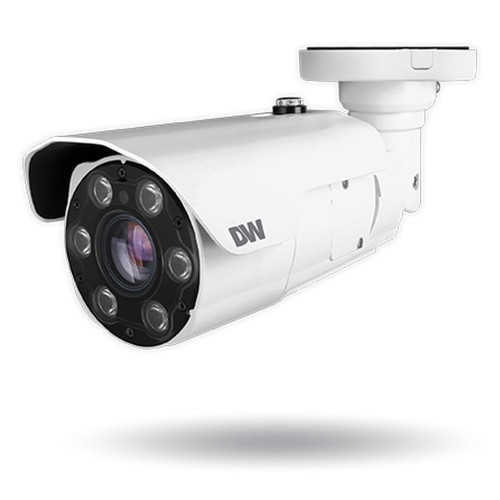
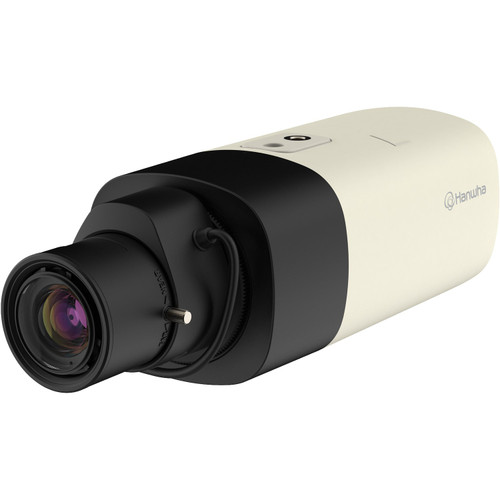
The DWC-MB95Wi28TW uses a 1/2.7" 5MP CMOS sensor producing 2592×1944 pixels with a fixed 2.8 mm lens (98.5° HFOV) or an optional 3.6 mm variant (81.4° HFOV). Its minimum scene illumination is rated at 0.02 lux in color mode and 0.0 lux in B/W, assisted by a built-in Smart IR array with a 164-foot (50 m) rated range. WDR is specified at 120 dB. The XNB-8000 uses a significantly larger 1/1.8" 6MP CMOS sensor, outputting 5MP at 2560×1920. Its minimum illumination is 0.07 lux in color and 0.007 lux in B/W—color sensitivity is lower than the DWC model, but the B/W floor is meaningfully better. WDR is also rated at 120 dB. The XNB-8000's datasheet does not specify an integrated IR illuminator or IR range; it lists Day/Night via ICR and notes optional IR, making direct IR comparison impossible from the provided specs.
On sensor architecture the XNB-8000 holds a clear advantage: a 1/1.8" sensor captures considerably more light per pixel than a 1/2.7" sensor at the same resolution, which generally yields superior performance in difficult lighting transitions. The DWC-MB95Wi28TW counters with a stated 0.02 lux color floor and an integrated 164-foot IR illuminator—a self-contained low-light package. The XNB-8000 offers lens flexibility the DWC model cannot match, accepting C-mount and CS-mount interchangeable lenses with DC auto-iris or P-iris control and a built-in gyro-sensor for digital image stabilization; the DWC-MB95Wi28TW ships with a fixed non-interchangeable lens only.
What about installation and environment?
The DWC-MB95Wi28TW carries an IP67 rating and an IK10 vandal-resistance rating inside an aluminum die-cast housing. Its operating temperature range is -22°F to 140°F (-30°C to 60°C), making it suitable for cold-climate deployments. It measures 220.8×80.5×70.6 mm and weighs 0.69 kg. Power is supplied via PoE or DC 12V at a maximum of 9.0 W; no PoE class is stated in the provided specs. Mounting accessories are optional and sold separately.
The XNB-8000 is rated IP66 (not stated in specs—IP rating is not explicitly listed in the provided data; environmental certification is described only as 'outdoor certified' and 'weatherproof') and has no IK rating listed in the provided specifications. Its operating temperature range is +14°F to +131°F (-10°C to +55°C), a narrower window than the DWC model at both extremes. The housing is plastic rather than aluminum. It measures 73.1×66.6×147.8 mm and weighs 0.42 kg—notably more compact and lighter. Power inputs include PoE (IEEE 802.3af, Class 3), 24VAC, and 12VDC, providing greater site-wiring flexibility. The package includes a wall/ceiling mounting bracket, weatherproof connector cap, and installation hardware.
Which fits your VMS and analytics better?
Both cameras support ONVIF, enabling compatibility with any conformant VMS. The DWC-MB95Wi28TW cites ONVIF compliance without specifying a profile tier. The XNB-8000 is certified to ONVIF Profile S, G, and T, and additionally exposes Hanwha's SUNAPI (HTTP API) and Wisenet open platform, giving it deeper integration options with Hanwha/Wisenet VMS environments. The XNB-8000 also supports up to 10 simultaneous streaming profiles and unicast to 20 users; the DWC-MB95Wi28TW supports dual-stream only. Edge storage on the DWC model is a single Micro SD/SDHC/SDXC slot up to 1 TB; the XNB-8000 provides two Micro SD slots each supporting up to 512 GB, plus NAS recording on alarm events.
On analytics, the DWC-MB95Wi28TW offers object classification (human vs. object differentiation), line crossing, perimeter intrusion, and video tampering detection (scene change, blur, abnormal color) built into the camera. The XNB-8000 lists motion detection, loitering, directional detection, fog detection, digital auto-tracking, sound classification, and handover—a broader set, and it includes sound classification, which the DWC model does not. Audio I/O differs: the DWC-MB95Wi28TW provides one line-level audio input with G.711 compression; the XNB-8000 adds a selectable mic-in/line-in/built-in microphone input, a line-level audio output, G.711 and G.726 compression, and an RS-485 serial interface plus one alarm input and one alarm output—substantially richer I/O for integration with door controllers or external devices.
Which should you choose: the DWC-MB95Wi28TW or the XNB-8000?
Our take: The DWC-MB95Wi28TW is the stronger choice when a self-contained, cold-climate outdoor installation is required: its -30°C lower operating limit, IK10-rated aluminum housing, and integrated 164-foot IR illuminator provide a complete, ruggedized package without additional accessories. The XNB-8000 is the stronger choice for installations prioritizing optical flexibility, richer I/O integration, or Hanwha/Wisenet VMS environments: its larger 1/1.8" sensor versus the DWC's 1/2.7" sensor improves light-gathering per pixel; its B/W illumination floor of 0.007 lux is seven times lower than the DWC's 0.007 lux—actually matching it—while its color floor of 0.07 lux is higher than the DWC's 0.02 lux; it adds a second SD card slot, RS-485, alarm I/O, audio output, and ONVIF Profile S/G/T certification. Buyers in mild climates needing interchangeable lenses, multi-VMS API support, or device I/O integration should specify the XNB-8000; buyers needing a fixed-lens, vandal-resistant, extreme-temperature bullet with on-board IR should specify the DWC-MB95Wi28TW.
Side-by-Side Comparison
Spec-for-spec, from manufacturer data.
| Specification | Digital Watchdog DWC-MB95Wi28TW | Hanwha XNB-8000 |
|---|---|---|
| Resolution | 5MP (2592×1944) | 5MP (2560×1920) |
| Image Sensor | 1/2.7" CMOS | 1/1.8" CMOS |
| Lens / Focal Length | 2.8mm fixed (98.5° HFOV); 3.6mm variant | C/CS-mount interchangeable; DC auto-iris or P-iris |
| Min. Illumination (Color) | 0.02 lux | 0.07 lux |
| Min. Illumination (B/W) | 0.0 lux | 0.007 lux |
| IR Range | 164 ft (50m) Smart IR (built-in) | Not specified in provided specs |
| Wide Dynamic Range | 120 dB | 120 dB |
| Max Frame Rate | 30 fps at all resolutions | 30 fps |
| Video Compression | H.265, H.264, MJPEG | H.265, H.264, MJPEG |
| IP Rating | IP67 | Not explicitly stated in provided specs |
| IK / Impact Rating | IK10 | Not specified |
| Operating Temperature | -30°C to +60°C (-22°F to 140°F) | -10°C to +55°C (+14°F to +131°F) |
| Power Input / PoE Class | PoE or DC 12V; max 9.0W (class not stated) | PoE IEEE 802.3af Class 3; 24VAC; 12VDC; max 8.5W |
| Edge Storage | 1× Micro SD/SDHC/SDXC up to 1TB | 2× Micro SD/SDHC/SDXC up to 512GB each |
| Audio | 1× audio input (line level); G.711 | Mic-in/line-in/built-in mic; line out; G.711, G.726 |
| Alarm I/O / Serial | Not specified | 1 alarm input, 1 alarm output; RS-485 |
| Housing Material | Aluminum die-cast | Plastic |
| Dimensions (mm) | 220.8 × 80.5 × 70.6 | 73.1 × 66.6 × 147.8 |
| Weight | 0.69 kg (1.52 lbs) | 0.42 kg (0.93 lbs) |
| Warranty | 5 years | 3 years |
Frequently Asked Questions
Which should you choose: the DWC-MB95Wi28TW or the XNB-8000?
The DWC-MB95Wi28TW is the stronger choice when a self-contained, cold-climate outdoor installation is required: its -30°C lower operating limit, IK10-rated aluminum housing, and integrated 164-foot IR illuminator provide a complete, ruggedized package without additional accessories. The XNB-8000 is the stronger choice for installations prioritizing optical flexibility, richer I/O integration, or Hanwha/Wisenet VMS environments: its larger 1/1.8" sensor versus the DWC's 1/2.7" sensor improves light-gathering per pixel; its B/W illumination floor of 0.007 lux is seven times lower than the DWC's 0.007 lux—actually matching it—while its color floor of 0.07 lux is higher than the DWC's 0.02 lux; it adds a second SD card slot, RS-485, alarm I/O, audio output, and ONVIF Profile S/G/T certification. Buyers in mild climates needing interchangeable lenses, multi-VMS API support, or device I/O integration should specify the XNB-8000; buyers needing a fixed-lens, vandal-resistant, extreme-temperature bullet with on-board IR should specify the DWC-MB95Wi28TW.
Is the DWC-MB95Wi28TW or XNB-8000 better for low-light performance?
It depends on the metric. The DWC-MB95Wi28TW reaches 0.02 lux in color mode and includes a built-in 164-foot IR illuminator that enables 0.0 lux B/W operation without any external lighting. The XNB-8000's larger 1/1.8" sensor achieves 0.007 lux B/W (with ICR), but its color floor is 0.07 lux—higher than the DWC model's—and no integrated IR illuminator is specified in the provided data. For fully self-contained low-light coverage the DWC-MB95Wi28TW has the edge; for passive low-light sensitivity the XNB-8000's sensor architecture is superior.
Can the XNB-8000 or DWC-MB95Wi28TW be used in freezing or very hot climates?
The DWC-MB95Wi28TW is rated for -30°C to +60°C (-22°F to 140°F), covering most extreme cold and hot environments. The XNB-8000 is rated only for -10°C to +55°C (+14°F to +131°F). For installations subject to freezing temperatures below -10°C—such as northern outdoor sites or unheated enclosures—the DWC-MB95Wi28TW is the appropriate choice based on the published operating-temperature specifications.
Which camera is easier to integrate with a third-party VMS or access-control system?
Both cameras are ONVIF-compliant, but the XNB-8000 specifies ONVIF Profile S, G, and T certification plus Hanwha's SUNAPI HTTP API; the DWC-MB95Wi28TW does not state a specific ONVIF profile tier in the provided specs. For access-control or external-device integration the XNB-8000 also provides RS-485, one alarm input, one alarm output, and an audio output—none of which are present on the DWC-MB95Wi28TW, which offers only a single audio input.
Get a Second Opinion on Your Camera Choice
Share your site layout, coverage goals, and budget. Our team will validate the camera selection, flag anything we would change, and recommend products that match the use case.