
Digital Watchdog DWC-MB95Wi28TW vs Hanwha QNO-8080R: Specification Comparison
Both the Digital Watchdog DWC-MB95Wi28TW and the Hanwha QNO-8080R are outdoor bullet cameras delivering 5MP resolution at 2592×1944 on similar-sized CMOS sensors, making them direct cross-shop candidates for installers specifying perimeter coverage in the same resolution class. The comparison covers imaging performance, environmental and installation requirements, and VMS/analytics integration — areas where these two cameras diverge despite sharing a headline resolution and form factor.
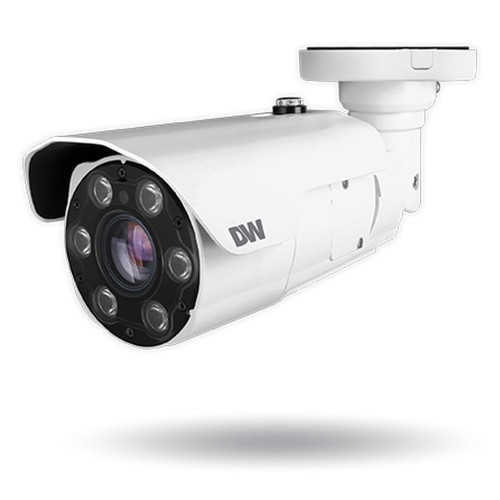
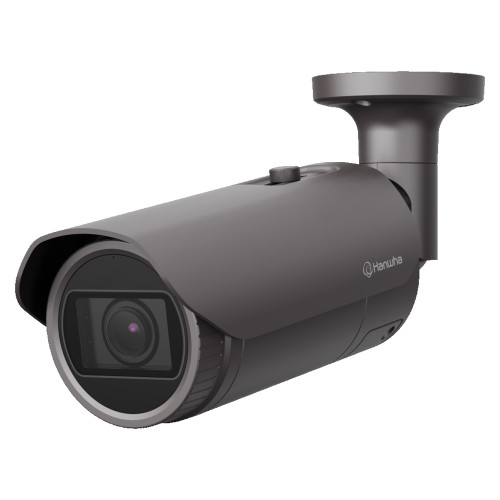
In This Guide
How do the imaging specs compare?
Both cameras use a 5MP CMOS sensor (DW: 1/2.7"; Hanwha: 1/2.8") and share 2592×1944 resolution with 120dB WDR. Low-light separation is significant: the DWC-MB95Wi28TW reaches 0.02 lux in color and 0.0 lux in B/W, while the QNO-8080R specifies 0.15 lux color and 0 lux IR — giving the DW a measurable advantage in color low-light sensitivity. IR range also differs: the DW delivers 164 ft (50m) Smart IR, versus the Hanwha's 30m (98 ft) IR at 850nm, a 67% reach advantage for the DW in dark environments.
The lens choice is the most consequential divergence. The DWC-MB95Wi28TW ships with a fixed 2.8mm lens (98.5° HFOV) with a 3.6mm variant available — both fixed, no remote adjustment. The QNO-8080R uses a motorized 3.2–10mm varifocal (3.1× zoom ratio), with HFOV ranging from 101° wide to approximately 31° tele, plus simple focus control and DC auto iris with IR correction. For installations requiring post-mount focus adjustment or variable coverage without a site return, the Hanwha's motorized varifocal is a material advantage. Both cameras deliver 30fps at full 5MP.
What about installation and environment?
The DWC-MB95Wi28TW carries an IP67 rating (complete dust ingress protection, temporary immersion to 1m), while the QNO-8080R is rated IP66 (dust-tight, high-pressure water jets but not immersion). Both carry IK10 vandal resistance. Operating temperature ranges are nearly identical: DW specifies −30°C to +60°C; Hanwha specifies −30°C to +55°C — a 5°C upper-temperature edge for the DW in high-heat installations such as rooftops in hot climates.
Power consumption is close: the DW draws a maximum 9.0W via PoE; the Hanwha draws a maximum 9.5W (typical 7.3W), both compatible with 802.3af PoE switches. The Hanwha explicitly states PoE Class 3. The DW also accepts DC 12V. Physical size differs notably: the DW measures 220.8×80.5×70.6mm and weighs 0.69 kg, while the Hanwha is 91×322.9mm and weighs 1.19 kg — the Hanwha is substantially heavier and longer, relevant for pole and parapet mounts. Both housings are aluminum die-cast. The Hanwha includes an alarm input and output (1 each); the DW specifies 1 audio input only — no alarm I/O is listed for the DW.
Which fits your VMS and analytics better?
Both cameras support ONVIF: the DW is listed as ONVIF conformant (specific profiles not stated in the provided spec); the Hanwha declares ONVIF Profile S, G, and T plus SUNAPI HTTP API and Wisenet open platform — giving integrators three named profiles and a documented HTTP API for deeper VMS and access control integration. The Hanwha also adds Bonjour and LLDP to its protocol list, supports SNMPv3 with MIB-2, and includes firmware encryption, device certificates via Hanwha Private Root CA, SD card partition encryption, and brute-force attack prevention — a more detailed security posture than the DW's digest authentication, IP filtering, and MAC filtering.
On analytics, the DW offers object classification (human vs. object), line crossing, perimeter intrusion, and video tampering detection (scene change, blur, abnormal color). The Hanwha provides motion detection, tampering, defocus detection, virtual area (intrusion/enter/exit), and virtual line (crossing/direction) — comparable depth, with the DW adding human/object classification and the Hanwha adding defocus detection. Edge storage: the DW supports Micro SD/SDHC/SDXC up to 1TB; the Hanwha caps at 128GB but adds NAS recording at alarm triggers. The DW includes 1 audio input; the Hanwha spec does not list audio I/O in the provided data. The Hanwha also supports up to 6 unicast users and 3 simultaneous stream profiles; the DW lists dual-stream. The Hanwha includes a CVBS analog output for installation alignment.
Which should you choose: the DWC-MB95Wi28TW or the QNO-8080R?
Our take: The DWC-MB95Wi28TW is the stronger choice when IR throw distance, color low-light sensitivity, and large-capacity edge storage are the primary drivers: its 164 ft IR range outreaches the QNO-8080R's 30m (98 ft) by 67%, its 0.02 lux color sensitivity undercuts the Hanwha's 0.15 lux specification, and its SD slot supports up to 1TB versus the Hanwha's 128GB cap. The QNO-8080R is the better fit when post-installation focal adjustment is needed — its motorized 3.2–10mm varifocal (3.1× zoom) versus the DW's fixed 2.8mm lens eliminates return trips for focus — and where deeper VMS integration matters: ONVIF Profile S/G/T, SUNAPI, and documented alarm I/O (1 in/1 out) that the DW's spec sheet does not list. Choose the DW for long-dark-range perimeter work on a fixed-angle run; choose the Hanwha where lens flexibility, alarm dry contacts, or a richer API ecosystem are required.
Side-by-Side Comparison
Spec-for-spec, from manufacturer data.
| Specification | Digital Watchdog DWC-MB95Wi28TW | Hanwha QNO-8080R |
|---|---|---|
| Resolution | 5MP (2592×1944) | 5MP (2592×1944) |
| Image Sensor | 1/2.7" CMOS | 1/2.8" CMOS |
| Lens / Focal Length | Fixed 2.8mm (98.5° HFOV); 3.6mm variant | Motorized varifocal 3.2–10mm (3.1×); 101°–~31° HFOV |
| Min. Illumination (Color) | 0.02 lux | 0.15 lux |
| Min. Illumination (B/W / IR) | 0.0 lux (B/W) | 0 lux (IR) |
| IR Range | 164 ft (50m) Smart IR | 30m (98.4 ft) @ 850nm |
| Wide Dynamic Range | 120dB True WDR | 120dB WDR |
| Max Frame Rate | 30fps at all listed resolutions | 30fps @ 5MP |
| Video Compression | H.265, H.264, MJPEG | H.265, H.264, MJPEG |
| IP Rating | IP67 | IP66 |
| IK / Impact Rating | IK10 | IK10 |
| Operating Temperature | -30°C to +60°C | -30°C to +55°C |
| Power Input / PoE Class | PoE or DC 12V; max 9.0W | PoE 802.3af Class 3; max 9.5W / typical 7.3W |
| Edge Storage | Micro SD/SDHC/SDXC up to 1TB | Micro SD/SDHC/SDXC up to 128GB |
| Alarm I/O | — | 1 input / 1 output |
| Audio | 1 audio input (line level); G.711A/U | — |
| ONVIF | ONVIF conformant (profiles not specified in provided spec) | ONVIF Profile S / G / T |
| Weight | 0.69 kg (1.52 lbs) | 1.19 kg (2.62 lbs) |
| Dimensions | 220.8 × 80.5 × 70.6 mm (8.69" × 3.16" × 2.77") | ø91 × 322.9 mm (ø3.58" × 12.71") |
| Warranty | 5 years | 3 years |
Frequently Asked Questions
Which should you choose: the DWC-MB95Wi28TW or the QNO-8080R?
The DWC-MB95Wi28TW is the stronger choice when IR throw distance, color low-light sensitivity, and large-capacity edge storage are the primary drivers: its 164 ft IR range outreaches the QNO-8080R's 30m (98 ft) by 67%, its 0.02 lux color sensitivity undercuts the Hanwha's 0.15 lux specification, and its SD slot supports up to 1TB versus the Hanwha's 128GB cap. The QNO-8080R is the better fit when post-installation focal adjustment is needed — its motorized 3.2–10mm varifocal (3.1× zoom) versus the DW's fixed 2.8mm lens eliminates return trips for focus — and where deeper VMS integration matters: ONVIF Profile S/G/T, SUNAPI, and documented alarm I/O (1 in/1 out) that the DW's spec sheet does not list. Choose the DW for long-dark-range perimeter work on a fixed-angle run; choose the Hanwha where lens flexibility, alarm dry contacts, or a richer API ecosystem are required.
Is the DWC-MB95Wi28TW or QNO-8080R better for low-light performance?
Based on the provided specifications, the DWC-MB95Wi28TW has an advantage in two low-light dimensions: its minimum color illumination is 0.02 lux versus the QNO-8080R's 0.15 lux, and its IR range reaches 164 ft (50m) compared to the Hanwha's 30m (approximately 98 ft). If the installation requires illuminating subjects at distances beyond 30m in darkness, the DW is the spec-supported choice.
Can I adjust the zoom or focus remotely on either camera?
Only the Hanwha QNO-8080R supports remote focal adjustment. It uses a motorized 3.2–10mm varifocal lens with simple focus control, allowing coverage angle to be changed from approximately 101° (wide) to roughly 31° (tele) without physically accessing the camera. The DWC-MB95Wi28TW uses a fixed 2.8mm lens (or fixed 3.6mm variant); once mounted, the field of view is set and cannot be adjusted remotely.
Which camera is easier to integrate with a third-party VMS or access control system?
The Hanwha QNO-8080R declares ONVIF Profile S, G, and T plus SUNAPI (HTTP API) and Wisenet open platform support, and it includes a physical alarm input and output (1 each) for dry-contact integration. The DWC-MB95Wi28TW lists ONVIF conformance but does not specify which profiles in the provided spec, and no alarm I/O is listed. For VMS environments requiring named ONVIF profiles, a documented HTTP API, or hardware alarm contacts, the QNO-8080R has the more complete integration spec on record.
Get a Second Opinion on Your Camera Choice
Share your site layout, coverage goals, and budget. Our team will validate the camera selection, flag anything we would change, and recommend products that match the use case.