
Digital Watchdog DWC-MB95Wi28TW vs Hanwha C8083R: Specification Comparison
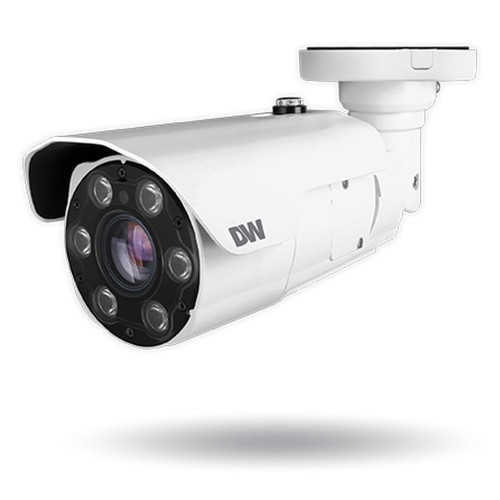
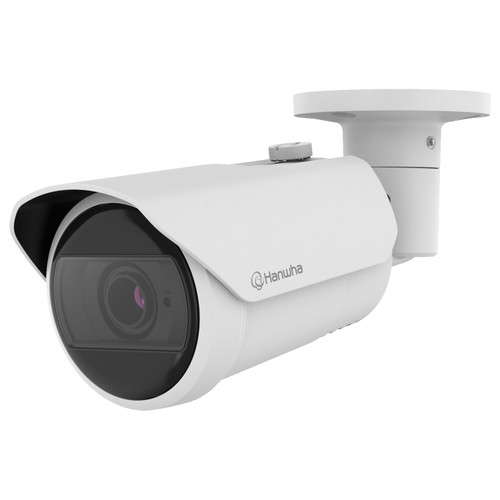
Both the Digital Watchdog DWC-MB95Wi28TW and the Hanwha QNO-C8083R are 5MP outdoor bullet cameras targeting perimeter surveillance installations. They share the same resolution class (2592×1944), wired PoE connectivity, IP-rated housings, and onboard IR illumination. The key differentiators under evaluation are lens type (fixed focal vs. motorized varifocal), AI analytics depth, IR range, security feature set, and environmental ratings—all factors a systems integrator must weigh before specifying either unit.
In This Guide
How do the imaging specs compare?
Both cameras resolve 5MP at 2592×1944 using a 1/2.7" (DW) and 1/2.8" (Hanwha) CMOS sensor respectively, and both deliver 30fps at full resolution. Low-light performance diverges meaningfully: the DWC-MB95Wi28TW is specified at 0.02 lux in color and 0.0 lux in B/W, while the QNO-C8083R is rated 0.07 lux color and 0 lux IR—giving the Digital Watchdog a measurable advantage in color sensitivity under dim ambient light. Both cameras implement 120dB True WDR, placing them on equal footing for high-contrast scenes.
Lens flexibility is where the two cameras diverge most sharply. The DWC-MB95Wi28TW ships with a fixed 2.8mm lens (98.5° HFOV) with a 3.6mm variant available at 81.4° HFOV—no remote adjustment is possible after mounting. The QNO-C8083R uses a 3.2–10.2mm (3.2×) motorized varifocal lens covering approximately 95° wide to a narrower tele position, with simple-focus support via a USB maintenance port. The Hanwha's IR range is 30m (98.4ft) at 850nm, while the Digital Watchdog's Smart IR reaches 164ft (50m)—a 65% longer throw that benefits large open perimeters.
What about installation and environment?
The DWC-MB95Wi28TW is rated IP67 and IK10, meaning it is fully dust-tight and withstands temporary immersion in addition to a 20-joule impact. The QNO-C8083R is rated IP66 and IK10—also fully dust-tight and impact-resistant, but IP66 does not cover submersion. Both are suitable for outdoor mounting in rain-exposed locations; specifiers in below-grade or wash-down environments should note the IP67 advantage of the Digital Watchdog. Both housings are white aluminum die-cast.
On temperature range, the DWC-MB95Wi28TW operates from -30°C to +60°C (-22°F to 140°F). The QNO-C8083R operates from -30°C to +55°C (-22°F to 131°F) per its primary spec block, with one field citing -40°C as the lower bound—the datasheet value of -30°C is used here as the authoritative figure. Both cameras are PoE-powered (no adapter included on the DW unit); the QNO-C8083R is explicitly specified as IEEE 802.3af Class 3 with a maximum draw of 12W, while the DWC-MB95Wi28TW draws a maximum of 9.0W via PoE. Both cameras support microSD edge storage; the QNO-C8083R is capped at 256GB, while the DWC-MB95Wi28TW supports up to 1TB.
Which fits your VMS and analytics better?
Both cameras declare ONVIF conformance, making them compatible with any ONVIF Profile S VMS. The QNO-C8083R additionally claims ONVIF Profiles G, T, and M, plus Hanwha's proprietary SUNAPI (HTTP API), providing broader integration paths for event-based recording and metadata streaming. The DWC-MB95Wi28TW lists ONVIF without specifying a profile tier. The Hanwha camera also implements WiseStream III AI-based smart codec and supports up to 5 concurrent stream profiles with unicast (20 users) or multicast delivery; the DW is specified for dual-stream only.
Analytics depth differs substantially. The DWC-MB95Wi28TW offers object classification (human vs. object), line crossing, perimeter intrusion, and video tampering. The QNO-C8083R adds AI-engine vehicle attribute classification (car/bus/truck/motorcycle/bicycle), people counting, vehicle counting, queue management, heatmap, and detection-shot support—features that require no separate server-side license. On security, the Hanwha adds secure boot, signed firmware, firmware encryption, AES data encryption, SD card partition encryption, brute-force prevention, SRTP, WSS, and a device certificate anchored to Hanwha's private root CA—none of these are listed for the DW unit. Both cameras provide one audio input; the QNO-C8083R additionally specifies a line-level audio output (0.5Vrms), alarm I/O (1 in / 1 out), and NAS recording, which are not specified for the DWC-MB95Wi28TW. The DW unit lists email and FTP event notifications; the Hanwha adds HTTP/HTTPS/TCP handover and audio clip playback on alarm.
Which should you choose: the DWC-MB95Wi28TW or the C8083R?
Our take: The QNO-C8083R is the stronger choice when installation geometry is unknown at design time, when the VMS environment demands deep ONVIF profile support or AI metadata, or when cybersecurity posture is a procurement criterion. Its 3.2–10.2mm motorized varifocal lens eliminates the need to specify focal length before mounting, its AI engine adds vehicle attribute classification and business intelligence analytics absent from the DW, and its security stack—secure boot, AES encryption, SD card partition encryption, and a device certificate—is substantially more hardened. The DWC-MB95Wi28TW, however, delivers a longer IR throw (164ft vs. 98.4ft), a lower color-mode minimum illumination (0.02 lux vs. 0.07 lux), higher IP ingress protection (IP67 vs. IP66), a wider operating temperature ceiling (+60°C vs. +55°C), larger on-board storage support (1TB vs. 256GB), and a longer warranty (5 years vs. 3 years). Specify the Digital Watchdog for fixed-angle, long-range, low-light perimeter runs; specify the Hanwha where lens flexibility, AI analytics breadth, and cybersecurity compliance are prioritized.
Side-by-Side Comparison
Spec-for-spec, from manufacturer data.
| Specification | Digital Watchdog DWC-MB95Wi28TW | Hanwha C8083R |
|---|---|---|
| Resolution | 5MP (2592×1944) | 5MP (2592×1944) |
| Image Sensor | 1/2.7" CMOS | 1/2.8" CMOS |
| Lens / Focal Length | Fixed 2.8mm (98.5° HFOV); 3.6mm variant (81.4°) | Motorized varifocal 3.2–10.2mm (3.2×); F1.6 Wide |
| Min. Illumination (Color / IR) | 0.02 lux color / 0.0 lux B/W | 0.07 lux color / 0 lux IR |
| IR Range | 164ft (50m) Smart IR™ | 30m (98.4ft) 850nm |
| Wide Dynamic Range | 120dB True WDR | 120dB WDR |
| Max Frame Rate | 30fps at all resolutions | 30fps @ 5MP |
| Video Compression | H.265, H.264, MJPEG | H.265, H.264, MJPEG |
| IP Rating | IP67 | IP66 |
| IK / Impact Rating | IK10 | IK10 |
| Operating Temperature | -30°C to +60°C (-22°F to +140°F) | -30°C to +55°C (-22°F to +131°F) |
| Power Input / PoE Class | PoE max 9.0W (class not specified) | PoE IEEE 802.3af Class 3, max 12W |
| Edge Storage | microSD/SDHC/SDXC up to 1TB | microSD/SDHC/SDXC up to 256GB |
| Audio | 1 audio input (line level) | Selectable mic/line in; line out 0.5Vrms |
| Alarm I/O | — | 1 input / 1 output |
| Analytics | Object classification, line crossing, perimeter intrusion, tampering | AI person/vehicle + attributes, virtual line/area, people counting, vehicle counting, queue mgmt, heatmap |
| ONVIF Profile | ONVIF (profile tier not specified) | ONVIF Profile S/G/T/M |
| Dimensions | 220.8 × 80.5 × 70.6 mm (8.69" × 3.16" × 2.77") | ø93.4 × 245.8 mm (ø3.68" × 9.68") |
| Weight | 0.69 kg (1.52 lbs) | 930g (2.05 lbs) |
| Warranty | 5 years | 3 years |
Frequently Asked Questions
Which should you choose: the DWC-MB95Wi28TW or the C8083R?
The QNO-C8083R is the stronger choice when installation geometry is unknown at design time, when the VMS environment demands deep ONVIF profile support or AI metadata, or when cybersecurity posture is a procurement criterion. Its 3.2–10.2mm motorized varifocal lens eliminates the need to specify focal length before mounting, its AI engine adds vehicle attribute classification and business intelligence analytics absent from the DW, and its security stack—secure boot, AES encryption, SD card partition encryption, and a device certificate—is substantially more hardened. The DWC-MB95Wi28TW, however, delivers a longer IR throw (164ft vs. 98.4ft), a lower color-mode minimum illumination (0.02 lux vs. 0.07 lux), higher IP ingress protection (IP67 vs. IP66), a wider operating temperature ceiling (+60°C vs. +55°C), larger on-board storage support (1TB vs. 256GB), and a longer warranty (5 years vs. 3 years). Specify the Digital Watchdog for fixed-angle, long-range, low-light perimeter runs; specify the Hanwha where lens flexibility, AI analytics breadth, and cybersecurity compliance are prioritized.
Is the DWC-MB95Wi28TW or QNO-C8083R better for low-light color performance?
Based on stated specifications, the DWC-MB95Wi28TW has a lower minimum color illumination at 0.02 lux versus the QNO-C8083R's 0.07 lux. Both reach 0 lux in IR (B/W) mode. If color detail under dim ambient light is the primary requirement, the Digital Watchdog's spec is more favorable.
Which camera is easier to aim after it's already mounted?
The QNO-C8083R uses a 3.2–10.2mm motorized varifocal lens that can be adjusted remotely or via the USB maintenance port without physically repositioning the camera. The DWC-MB95Wi28TW uses a fixed focal length (2.8mm or 3.6mm depending on variant); the field of view cannot be changed after the lens is selected.
Does either camera support alarm I/O for integration with access control or external devices?
The QNO-C8083R specifies one alarm input and one alarm output, supporting triggers from analytics, network disconnect, or external contacts, with responses including recording, FTP/email upload, handover commands, and audio clip playback. The DWC-MB95Wi28TW's specifications do not list alarm I/O contacts; its event notifications are limited to email and FTP.
Get a Second Opinion on Your Camera Choice
Share your site layout, coverage goals, and budget. Our team will validate the camera selection, flag anything we would change, and recommend products that match the use case.