
Digital Watchdog D4583WTIR vs Digital Watchdog DWC-MF5Wi4TW: Specification Comparison
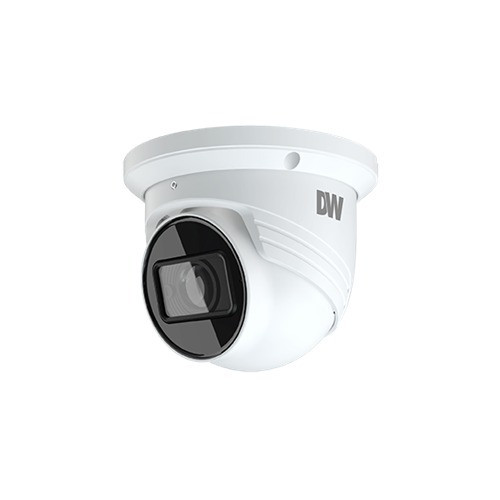
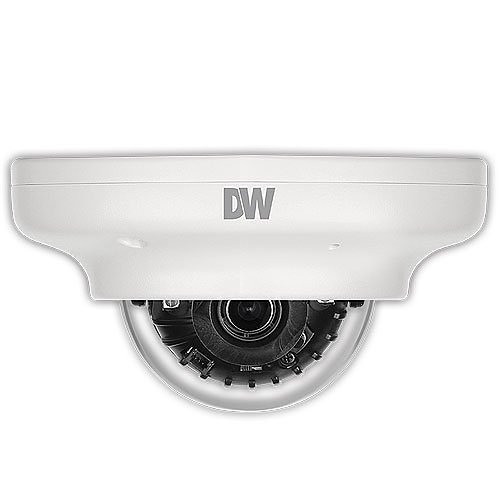
Both the Digital Watchdog DWC-D4583WTIR and DWC-MF5Wi4TW are 5MP IP dome cameras from the same manufacturer, sharing a 1/2.8" CMOS sensor and vandal-dome form factor. Despite that common ground, they diverge meaningfully in lens type, signal architecture, outdoor readiness, network capability, and analytics depth. This comparison examines those differences so installers and IT buyers can match the right model to their deployment requirements — analog-coax hybrid indoor retrofit versus IP-native outdoor installation.
In This Guide
How do the imaging specs compare?
Both cameras use a 5MP 1/2.8" CMOS sensor with True WDR at 120dB and Smart DNR 3D noise reduction. The DWC-D4583WTIR resolves 2608×1960 pixels and delivers a motorized varifocal lens spanning 2.7–13.5mm (85°–32° HFOV), with P-iris control and auto-focus — useful when precise depth-of-field tuning or post-installation lens adjustment is needed. The DWC-MF5Wi4TW resolves 2592×1944 pixels and ships in fixed focal-length variants (4.0mm, 6.0mm, or 8.0mm); the 4.0mm version reviewed here provides an 82.3° HFOV. Frame rate for the D4583WTIR is listed as variable with a published maximum of 20fps at full 5MP; the MF5Wi4TW achieves up to 30fps at all supported resolutions including 5MP.
On low-light performance, the D4583WTIR reaches 0.08 lux in color and 0.0 lux in B/W, augmented by Star-Light sense-up amplification (off, ×2–×32) and a 70-foot Smart IR range. The MF5Wi4TW reaches 0.16 lux in color and 0.0 lux in B/W with a 50-foot Smart IR range; slow-shutter modes (×2–×15) are available but no Star-Light amplification is specified. The D4583WTIR therefore holds a stated edge in color low-light sensitivity (0.08 vs 0.16 lux) and IR throw distance (70 ft vs 50 ft), while the MF5Wi4TW counters with a higher maximum frame rate (30fps vs 20fps).
What about installation and environment?
Both cameras carry an IP66 ingress-protection rating and are rated for the same operating temperature range of −4°F to 122°F (−20°C to 50°C) at 10–90% non-condensing humidity. The DWC-MF5Wi4TW adds an IK10 vandal-impact rating and uses an aluminum die-cast body with polycarbonate lens cover, making it the specified choice for outdoor or impact-risk environments. The DWC-D4583WTIR uses a plastic Snapit housing with no IK rating published, and is explicitly categorized as an indoor dome.
Power delivery also differs. The DWC-D4583WTIR lists 24 V AC and 12 VDC as primary power inputs with a 6.5W maximum draw; PoE is referenced in supplemental data but not in the primary power specification. The DWC-MF5Wi4TW is specified for PoE (Class 3) at up to 7.2W, or DC12V at up to 5.9W — an adapter is not included. The D4583WTIR is notably larger (107.8×99.1mm) and lighter (0.25kg), while the MF5Wi4TW is taller but narrower (125×48mm) and heavier (0.4kg per primary spec). Both note mounting accessories are optional and sold separately.
Which fits your VMS and analytics better?
The DWC-MF5Wi4TW is a full IP network camera with onboard H.264, H.265, and MJPEG compression, dual-stream CBR/VBR capability, IPv4 networking, and an extensive protocol stack including ONVIF, RTSP, HTTPS/TLS, SNMP v1/v2/v3, 802.1x, Bonjour, DDNS, UPnP, and Genetec Protocol — making it broadly compatible with enterprise VMS platforms. It also includes a Micro SD/SDHC/SDXC slot supporting up to 1TB for edge recording, plus alarm output activation, email, and SD card recording notifications. Bidirectional audio is supported (1 audio in, 1 audio out) with G.711 compression. Licensed IVA analytics cover intrusion, line crossing, counting, loitering, enter/exit, and tamper detection.
The DWC-D4583WTIR presents a different integration profile: its primary signal outputs are analog coax formats (CVBS, 960H, HD-CVI, HD-TVI, HD over Coax), with a CVBS test output. No IP networking specifications — compression codecs, streaming protocols, ONVIF compliance, or VMS compatibility — are listed in the provided specifications. It includes a built-in microphone (1 audio in, no audio out specified) and 24 programmable privacy zones versus 16 on the MF5Wi4TW. No onboard SD storage slot is specified. Camera control is via Pelco C and UTC protocols. Buyers requiring IP/VMS integration, edge storage, or licensed video analytics should note these capabilities are not documented for the D4583WTIR.
Which should you choose: the D4583WTIR or the DWC-MF5Wi4TW?
Our take: The DWC-MF5Wi4TW is the stronger choice when the deployment calls for outdoor IP camera integration into a modern VMS environment. It delivers 30fps at full 5MP versus the D4583WTIR's specified 20fps maximum, carries an IK10 vandal impact rating the D4583WTIR lacks, and provides a fully documented IP networking stack — H.264/H.265/MJPEG compression, ONVIF, dual-stream, up to 1TB edge SD storage, and licensed IVA analytics — none of which appear in the D4583WTIR's published specifications. The D4583WTIR is the stronger choice for indoor retrofit projects on existing coax infrastructure: its motorized 2.7–13.5mm varifocal lens with auto-focus and P-iris offers far more flexible field-of-view adjustment post-installation than the fixed 4.0mm lens on the MF5Wi4TW, and its 70-foot Smart IR range and 0.08 lux color sensitivity outperform the MF5Wi4TW's 50-foot IR range and 0.16 lux color threshold. Select the D4583WTIR for analog-coax hybrid sites requiring flexible lensing; select the MF5Wi4TW for outdoor IP deployments requiring VMS integration and impact resistance.
Side-by-Side Comparison
Spec-for-spec, from manufacturer data.
| Specification | Digital Watchdog D4583WTIR | Digital Watchdog DWC-MF5Wi4TW |
|---|---|---|
| Resolution (Active Pixels) | 2608 × 1960 (5MP) | 2592 × 1944 (5MP) |
| Image Sensor | 5MP 1/2.8" CMOS | 5MP 1/2.8" CMOS |
| Lens / Focal Length | Motorized varifocal 2.7–13.5mm | Fixed 4.0mm / 6.0mm / 8.0mm |
| Horizontal FOV | 85° – 32° (varifocal range) | 82.3° / 51.9° / 37.8° (by focal length) |
| Min. Illumination (Color / B&W) | 0.08 lux color / 0.0 lux B&W | 0.16 lux color / 0.0 lux B&W |
| IR Range | 70 ft Smart IR | 50 ft Smart IR |
| Wide Dynamic Range | True WDR 120dB | True WDR 120dB |
| Max Frame Rate | 20fps at 5MP | 30fps at all resolutions |
| Video Compression | Not specified (analog coax outputs) | H.264 / H.265 / MJPEG |
| IP Rating | IP66 | IP66 |
| IK / Impact Rating | — | IK10 |
| Operating Temperature | −4°F to 122°F (−20°C to 50°C) | −4°F to 122°F (−20°C to 50°C) |
| Power Input | 24VAC / 12VDC; max 6.5W | PoE Class 3 (max 7.2W) / DC12V (max 5.9W) |
| Edge Storage | — | Micro SD/SDHC/SDXC up to 1TB |
| Audio | Built-in mic (1 in, no out specified) | 1 audio in, 1 audio out; G.711 |
| ONVIF / VMS Integration | — | ONVIF compatible; Genetec Protocol listed |
| Analytics | Motion detection, privacy zones (24) | IVA licensed: intrusion, line crossing, loitering, tamper, and more |
| Housing / Material | Plastic Snapit, Indoor Dome, Ivory | Aluminum die-cast + polycarbonate lens, Vandal Dome, White |
| Dimensions (H × W/D) | 4.24" × 3.9" (107.8 × 99.1mm) | 4.92" × 1.88" (125 × 48mm) |
| Weight | 0.55 lbs (0.25kg) | 0.88 lbs (0.4kg) |
| Warranty | 5 Year | 5 Year |
Frequently Asked Questions
Which should you choose: the D4583WTIR or the DWC-MF5Wi4TW?
The DWC-MF5Wi4TW is the stronger choice when the deployment calls for outdoor IP camera integration into a modern VMS environment. It delivers 30fps at full 5MP versus the D4583WTIR's specified 20fps maximum, carries an IK10 vandal impact rating the D4583WTIR lacks, and provides a fully documented IP networking stack — H.264/H.265/MJPEG compression, ONVIF, dual-stream, up to 1TB edge SD storage, and licensed IVA analytics — none of which appear in the D4583WTIR's published specifications. The D4583WTIR is the stronger choice for indoor retrofit projects on existing coax infrastructure: its motorized 2.7–13.5mm varifocal lens with auto-focus and P-iris offers far more flexible field-of-view adjustment post-installation than the fixed 4.0mm lens on the MF5Wi4TW, and its 70-foot Smart IR range and 0.08 lux color sensitivity outperform the MF5Wi4TW's 50-foot IR range and 0.16 lux color threshold. Select the D4583WTIR for analog-coax hybrid sites requiring flexible lensing; select the MF5Wi4TW for outdoor IP deployments requiring VMS integration and impact resistance.
Is the DWC-D4583WTIR or DWC-MF5Wi4TW better for low-light performance?
Based on published specs, the DWC-D4583WTIR has an edge in color low-light sensitivity at 0.08 lux versus the DWC-MF5Wi4TW's 0.16 lux, and its Smart IR throws to 70 feet compared to the MF5Wi4TW's 50 feet. Both reach 0.0 lux in B/W mode with IR active. The D4583WTIR also lists Star-Light sense-up amplification (×2–×32); no equivalent is specified for the MF5Wi4TW.
Can the DWC-D4583WTIR be used on an IP/VMS system the same way the DWC-MF5Wi4TW can?
Not based on the provided specifications. The DWC-MF5Wi4TW is a documented IP network camera with H.264/H.265/MJPEG compression, ONVIF compliance, RTSP/HTTPS/SNMP protocol support, dual-streaming, and VMS compatibility listed explicitly. The DWC-D4583WTIR's primary outputs are analog coax formats (CVBS, HD-CVI, HD-TVI, HD over Coax); no IP networking, codec, ONVIF, or VMS specifications are provided in the spec sheet supplied for this comparison.
Which camera is better suited for outdoor or high-vandal-risk locations?
The DWC-MF5Wi4TW is specified for outdoor use with an IK10 vandal-impact rating and an aluminum die-cast body. Both cameras share an IP66 ingress rating and the same −4°F to 122°F operating temperature range. The DWC-D4583WTIR is categorized as an indoor dome with a plastic Snapit housing and no IK impact rating published, making the MF5Wi4TW the appropriate choice for outdoor or impact-exposed installations.
Get a Second Opinion on Your Camera Choice
Share your site layout, coverage goals, and budget. Our team will validate the camera selection, flag anything we would change, and recommend products that match the use case.