
Digital Watchdog D3263WTIR vs Digital Watchdog D4283WTIR: Specification Comparison
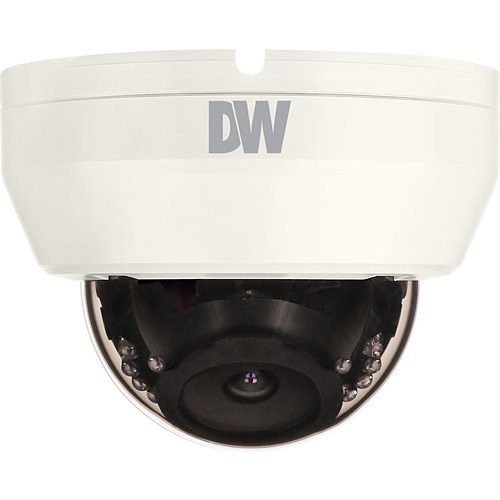
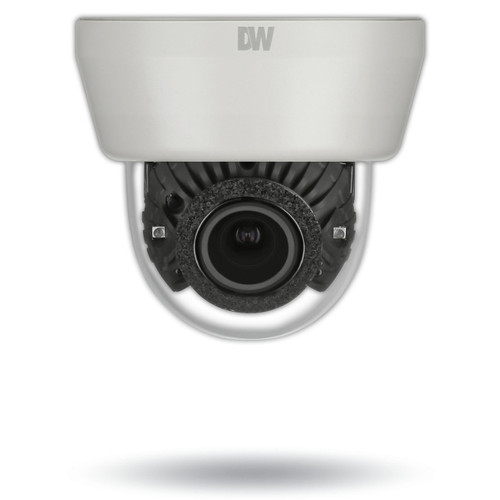
Both the DWC-D3263WTIR and DWC-D4283WTIR are Digital Watchdog 2.1MP (1080p) HD-Analog indoor dome cameras sharing the same 1/3" CMOS sensor, identical active-pixel array, and Smart IR platform. A buyer evaluating one will naturally consider the other. The comparison centers on lens automation, built-in audio, edge storage, operating temperature floor, power consumption, and integration breadth — differences that matter when specifying cameras for managed deployments, mixed coax/IP environments, or sites requiring local audio capture.
In This Guide
How do the imaging specs compare?
Both cameras share a 2.1MP 1/3" progressive-scan CMOS sensor with identical active pixels (1944H × 1092V), identical minimum scene illumination (0.03 lux color / 0.0 lux B/W), and identical 100-foot Smart IR range. WDR is rated at 100dB True WDR on both models, and both support Smart DNR 3D digital noise reduction, Star-Light sense-up (x2–x32), BLC, de-fog, DRC, and a gamma range of 0.45–0.75. Shutter speed range (1/30–1/30000) and frequency support (50Hz/60Hz) are also identical.
The key imaging differentiator is the lens mechanism. The D3263WTIR uses a manual vari-focal 2.8–12mm lens with P-iris, requiring physical adjustment to set zoom and focus. The D4283WTIR uses a motorized vari-focal 2.8–12mm lens with both motorized zoom and auto-focus, in addition to P-iris. Horizontal FOV is identical at 91°–28°; vertical FOV differs slightly — 47.8°–18.7° on the D3263WTIR versus 46.8°–19.6° on the D4283WTIR — a minor difference attributable to housing geometry. The motorized lens on the D4283WTIR enables remote focus and zoom adjustment without physical access to the camera, which is a practical installation advantage in ceiling or elevated mounts.
What about installation and environment?
Both cameras carry an IP66 rating and are specified for indoor dome use with ivory plastic housings. Mounting accessories are optional and sold separately for both. The D3263WTIR measures 4.72" × 3.51" (120 × 89.4 mm) and weighs 0.50 lbs (0.226 kg). The D4283WTIR is slightly more compact in height at 4.24" × 3.90" (107.8 × 99.1 mm) but marginally heavier at 0.53 lbs (0.24 kg). The D4283WTIR uses a Snapit housing design; the D3263WTIR uses standard plastic construction. Both use AWG #18 cable.
Operating temperature diverges meaningfully: the D3263WTIR is rated –4°F to 122°F (–20°C to 50°C), while the D4283WTIR extends to –40°F to 122°F (–40°C to 50°C), a 36°F (20°C) lower cold-floor. Power consumption is also distinct — the D3263WTIR draws up to 4.35W and supports both 12V DC and 24V AC, whereas the D4283WTIR draws a lower 2.3W maximum and is specified for 24V AC only. Both are listed as PoE-capable; the D4283WTIR explicitly cites PoE 802.3af. Signal technology is identical across both: CVBS/960H, HD-Analog, HD-CVI, HD-TVI, and HD-over-Coax.
Which fits your VMS and analytics better?
The D4283WTIR has explicitly documented ONVIF compliance, H.264 and MJPEG video compression support, a built-in microphone (audio sensitivity –38dB ±2dB, frequency response 50Hz–10KHz), and onboard microSD storage (up to 32GB SDHC). These specifications are not present in the D3263WTIR's published spec data — ONVIF compliance, video compression codec, audio input, and edge storage are all absent from its listed specifications.
Both cameras share the same camera control protocols — Pelco C, Pelco D, and UTP built-in — providing equivalent PTZ control compatibility for HD-Analog systems. Both include 16 programmable privacy masks, motion detection, mirror/flip, and sharpness control. The D4283WTIR's additional capabilities (ONVIF, codec documentation, audio, microSD) make it more integration-ready for hybrid or IP-capable VMS platforms and deployments requiring local evidence buffering or audio logging.
Which should you choose: the D3263WTIR or the D4283WTIR?
Our take: The D4283WTIR is the stronger choice when the deployment requires remote lens adjustment, built-in audio, onboard edge storage, or verified ONVIF integration. Concretely: its motorized auto-focus lens eliminates on-site refocusing after installation; its cold-floor temperature rating extends 36°F lower (–40°F vs –4°F), covering unheated spaces the D3263WTIR cannot; and its 2.3W maximum draw is roughly half the D3263WTIR's 4.35W, reducing PoE budget requirements per camera. The D3263WTIR accepts both 12V DC and 24V AC inputs — an advantage in legacy coax-only retrofits where 12V DC power is already present and PoE or 24V AC is unavailable. For straightforward analog replacements with existing 12V DC infrastructure and no audio or edge-storage requirement, the D3263WTIR's dual-voltage input is the deciding spec. For new installations or those requiring analytics-ready infrastructure, the D4283WTIR's feature set justifies selection.
Side-by-Side Comparison
Spec-for-spec, from manufacturer data.
| Specification | Digital Watchdog D3263WTIR | Digital Watchdog D4283WTIR |
|---|---|---|
| Sensor | 2.1MP 1/3" CMOS | 2.1MP 1/3" CMOS |
| Max Resolution | 2.1MP / 1080p | 2.1MP / 1080p |
| Active Pixels | 1944 × 1092 | 1944 × 1092 |
| Min Illumination (Color / B/W) | 0.03 lux / 0.0 lux | 0.03 lux / 0.0 lux |
| Lens / Focal Length | Manual vari-focal 2.8–12mm, P-iris | Motorized vari-focal 2.8–12mm, auto-focus, P-iris |
| Horizontal FOV | 91° – 28° | 91° – 28° |
| IR Range | 100 ft Smart IR | 100 ft Smart IR |
| WDR | True WDR 100dB | True WDR 100dB |
| Video Compression | — | H.264, MJPEG |
| ONVIF | — | Yes |
| Audio | — | Built-in mic (–38dB ±2dB, 50Hz–10KHz) |
| Edge Storage | — | microSDHC up to 32GB |
| IP Rating | IP66 | IP66 |
| Operating Temperature | –4°F to 122°F (–20°C to 50°C) | –40°F to 122°F (–40°C to 50°C) |
| Power Input | 12V DC or 24V AC, PoE | 24V AC, PoE (802.3af) |
| Max Power Draw | 4.35W | 2.3W |
| Dimensions (H × W) | 4.72" × 3.51" (120 × 89.4 mm) | 4.24" × 3.90" (107.8 × 99.1 mm) |
| Weight | 0.50 lbs (0.226 kg) | 0.53 lbs (0.24 kg) |
| Warranty | 5 Year | 5 Year |
Frequently Asked Questions
Which should you choose: the D3263WTIR or the D4283WTIR?
The D4283WTIR is the stronger choice when the deployment requires remote lens adjustment, built-in audio, onboard edge storage, or verified ONVIF integration. Concretely: its motorized auto-focus lens eliminates on-site refocusing after installation; its cold-floor temperature rating extends 36°F lower (–40°F vs –4°F), covering unheated spaces the D3263WTIR cannot; and its 2.3W maximum draw is roughly half the D3263WTIR's 4.35W, reducing PoE budget requirements per camera. The D3263WTIR accepts both 12V DC and 24V AC inputs — an advantage in legacy coax-only retrofits where 12V DC power is already present and PoE or 24V AC is unavailable. For straightforward analog replacements with existing 12V DC infrastructure and no audio or edge-storage requirement, the D3263WTIR's dual-voltage input is the deciding spec. For new installations or those requiring analytics-ready infrastructure, the D4283WTIR's feature set justifies selection.
Is the D3263WTIR or D4283WTIR better for low light?
Both cameras are rated identically for low-light performance: 0.03 lux in color mode and 0.0 lux in black-and-white, with the same 100-foot Smart IR range and Star-Light sense-up (x2–x32). Neither model has a specified advantage over the other based on published illumination specs.
Does either camera support onboard recording without a DVR?
Only the D4283WTIR specifies onboard storage support — up to a 32GB microSDHC card. The D3263WTIR's published specifications do not list any edge storage capability. If local buffering is required, the D4283WTIR is the only option between these two based on available spec data.
Can these cameras be used in an unheated warehouse or loading dock in cold climates?
The D4283WTIR is rated down to –40°F (–40°C), making it suitable for very cold unheated environments. The D3263WTIR's published lower operating limit is –4°F (–20°C). For installations where temperatures may drop below –4°F, only the D4283WTIR is spec-qualified between these two models.
Get a Second Opinion on Your Camera Choice
Share your site layout, coverage goals, and budget. Our team will validate the camera selection, flag anything we would change, and recommend products that match the use case.