
Datalogic PM9100-D910RB vs Zebra LI2208-SR7U2100AZW: Specification Comparison
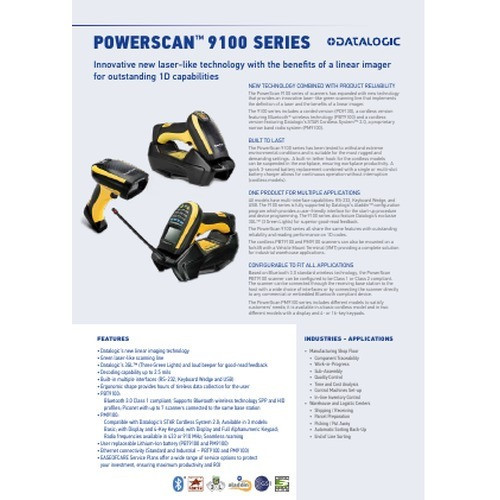
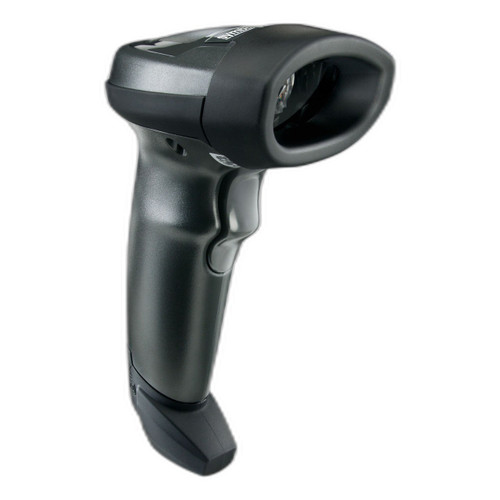
Both the Datalogic PowerScan PM9100-D910RB and the Zebra LI2208-SR7U2100AZW are handheld 1D linear imager barcode scanners, placing them in the same general device class. The PM9100-D910RB is positioned as an industrial-grade cordless scanner with IP65 sealing and Bluetooth, while the LI2208-SR7U2100AZW is a USB-wired scanner targeting retail and light-commercial environments. Buyers evaluating a 1D handheld scanner will encounter both models across distributor catalogs, making a direct comparison meaningful for procurement teams weighing ruggedness, connectivity, and scan performance against deployment context.
In This Guide
- Which scanner offers stronger ingress protection and drop resilience for the target environment?
- Which scanner better fits the site's connectivity architecture — wired, wireless, or mixed?
- How do scan speed and supported symbology sets compare between the two models?
- Which should you choose: the PM9100-D910RB or the LI2208-SR7U2100AZW?
- Side-by-Side Specs
- FAQ
Which scanner offers stronger ingress protection and drop resilience for the target environment?
The PM9100-D910RB carries an IP65 rating, meaning it is fully dust-tight and protected against low-pressure water jets from any direction — a specification appropriate for warehouse floors, manufacturing lines, and cold-storage environments where liquids and particulates are present.
The LI2208-SR7U2100AZW is rated IP42, which provides protection against solid objects greater than 1 mm and against dripping water at an angle up to 15 degrees — adequate for indoor retail but meaningfully less sealed than IP65.
On drop resistance, the LI2208-SR7U2100AZW specifies a 1.8 m drop rating to concrete and 1,000 tumble cycles (2,000 drops). The PM9100-D910RB describes its drop durability as 'industrial-grade rated for rugged use'; a precise drop-height figure in meters is not stated in the provided specifications.
For environments with wash-down risk, dust exposure, or frequent drops from height, the PM9100-D910RB's IP65 rating is the stronger documented ingress specification. The LI2208-SR7U2100AZW's concrete drop figure of 1.8 m is a precise, quantified advantage not matched by an equivalent number in the PM9100-D910RB spec sheet.
Which scanner better fits the site's connectivity architecture — wired, wireless, or mixed?
The PM9100-D910RB supports USB, RS-232, and Bluetooth (STAR 433 MHz radio also noted in spec bullets), giving it multiple wired and wireless interface options. Bluetooth connectivity enables cordless operation and pairing to mobile computers, forklift terminals, or Bluetooth-capable hosts — a meaningful advantage in large-footprint facilities where tethered operation restricts worker movement.
The LI2208-SR7U2100AZW is a USB-wired scanner only. It draws power directly from the USB host, eliminating battery management entirely. No wireless interface is listed in the provided specifications.
For fixed-station deployments — retail point-of-sale, receiving desks, or kiosk applications — the LI2208-SR7U2100AZW's host-powered USB connection simplifies deployment and removes battery charging from the maintenance cycle. For roving workers, forklift-mounted terminals, or any application requiring freedom of movement, the PM9100-D910RB's Bluetooth interface is the enabling specification.
How do scan speed and supported symbology sets compare between the two models?
The LI2208-SR7U2100AZW specifies a scan rate of 547 scans per second on a single-pass pattern — a concrete, measurable throughput figure relevant to high-velocity retail checkout lanes where label presentation speed and scan rate directly affect queue time.
The PM9100-D910RB does not include a numeric scans-per-second figure in the provided specifications. Its scan engine is described as a 1D linear imager, and the product is positioned for industrial speed, but no equivalent scan-rate number is available for direct comparison.
On symbologies, the PM9100-D910RB lists Code 128, Code 39, UPC, and EAN. The LI2208-SR7U2100AZW lists Code 39, UPC, and EAN. Code 128 is not listed for the LI2208-SR7U2100AZW in the provided specifications — a potential gap for supply-chain and logistics applications where GS1-128 shipping labels are standard.
Buyers requiring Code 128 support should note that only the PM9100-D910RB explicitly includes it. Buyers requiring a quantified scan rate for throughput benchmarking have that figure only for the LI2208-SR7U2100AZW.
Which should you choose: the PM9100-D910RB or the LI2208-SR7U2100AZW?
Our take: The PM9100-D910RB is the stronger choice when the deployment environment demands sealed ingress protection, wireless mobility, and Code 128 symbology support. Its IP65 rating surpasses the LI2208-SR7U2100AZW's IP42 by two full protection tiers on both dust and liquid ingress. It adds Bluetooth and RS-232 interfaces versus the LI2208-SR7U2100AZW's USB-only connection, and it explicitly covers Code 128 — a symbology absent from the LI2208-SR7U2100AZW's listed set. Conversely, the LI2208-SR7U2100AZW has a documented 547 scans/sec rate and a concrete 1.8 m drop-to-concrete specification that the PM9100-D910RB's spec sheet does not match with equivalent numbers. Choose the LI2208-SR7U2100AZW for fixed retail checkout stations where host-powered USB simplicity, quantified scan throughput, and lower unit cost are the priorities. Choose the PM9100-D910RB for industrial, warehouse, or cold-storage deployments where IP65 sealing, cordless range, and Code 128 are operational requirements.
Side-by-Side Comparison
Spec-for-spec, from manufacturer data.
| Specification | Datalogic PM9100-D910RB | Zebra LI2208-SR7U2100AZW |
|---|---|---|
| Product Type | Industrial Handheld Barcode Scanner | Handheld Barcode Scanner |
| Scan Engine | 1D Linear Imager | 1D Linear Imager |
| Ingress Protection | IP65 | IP42 |
| Drop Rating | Industrial-grade (no specific height stated) | 1.8 m to concrete |
| Tumble Testing | — | 1,000 cycles (2,000 drops) |
| Scan Rate | — | 547 scans/sec |
| Scan Pattern | — | Single-pass |
| Connectivity | USB, RS-232, Bluetooth, STAR 433 MHz | USB (wired only) |
| Power Source | Battery (wireless capable) | USB host power or external power |
| Symbologies | Code 128, Code 39, UPC, EAN | Code 39, UPC, EAN |
| Weight | 399 g (0.88 lb) | 140 g (4.95 oz) |
| Dimensions | 71 x 193 x 102 mm (2.8 x 7.6 x 4.0 in) | 6.30 in H x 2.64 in W x 3.90 in L |
| Ambient Light Max | — | 108,000 lux |
| Operating Temperature | Wide range (cold storage to heated) | 0°C to 50°C (32°F to 122°F) |
| Read Confirmation | Datalogic Green Spot visual confirmation | — |
| Warranty | 1-Year Limited | 1-Year |
Frequently Asked Questions
Which should you choose: the PM9100-D910RB or the LI2208-SR7U2100AZW?
The PM9100-D910RB is the stronger choice when the deployment environment demands sealed ingress protection, wireless mobility, and Code 128 symbology support. Its IP65 rating surpasses the LI2208-SR7U2100AZW's IP42 by two full protection tiers on both dust and liquid ingress. It adds Bluetooth and RS-232 interfaces versus the LI2208-SR7U2100AZW's USB-only connection, and it explicitly covers Code 128 — a symbology absent from the LI2208-SR7U2100AZW's listed set. Conversely, the LI2208-SR7U2100AZW has a documented 547 scans/sec rate and a concrete 1.8 m drop-to-concrete specification that the PM9100-D910RB's spec sheet does not match with equivalent numbers. Choose the LI2208-SR7U2100AZW for fixed retail checkout stations where host-powered USB simplicity, quantified scan throughput, and lower unit cost are the priorities. Choose the PM9100-D910RB for industrial, warehouse, or cold-storage deployments where IP65 sealing, cordless range, and Code 128 are operational requirements.
Can the PM9100-D910RB or LI2208-SR7U2100AZW handle wet or dusty warehouse conditions?
The PM9100-D910RB is rated IP65, meaning it is fully dust-tight and resistant to water jets — suitable for warehouse, manufacturing, and cold-storage environments. The LI2208-SR7U2100AZW is rated IP42, which protects against solid objects larger than 1 mm and angled dripping water only. For reliably wet or dusty conditions, the PM9100-D910RB's IP65 rating is the documented specification that addresses that requirement.
Does either scanner work without being plugged in during use?
Yes — the PM9100-D910RB supports Bluetooth (and a STAR 433 MHz radio per spec bullets), enabling cordless operation. The LI2208-SR7U2100AZW is a USB-wired scanner only; it draws power from the host and has no wireless interface listed in its provided specifications. If cordless operation is required, only the PM9100-D910RB meets that need based on the available specs.
Which scanner is better suited for retail point-of-sale checkout versus industrial logistics scanning?
The LI2208-SR7U2100AZW is spec'd for retail: it is USB host-powered, has a documented 547 scans/sec rate for high-velocity checkout, and comes in retail color options. The PM9100-D910RB is spec'd for industrial logistics: IP65 sealing, Bluetooth mobility, Code 128 support for GS1 shipping labels, and a weight of 399 g in a larger form factor suited to industrial handheld use. The two products target different primary environments, though both perform basic 1D scanning.
More Barcode Scanner Comparisons
- Datalogic PM9100-910RB vs CipherLab A1000ACBU0001
- Datalogic PM9100-910RB vs CipherLab A1000ACWU0001
- Datalogic PM9100-910RB vs Zebra LI2208-SR7U2100AZW
- Datalogic PM9100-910RB vs CipherLab A8001RSC00025
- Datalogic PM9100-910RB vs Datalogic PM9100-D910RB
- Datalogic PM9100-910RB vs Datalogic QBT2500-BK
Barcode Scanner Buying Guides
Get a Second Opinion on Your Camera Choice
Share your site layout, coverage goals, and budget. Our team will validate the camera selection, flag anything we would change, and recommend products that match the use case.