
Datalogic PM9100-910RB vs Datalogic PM9100-D910RB: Specification Comparison
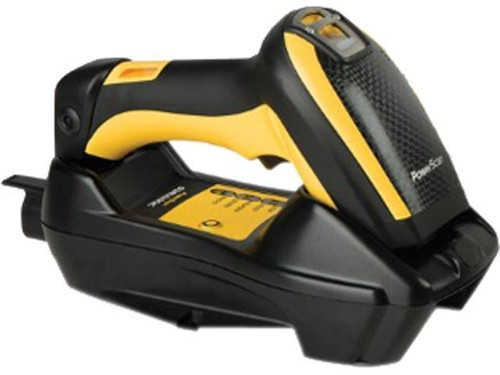
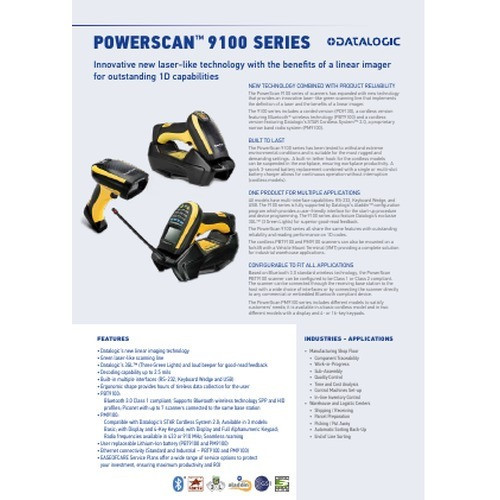
Both products belong to Datalogic's PowerScan 9100 family of industrial handheld barcode scanners, sharing the same 1D linear imager scan engine, IP65 ingress protection, and industrial-grade form factor. The PM9100-910RB and PM9100-D910RB are directly cross-shoppable units targeting warehouse, manufacturing, and logistics environments. This comparison examines the documented specification differences across connectivity, symbology support, and feature disclosures to help procurement and integration teams determine which variant best fits their deployment requirements.
In This Guide
- Which scanner offers broader connectivity options for your infrastructure?
- Which unit provides documented symbology coverage for your scan environment?
- Are the physical build, environmental ratings, and ergonomics equivalent between these two units?
- Which should you choose: the PM9100-910RB or the PM9100-D910RB?
- Side-by-Side Specs
- FAQ
Which scanner offers broader connectivity options for your infrastructure?
Both units specify USB, RS-232, and Bluetooth as confirmed interfaces. Product A (PM9100-910RB) additionally lists STAR 433 MHz radio in its connectivity spec fields, providing a third wireless channel alongside Bluetooth. Product B (PM9100-D910RB) lists STAR 433 MHz only in a marketing bullet (~Card_Bullet_3) and not in its structured Interface spec field, meaning that radio capability is asserted but not formally confirmed in the spec layer for Product B. For integrators building against documented specs, Product A has the more explicitly spec-confirmed multi-radio profile. Both devices confirm Bluetooth with security mode options per their shared wireless spec sections.
Which unit provides documented symbology coverage for your scan environment?
Product B (PM9100-D910RB) explicitly enumerates supported 1D symbologies in its structured spec fields: Code 128, Code 39, UPC, and EAN. Product A (PM9100-910RB) lists symbologies as a spec category but does not enumerate specific codes in the provided specification data — the entry reads as a section header referencing page 75 of what appears to be a manual table of contents rather than a populated value. For procurement purposes, Product B delivers a concrete, auditable symbology list; Product A's symbology coverage cannot be confirmed from the provided specs alone and would require datasheet review.
Are the physical build, environmental ratings, and ergonomics equivalent between these two units?
On all documented physical and environmental parameters, the two units are identical. Both weigh 399 g (0.88 lb) and share identical dimensions of 71 × 193 × 102 mm (2.8 × 7.6 × 4.0 in). Both carry an IP65 rating covering dust ingress and water resistance. Both reference industrial-grade drop resistance, though neither spec set provides a specific drop-height rating in meters. Both carry a 1-Year Limited warranty. Operating temperature is described only in general terms for both units — 'wide range' — with no numerical floor or ceiling provided for either model. The two units are physically indistinguishable based on available specifications.
Which should you choose: the PM9100-910RB or the PM9100-D910RB?
Our take: The PM9100-D910RB is the stronger documented choice when verified symbology coverage is a procurement or compliance requirement, as it explicitly lists Code 128, Code 39, UPC, and EAN in its structured spec fields while the PM9100-910RB does not enumerate specific symbologies in the provided data. Conversely, the PM9100-910RB has STAR 433 MHz radio confirmed in its structured connectivity spec, whereas Product B asserts the same radio only in a marketing bullet. All other measurable parameters are identical: both weigh 399 g, measure 71 × 193 × 102 mm, hold IP65 ratings, and carry 1-Year Limited warranties. Additionally, Product B specifies Datalogic Green Spot visual read confirmation, a feature not documented for Product A. The PM9100-D910RB suits buyers who need a formally spec-confirmed symbology list and visual feedback; the PM9100-910RB may be preferred where STAR 433 MHz radio confirmation at the spec level is critical to system integration sign-off.
Side-by-Side Comparison
Spec-for-spec, from manufacturer data.
| Specification | Datalogic PM9100-910RB | Datalogic PM9100-D910RB |
|---|---|---|
| Series / Family | PowerScan 9100 | PowerScan 9100 |
| Product Type | Industrial Handheld Barcode Scanner | Industrial Handheld Barcode Scanner |
| Scan Engine | 1D Linear Imager | 1D Linear Imager |
| IP Rating | IP65 | IP65 |
| Weight | 399 g (0.88 lb) | 399 g (0.88 lb) |
| Dimensions (mm) | 71 x 193 x 102 | 71 x 193 x 102 |
| Dimensions (in) | 2.8 x 7.6 x 4.0 | 2.8 x 7.6 x 4.0 |
| Warranty | 1-Year Limited | 1-Year Limited |
| USB Interface | Yes (spec-confirmed) | Yes (spec-confirmed) |
| RS-232 Interface | Yes (spec-confirmed) | Yes (spec-confirmed) |
| Bluetooth | Yes (spec-confirmed) | Yes (spec-confirmed) |
| STAR 433 MHz Radio | Yes (spec-confirmed) | Mentioned in bullet only — not in Interface spec |
| Documented Symbologies | — | Code 128; Code 39; UPC; EAN |
| Visual Read Confirmation | — | Datalogic Green Spot |
| Drop Rating | Industrial-grade (no height spec) | Industrial-grade (no height spec) |
| Operating Temperature | Wide range (no numeric values provided) | Wide range (no numeric values provided) |
Frequently Asked Questions
Which should you choose: the PM9100-910RB or the PM9100-D910RB?
The PM9100-D910RB is the stronger documented choice when verified symbology coverage is a procurement or compliance requirement, as it explicitly lists Code 128, Code 39, UPC, and EAN in its structured spec fields while the PM9100-910RB does not enumerate specific symbologies in the provided data. Conversely, the PM9100-910RB has STAR 433 MHz radio confirmed in its structured connectivity spec, whereas Product B asserts the same radio only in a marketing bullet. All other measurable parameters are identical: both weigh 399 g, measure 71 × 193 × 102 mm, hold IP65 ratings, and carry 1-Year Limited warranties. Additionally, Product B specifies Datalogic Green Spot visual read confirmation, a feature not documented for Product A. The PM9100-D910RB suits buyers who need a formally spec-confirmed symbology list and visual feedback; the PM9100-910RB may be preferred where STAR 433 MHz radio confirmation at the spec level is critical to system integration sign-off.
Do the PM9100-910RB and PM9100-D910RB support the same barcodes?
Product B (PM9100-D910RB) explicitly documents Code 128, Code 39, UPC, and EAN in its structured spec fields. Product A (PM9100-910RB) lists symbologies as a spec category but does not enumerate specific codes in the provided specification data. Both are 1D linear imagers in the same PowerScan 9100 family, so full coverage is likely similar, but only Product B provides a verifiable list from the supplied specs.
Is one scanner more rugged or water-resistant than the other?
Based on available specifications, both units are equivalent in physical durability. Both carry an IP65 ingress protection rating, both reference industrial-grade drop resistance (no specific drop height is documented for either), both weigh 399 g, and both share identical dimensions. Neither unit has a documented advantage over the other in this dimension.
Which unit is better if my warehouse uses a STAR 433 MHz wireless network?
The PM9100-910RB has STAR 433 MHz radio explicitly confirmed in its structured connectivity and radio spec fields. The PM9100-D910RB mentions STAR 433 MHz in a marketing bullet but does not list it in its structured Interface spec field. For deployments where radio compatibility must be verifiable from documented specs, the PM9100-910RB provides the stronger formal confirmation.
More Barcode Scanner Comparisons
- Datalogic PM9100-910RB vs CipherLab A1000ACBU0001
- Datalogic PM9100-910RB vs CipherLab A1000ACWU0001
- Datalogic PM9100-910RB vs Zebra LI2208-SR7U2100AZW
- Datalogic PM9100-910RB vs CipherLab A8001RSC00025
- Datalogic PM9100-910RB vs Datalogic QBT2500-BK
- Datalogic PM9100-D910RB vs CipherLab A1000ACBU0001
Barcode Scanner Buying Guides
Get a Second Opinion on Your Camera Choice
Share your site layout, coverage goals, and budget. Our team will validate the camera selection, flag anything we would change, and recommend products that match the use case.