
Datalogic PM9100-910RBK10 vs Zebra LI2208-SR7U2100AZW: Specification Comparison
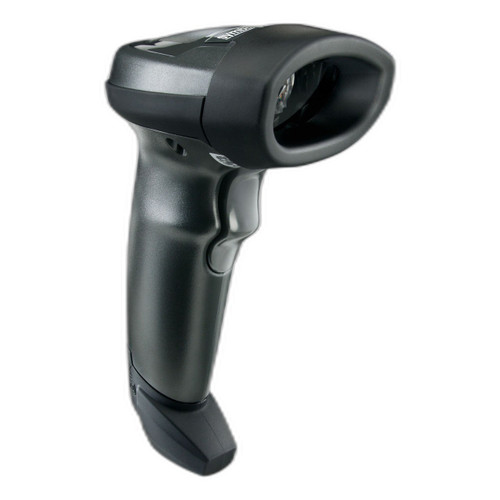
Both the Datalogic PM9100-910RBK10 and the Zebra LI2208-SR7U2100AZW are handheld 1D linear imager barcode scanners, making them directly cross-shoppable in principle. However, they occupy meaningfully different deployment tiers: the PM9100-910RBK10 is a battery-powered industrial unit built for harsh environments, while the LI2208-SR7U2100AZW is a USB host-powered wired scanner aimed at retail and light-duty applications. Buyers evaluating both are typically weighing mobility and ruggedness against throughput speed and installation simplicity in a fixed-point setting.
In This Guide
- Which scanner fits your deployment model—wired fixed-point or wireless mobile?
- Which unit can withstand the physical and environmental demands of your site?
- Which scanner delivers the speed and symbology coverage your operation requires?
- Which should you choose: the PM9100-910RBK10 or the LI2208-SR7U2100AZW?
- Side-by-Side Specs
- FAQ
Which scanner fits your deployment model—wired fixed-point or wireless mobile?
The Datalogic PM9100-910RBK10 supports both wired and wireless operation. Its specified connectivity includes USB, RS-232, Bluetooth, and 433 MHz radio, and it is powered by an onboard Li-Ion 3350 mAh battery, enabling fully untethered use across a warehouse floor, loading dock, or production line.
The Zebra LI2208-SR7U2100AZW is strictly wired. It connects via USB and draws power directly from the host device, eliminating battery management entirely. The package contents confirm a USB cable is included; no wireless capability is listed in the provided specifications.
For fixed checkout counters, kiosk stations, or any point-of-use where the scanner never leaves the cable's reach, the LI2208's host-powered simplicity reduces operational overhead. For any application requiring the operator to move freely—receiving docks, pick-and-pack, yard operations—the PM9100's battery and wireless radio options are the deciding factor.
Which unit can withstand the physical and environmental demands of your site?
The Datalogic PM9100-910RBK10 carries an IP65 ingress protection rating, meaning it is fully sealed against dust and protected against low-pressure water jets from any direction. The specifications also note industrial-grade drop resistance, though a specific drop height in meters is not provided in the available spec data.
The Zebra LI2208-SR7U2100AZW is rated IP42, providing protection against solid objects greater than 1 mm and against water dripping vertically. It is specified to survive drops to concrete from 1.8 m and has been tumble-tested to 1,000 cycles (2,000 drops). Its operating temperature range is stated as 0 °C to 50 °C; no equivalent operating temperature range is provided in the PM9100 spec data.
IP65 versus IP42 is a meaningful gap. The PM9100 is appropriate for food processing, pharmaceutical manufacturing, outdoor receiving, or any environment with washdown exposure, airborne particulate, or high humidity. The LI2208 is suited to clean indoor retail environments where the primary physical risk is accidental drops—which its 1.8 m drop spec and tumble certification directly address.
Which scanner delivers the speed and symbology coverage your operation requires?
The Zebra LI2208-SR7U2100AZW specifies a scan rate of 547 scans per second with a single-pass scan pattern, and its supported symbologies are listed as Code 39, UPC, and EAN. These figures are explicitly documented in the provided specifications.
The Datalogic PM9100-910RBK10 specifications describe the scan engine as a 1D linear imager and note compatibility with EAN, UPC, and Code 128. However, no numerical scan rate (scans per second) is provided in the available spec data for the PM9100, preventing a direct numerical comparison on throughput.
For high-velocity retail checkout where scan rate is a measurable bottleneck, the LI2208's 547 scans/sec figure is a concrete performance reference. The PM9100's spec sheet does not supply an equivalent number, so buyers requiring a confirmed scan-rate benchmark for industrial throughput planning should request that data from Datalogic before finalizing a decision.
Which should you choose: the PM9100-910RBK10 or the LI2208-SR7U2100AZW?
Our take: The PM9100-910RBK10 is the stronger choice when mobility, wireless connectivity, or harsh-environment sealing is required. Its IP65 rating surpasses the LI2208's IP42 by two full ingress-protection tiers, its Li-Ion 3350 mAh battery enables untethered operation, and its connectivity options—Bluetooth, 433 MHz radio, USB, and RS-232—cover wired and wireless deployment scenarios the LI2208 cannot address at all. Conversely, the LI2208-SR7U2100AZW holds a concrete advantage in documented scan throughput (547 scans/sec), verified drop tolerance (1.8 m to concrete with 1,000-cycle tumble testing), and zero battery overhead via host USB power. The PM9100 belongs in industrial, logistics, or regulated-environment settings; the LI2208 is purpose-built for retail point-of-sale or light-duty fixed scanning where speed and installation simplicity outweigh ruggedness requirements.
Side-by-Side Comparison
Spec-for-spec, from manufacturer data.
| Specification | Datalogic PM9100-910RBK10 | Zebra LI2208-SR7U2100AZW |
|---|---|---|
| Product Type | Industrial Handheld Barcode Scanner | Handheld Barcode Scanner |
| Scan Engine | 1D Linear Imager | 1D Linear Imager |
| Scan Rate | — | 547 scans/sec |
| Scan Pattern | — | Single-pass |
| Symbologies | EAN, UPC, Code 128 | Code 39, UPC, EAN |
| Connectivity | USB, RS-232, Bluetooth, 433 MHz radio | USB (wired only) |
| Power Source | Li-Ion 3350 mAh battery | USB host power |
| IP Rating | IP65 | IP42 |
| Drop Tolerance | Industrial-grade rated (height not specified) | 1.8 m to concrete |
| Tumble Testing | — | 1,000 cycles (2,000 drops) |
| Weight | 399 g (14 oz) | 140 g (4.95 oz) |
| Dimensions | 71 × 193 × 102 mm | 6.30 in H × 2.64 in W × 3.90 in L |
| Operating Temp | — | 0 °C to 50 °C |
| Color Options | — | Twilight Black; Nova White |
| Warranty | 1-Year Limited | 1-Year |
| Package Contents | — | Scanner; USB cable |
Frequently Asked Questions
Which should you choose: the PM9100-910RBK10 or the LI2208-SR7U2100AZW?
The PM9100-910RBK10 is the stronger choice when mobility, wireless connectivity, or harsh-environment sealing is required. Its IP65 rating surpasses the LI2208's IP42 by two full ingress-protection tiers, its Li-Ion 3350 mAh battery enables untethered operation, and its connectivity options—Bluetooth, 433 MHz radio, USB, and RS-232—cover wired and wireless deployment scenarios the LI2208 cannot address at all. Conversely, the LI2208-SR7U2100AZW holds a concrete advantage in documented scan throughput (547 scans/sec), verified drop tolerance (1.8 m to concrete with 1,000-cycle tumble testing), and zero battery overhead via host USB power. The PM9100 belongs in industrial, logistics, or regulated-environment settings; the LI2208 is purpose-built for retail point-of-sale or light-duty fixed scanning where speed and installation simplicity outweigh ruggedness requirements.
Can the PM9100-910RBK10 or LI2208-SR7U2100AZW be used in a food processing or washdown environment?
Only the PM9100-910RBK10 is rated for that environment. Its IP65 certification means it is fully dust-tight and protected against water jets, which is the minimum typically required near washdown zones. The LI2208-SR7U2100AZW is rated IP42—protected against solid objects larger than 1 mm and dripping water only—and is not specified for washdown or high-humidity industrial settings.
Which scanner is better for a high-volume retail checkout lane?
Based on the provided specifications, the LI2208-SR7U2100AZW is the purpose-fit choice for retail checkout. It delivers 547 scans per second, is powered directly by the USB host (no battery to manage), and its 1.8 m drop tolerance and 1,000-cycle tumble test results match the daily-use abuse of a busy checkout environment. The PM9100's scan rate is not specified in the available data, and its battery-based design adds complexity unnecessary in a fixed-point retail lane.
Does the PM9100-910RBK10 support wireless operation, and does the LI2208-SR7U2100AZW have any wireless option?
Yes and no. The PM9100-910RBK10 specifies Bluetooth and 433 MHz radio connectivity in addition to USB and RS-232, and it carries an onboard Li-Ion 3350 mAh battery, making fully wireless deployment possible. The LI2208-SR7U2100AZW's provided specifications list only USB wired connectivity and host power; no wireless interface or battery is documented for this model.
More Barcode Scanner Comparisons
- Datalogic PM9100-910RB vs CipherLab A1000ACBU0001
- Datalogic PM9100-910RB vs CipherLab A1000ACWU0001
- Datalogic PM9100-910RB vs Zebra LI2208-SR7U2100AZW
- Datalogic PM9100-910RB vs CipherLab A8001RSC00025
- Datalogic PM9100-910RB vs Datalogic PM9100-D910RB
- Datalogic PM9100-910RB vs Datalogic QBT2500-BK
Barcode Scanner Buying Guides
Get a Second Opinion on Your Camera Choice
Share your site layout, coverage goals, and budget. Our team will validate the camera selection, flag anything we would change, and recommend products that match the use case.