
CyberPower CP1200AVR vs Panduit U10S12V: Specification Comparison
Both the CyberPower CP1200AVR and Panduit U10S12V are 1200 VA / 720 W line-interactive UPS units with automatic voltage regulation, sealed lead-acid batteries, and UL 1778 certification — squarely in the same purchasing tier. The comparison centers on three axes that drive UPS selection at this capacity: output waveform and load protection quality; physical form factor and deployment fit; and management depth, data-line protection, and compliance posture. Neither unit is an accessory or a different device class, making this a valid cross-shop.
In This Guide
- Which unit delivers cleaner power under battery, and how does that affect connected equipment?
- How does each unit physically fit into a rack, closet, or desktop deployment?
- Which unit offers deeper monitoring, remote management, and regulatory compliance for IT environments?
- Which should you choose: the CP1200AVR or the U10S12V?
- Side-by-Side Specs
- FAQ
Which unit delivers cleaner power under battery, and how does that affect connected equipment?
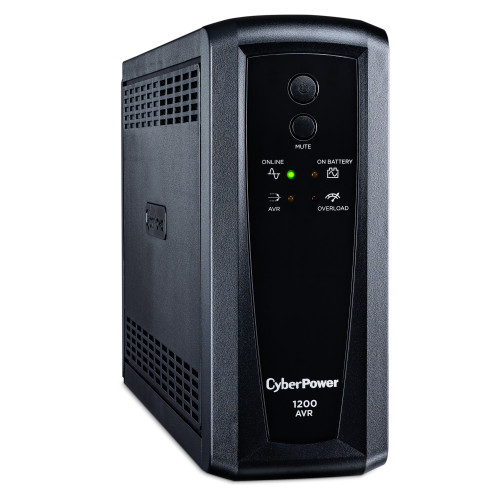
The Panduit U10S12V outputs a pure sine wave in both AC-utility and battery modes, meeting the stricter power-quality requirement of active PFC power supplies found in most contemporary servers, edge appliances, and network switches. The CyberPower CP1200AVR produces a simulated sine wave when running on battery and pure sine wave only while on utility AC. Equipment with active PFC power supplies can behave unpredictably — or shut down — when fed a simulated sine wave during a transfer event, a risk the U10S12V eliminates.
Both units are rated identically at 1200 VA / 720 W (0.6 power factor). Runtime specs are provided only for the CP1200AVR: 3 minutes at full load (720 W) and 12 minutes at half load (360 W). The U10S12V datasheet does not publish runtime figures in the provided specifications, so a direct runtime comparison cannot be made. Both list user-replaceable sealed lead-acid batteries. The CP1200AVR specifies 2 × 12 V / 7 Ah cells and a named replacement kit (RB1270X2A); the U10S12V does not disclose cell count or Ah rating.
The CP1200AVR specifies AVR boost and trim across an 88–144 VAC input window, with a transfer time of less than 10 ms typical. The U10S12V lists AVR as part of its line-interactive topology and references ANSI/IEEE C62.41 Category A and B surge protection with multi-stage EMI/RFI filtering; its transfer time and AVR regulation window are not specified in the provided data.
How does each unit physically fit into a rack, closet, or desktop deployment?
The CyberPower CP1200AVR is a mini-tower unit measuring 13.7 × 9.8 × 3.9 in (W × H × D) and weighing 21.83 lb. It is designed to stand on a desktop or floor, not rack-mount. Its ten NEMA 5-15R outlets (five battery-backed, five surge-only) with a detachable 5-ft NEMA 5-15P input cord suit a workstation or small office environment. The unit ships in black.
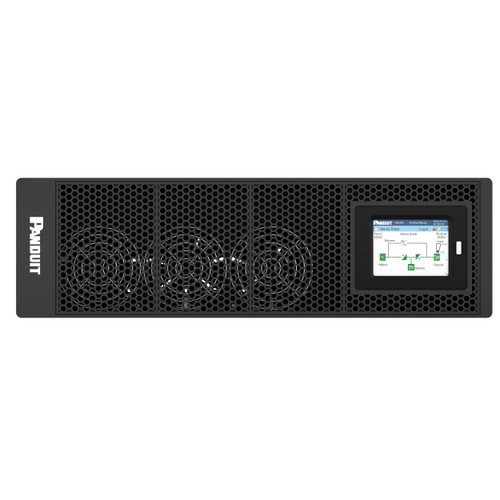
The Panduit U10S12V is described as 'rackmount-compatible compact' with dimensions of 10.3 in H × 17.3 in W (262 mm × 440 mm). At 17.3 in wide it is consistent with a 1U or 2U rack profile, though rack-unit height and depth are not stated in the provided specifications. Panduit positions it explicitly for data center, edge computing, and enterprise MTDC environments. Outlet count, outlet type, and input cord specifications are not disclosed in the provided data.
The CP1200AVR's cold-start capability is not specified. The U10S12V explicitly lists cold-start capability, which allows the UPS to power up connected equipment from battery without utility power present — a meaningful feature for remote or edge deployments where utility power may be absent during commissioning.
Which unit offers deeper monitoring, remote management, and regulatory compliance for IT environments?
The CyberPower CP1200AVR provides a USB HID-compliant interface and includes PowerPanel Personal software for Windows, macOS, and Linux — enabling graceful OS shutdown, power scheduling, and event logging from a locally connected host. Data-line protection covers RJ45 Ethernet (10/100/1000), RG6 coaxial, and RJ11 telephone lines. Its FCC rating is Part 15 Class B, which permits use in residential and light-commercial environments.
The Panduit U10S12V offers USB management as standard and an optional SNMP card for network-based monitoring and SNMP trap integration into enterprise NMS platforms. No bundled software title is named in the provided specifications. The U10S12V carries FCC Part 15 Class A certification, which is the stricter commercial/industrial emissions rating but restricts deployment in residential settings. Data-line protection offerings for the U10S12V are not specified in the provided data.
On certifications, both units hold UL 1778 and ENERGY STAR. The CP1200AVR additionally lists cUL 107.5 (Canadian), FCC Part 15 Class B, and RoHS, and carries a $300,000 connected equipment guarantee (terms apply). The U10S12V's warranty terms, connected equipment guarantee, and RoHS status are not disclosed in the provided specifications. The optional SNMP card on the U10S12V is the clear differentiator for environments requiring centralized power monitoring without a dedicated management host.
Which should you choose: the CP1200AVR or the U10S12V?
Our take: The CP1200AVR is the stronger choice when budget, desktop/tower deployment, residential or light-commercial compliance, and comprehensive data-line protection are the primary criteria. The U10S12V is the stronger choice for rack-oriented data center, edge, or MTDC deployments requiring pure sine wave output on battery, cold-start capability, optional SNMP remote management, and FCC Class A commercial compliance. Three concrete deltas: (1) output waveform — U10S12V delivers pure sine wave on battery; CP1200AVR delivers simulated sine wave on battery; (2) management ceiling — U10S12V supports optional SNMP network management; CP1200AVR is USB-local only; (3) deployment posture — CP1200AVR is a desktop mini-tower with 10 specified NEMA 5-15R outlets; U10S12V is rack-compatible with outlet count unspecified. Buyers protecting active-PFC server loads in a rack environment should favor the U10S12V; buyers protecting workstations or AV equipment in a desktop context should favor the CP1200AVR.
Side-by-Side Comparison
Spec-for-spec, from manufacturer data.
| Specification | CyberPower CP1200AVR | Panduit U10S12V |
|---|---|---|
| Capacity (VA / W) | 1200 VA / 720 W | 1200 VA / 720 W |
| Topology | Line Interactive with AVR | Line-Interactive with AVR |
| Output Waveform (battery) | Simulated Sine Wave | Pure Sine Wave |
| Output Waveform (AC utility) | Pure Sine Wave | Pure Sine Wave |
| Form Factor | Mini-Tower (desktop) | Rackmount-Compatible Compact |
| Dimensions | 13.7 × 9.8 × 3.9 in (W×H×D) | 17.3 × 10.3 in (W×H); depth not specified |
| Weight | 21.83 lb | — |
| Outlets (total / battery / surge) | 10 / 5 / 5 × NEMA 5-15R | — |
| Runtime at Half Load (360 W) | 12 min | — |
| Runtime at Full Load (720 W) | 3 min | — |
| Battery | 2 × 12 V / 7 Ah SLA, user-replaceable | SLA, user-replaceable; Ah not specified |
| Transfer Time | < 10 ms typical | — |
| Cold-Start | — | Yes |
| Management Interface | USB HID + PowerPanel Personal (Win/Mac/Linux) | USB standard; optional SNMP card |
| Data Line Protection | RJ45 (GbE), RG6 Coax, RJ11 Phone | — |
| FCC Class | Part 15 Class B (residential/commercial) | Part 15 Class A (commercial/industrial) |
| Certifications | UL 1778, cUL 107.5, FCC Pt 15 Cl B, RoHS, ENERGY STAR | UL 1778, FCC Pt 15 Cl A, ENERGY STAR |
| Connected Equipment Guarantee | $300,000 (terms apply) | — |
Frequently Asked Questions
Which should you choose: the CP1200AVR or the U10S12V?
The CP1200AVR is the stronger choice when budget, desktop/tower deployment, residential or light-commercial compliance, and comprehensive data-line protection are the primary criteria. The U10S12V is the stronger choice for rack-oriented data center, edge, or MTDC deployments requiring pure sine wave output on battery, cold-start capability, optional SNMP remote management, and FCC Class A commercial compliance. Three concrete deltas: (1) output waveform — U10S12V delivers pure sine wave on battery; CP1200AVR delivers simulated sine wave on battery; (2) management ceiling — U10S12V supports optional SNMP network management; CP1200AVR is USB-local only; (3) deployment posture — CP1200AVR is a desktop mini-tower with 10 specified NEMA 5-15R outlets; U10S12V is rack-compatible with outlet count unspecified. Buyers protecting active-PFC server loads in a rack environment should favor the U10S12V; buyers protecting workstations or AV equipment in a desktop context should favor the CP1200AVR.
Will either UPS work safely with a server that has an active PFC power supply?
The Panduit U10S12V is the safer choice for active PFC power supplies because it outputs pure sine wave in both utility and battery modes. The CyberPower CP1200AVR outputs a simulated sine wave when on battery; active PFC supplies can malfunction or shut down on simulated sine wave, so the CP1200AVR carries risk in that application.
Can I monitor and manage either UPS remotely across the network?
The Panduit U10S12V supports an optional SNMP card that enables network-based monitoring and integration with enterprise NMS platforms. The CyberPower CP1200AVR connects only via USB to a local host running PowerPanel Personal software; remote network management is not listed in its specifications.
Which unit is better suited for a data center rack installation?
The Panduit U10S12V is described as rackmount-compatible compact (17.3 in wide, 10.3 in tall) and is explicitly positioned for data center, edge computing, and enterprise MTDC environments. The CyberPower CP1200AVR is a mini-tower designed for desktop or floor placement and is not described as rack-mountable in the provided specifications.
More UPS Comparisons
- CyberPower CP1200AVR vs APC by Schneider Electric BVK1200M2
- Panduit U10S12V vs APC by Schneider Electric BVK1200M2
UPS Buying Guides
Get a Second Opinion on Your Camera Choice
Share your site layout, coverage goals, and budget. Our team will validate the camera selection, flag anything we would change, and recommend products that match the use case.