
Bosch NDS-5703-F360LE vs Hanwha QNF-8010: Specification Comparison
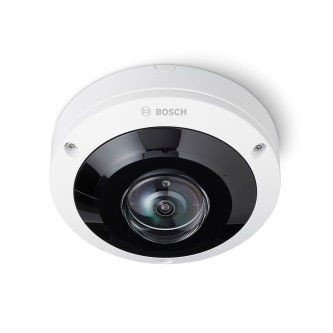
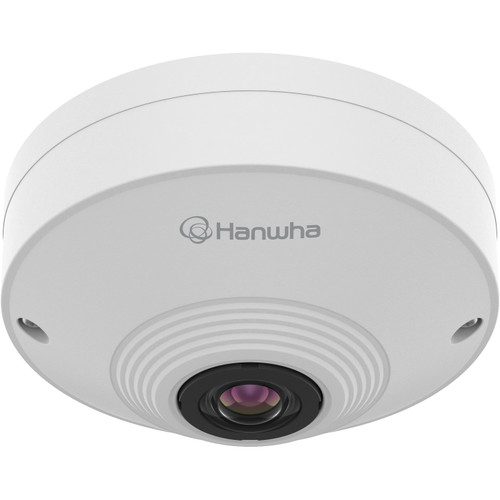
Both the Bosch NDS-5703-F360LE and Hanwha QNF-8010 are 6MP fixed-lens panoramic/fisheye network cameras sharing a 1/1.8" CMOS sensor and 360-degree coverage intent. However, they are designed for fundamentally different deployment environments and protection requirements. This comparison examines how their imaging performance, installation suitability, and integration capabilities differ so buyers can determine which aligns with their specific project requirements.
In This Guide
How do the imaging specs compare?
Both cameras use a 1/1.8" 6MP CMOS sensor at 30fps and offer 120dB Wide Dynamic Range, making them equivalent on sensor size and dynamic range. The Bosch NDS-5703-F360LE achieves a minimum illumination of 0.099 Lux color and 0.008 Lux B/W, supported by active 850nm IR illumination with a 20m throw, enabling genuine low-light and no-light capture. The Hanwha QNF-8010 specifies 0.2 Lux color at F2.5 and provides no B/W lux figure; it uses electrical day/night switching with no IR cut filter or IR emitter specified, making it unsuitable for unlit environments.
Focal lengths are nearly identical—1.155mm (Bosch) versus 1.14mm (Hanwha)—and both deliver full 360-degree panoramic fields of view. The QNF-8010 explicitly states 187° H/V/D with onboard dewarping and runs MJPEG at only 15fps versus 30fps for H.264/H.265. The NDS-5703-F360LE maintains 30fps across all three streams and adds IVA Pro and Intelligent Audio analytics. The QNF-8010 counters with WiseStream II smart codec compression, people counting, and heatmap analytics. The Bosch carries 2048MB RAM and 8192MB Flash; the Hanwha has 1024MB RAM and 256MB Flash.
What about installation and environment?
The Bosch NDS-5703-F360LE is rated IP66 and IK10, making it fully weatherproof and vandal-resistant for outdoor deployment. It operates across -40°C to +55°C (-40°F to +131°F) and holds a NEMA TS-2 rating, suitable for roadside and traffic infrastructure. It requires PoE+ (802.3at) and ships with a shielded RJ45 connector. Mounting options include wall, ceiling, pole, pendant, corner, and rack. Weight is 820g with a Ø148mm x H70mm footprint.
The Hanwha QNF-8010 is rated IP42—dust-protected and splash-resistant from vertical drips only—and no IK impact rating is specified, making it an indoor-only unit. Its operating temperature range is -10°C to +55°C (+14°F to +131°F), with no cold-environment tolerance below -10°C. It draws a maximum of 6.4W on standard PoE (802.3af, Class 3), requiring no PoE+ switch. The unit is significantly smaller and lighter at Ø99mm x H49mm and 320g, appropriate for ceiling-flush indoor installations.
Which fits your VMS and analytics better?
Both cameras support ONVIF and H.265/H.264/MJPEG compression, ensuring broad VMS compatibility. The Hanwha QNF-8010 explicitly certifies ONVIF Profile S, G, and T and adds SUNAPI (HTTP API) and the Wisenet open platform, which benefits installations already within the Hanwha/Wisenet ecosystem. Its edge analytics include people counting, heatmap, 8-zone motion detection, defocus detection, and tampering. It supports 6-zone privacy masking, 802.1X EAP-TLS/EAP-LEAP security, and unicast streaming for up to 6 simultaneous users.
The Bosch NDS-5703-F360LE offers IVA Pro video analytics and Intelligent Audio analysis—capabilities absent from the QNF-8010 spec sheet. Both provide built-in microphones and two-way audio; the Bosch additionally specifies alarm inputs/outputs for external trigger integration. The Bosch supports cloud connectivity and encrypts streams with TLS 1.2, TLS 1.3, AES 128, and AES 256. Local storage is microSD/SDHC/SDXC on both; the QNF-8010 specifies up to 256GB capacity while the Bosch does not state a maximum. The Bosch carries an NDAA compliance designation; the QNF-8010 does not list this.
Which should you choose: the NDS-5703-F360LE or the QNF-8010?
Our take: The NDS-5703-F360LE is the stronger choice when the deployment site is outdoors, requires low-light or no-light coverage, or mandates NDAA compliance. Its IP66/IK10 rating and -40°C cold-weather tolerance make it suitable for exposed or harsh environments where the QNF-8010's IP42 indoor rating and -10°C floor would fail. The Bosch's 0.099 Lux color / 0.008 Lux B/W minimum illumination with active 20m IR throws well beyond the QNF-8010's 0.2 Lux electrical-only day/night with no specified IR. The Bosch also doubles the RAM (2048MB versus 1024MB) and adds IVA Pro plus Intelligent Audio analytics. Conversely, the QNF-8010 is the rational selection for indoor environments where standard PoE (802.3af) infrastructure is already in place, WiseStream II compression matters for bandwidth control, and Wisenet VMS or SUNAPI integration is preferred. Its lighter 320g form and smaller footprint ease flush ceiling installation in commercial interiors.
Side-by-Side Comparison
Spec-for-spec, from manufacturer data.
| Specification | Bosch NDS-5703-F360LE | Hanwha QNF-8010 |
|---|---|---|
| Resolution | 6MP @ 30fps | 6MP @ 30fps (H.264/H.265); 15fps MJPEG |
| Sensor Size | 1/1.8" CMOS | 1/1.8" CMOS |
| Focal Length | 1.155mm fixed | 1.14mm fixed |
| Min. Illumination (Color) | 0.099 Lux | 0.2 Lux (F2.5, 1/30s) |
| Min. Illumination (B/W) | 0.008 Lux | — |
| IR Illumination | 850nm, 20m range | — |
| Wide Dynamic Range | 120dB | 120dB |
| Day/Night | Day/Night (IR cut filter, 850nm IR) | Auto Electrical (no mechanical ICR specified) |
| IP Rating | IP66 | IP42 |
| IK Rating | IK10 | — |
| Operating Temperature | -40°C to +55°C | -10°C to +55°C |
| Power | PoE+ (802.3at) | PoE (802.3af, Class 3, max 6.4W) |
| ONVIF | Yes | Profile S/G/T |
| NDAA Compliant | Yes | — |
| Edge Analytics | IVA Pro, Intelligent Audio | People counting, Heatmap, Motion, Defocus, Tampering |
| Environment Rating | Outdoor | Indoor |
Frequently Asked Questions
Which should you choose: the NDS-5703-F360LE or the QNF-8010?
The NDS-5703-F360LE is the stronger choice when the deployment site is outdoors, requires low-light or no-light coverage, or mandates NDAA compliance. Its IP66/IK10 rating and -40°C cold-weather tolerance make it suitable for exposed or harsh environments where the QNF-8010's IP42 indoor rating and -10°C floor would fail. The Bosch's 0.099 Lux color / 0.008 Lux B/W minimum illumination with active 20m IR throws well beyond the QNF-8010's 0.2 Lux electrical-only day/night with no specified IR. The Bosch also doubles the RAM (2048MB versus 1024MB) and adds IVA Pro plus Intelligent Audio analytics. Conversely, the QNF-8010 is the rational selection for indoor environments where standard PoE (802.3af) infrastructure is already in place, WiseStream II compression matters for bandwidth control, and Wisenet VMS or SUNAPI integration is preferred. Its lighter 320g form and smaller footprint ease flush ceiling installation in commercial interiors.
Is the NDS-5703-F360LE or QNF-8010 better for low-light performance?
The NDS-5703-F360LE is significantly better for low light. It achieves 0.099 Lux color and 0.008 Lux B/W with active 850nm IR illumination rated to 20 meters. The QNF-8010 specifies only 0.2 Lux color with electrical day/night switching and no IR emitter or B/W lux figure, making it unsuitable for poorly lit or unlit spaces.
Can the QNF-8010 be used outdoors?
No. The QNF-8010 carries an IP42 rating, which provides protection against solid objects larger than 1mm and vertically dripping water only. It is not weatherproof and is not rated for outdoor exposure. Its operating temperature also floors at -10°C. The NDS-5703-F360LE is the outdoor-capable option, rated IP66, IK10, and operational from -40°C.
Does either camera meet NDAA compliance requirements for federal or government projects?
The Bosch NDS-5703-F360LE is listed as NDAA compliant in the provided specifications. The Hanwha QNF-8010 specifications provided do not include an NDAA compliance designation. Buyers with federal procurement requirements should verify compliance status directly with each manufacturer before specifying.
Get a Second Opinion on Your Camera Choice
Share your site layout, coverage goals, and budget. Our team will validate the camera selection, flag anything we would change, and recommend products that match the use case.