
Bosch NDS-5703-F360LE vs Hanwha XNF-8010RV: Specification Comparison
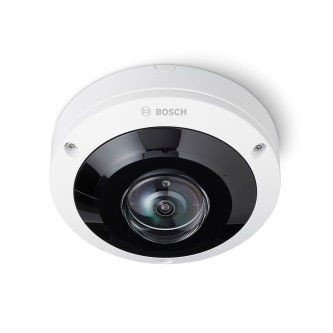
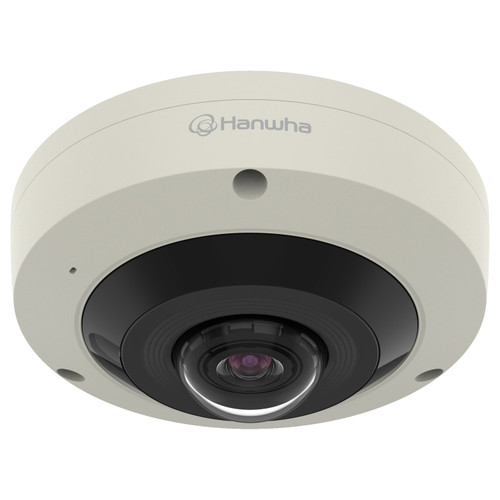
Both the Bosch NDS-5703-F360LE and Hanwha XNF-8010RV are 6MP outdoor panoramic/fisheye fixed network cameras sharing a 1/1.8" CMOS sensor, IP66/IK10 environmental ratings, and 120dB WDR. Buyers evaluating a single-mount 360-degree coverage solution in this resolution class will likely cross-shop these two. This comparison covers imaging performance, installation and environmental suitability, and VMS/analytics integration, drawing exclusively from the published specifications above.
In This Guide
How do the imaging specs compare?
Both cameras use a 1/1.8" CMOS sensor at 6MP and deliver 30fps, and both specify 120dB Wide Dynamic Range. The Bosch NDS-5703-F360LE uses a 1.155mm fixed-focus lens and achieves a minimum illumination of 0.099 Lux color / 0.008 Lux B/W, with an integrated IR range of 20m at 850nm. The Hanwha XNF-8010RV uses a 1.6mm fixed focal lens at F1.6 aperture, with a minimum illumination of 0.1 Lux color / 0 Lux IR, and an integrated IR range of 15m. The Bosch therefore offers modestly better color low-light sensitivity (0.099 vs 0.1 Lux) and a meaningfully longer IR throw (20m vs 15m).
The Hanwha XNF-8010RV specifies an angular field of view of 192° H/V/D and a 2048×2048 pixel resolution, confirming a true equidistant fisheye projection. The Bosch NDS-5703-F360LE is specified as 6MP panoramic with a 1.155mm focal length, but its exact pixel array dimensions and angular field of view are not stated in the provided specifications. The Hanwha also lists a minimum object distance of 0.3m, which is not specified for the Bosch. Hanwha adds SSNR V digital noise reduction and a Defog function; comparable noise-reduction or defog features are not enumerated in the Bosch's provided specs.
What about installation and environment?
Both cameras carry IP66 and IK10 ratings and share an operating temperature range of -40°C to +55°C (-40°F to +131°F), making them equally suited for harsh outdoor deployments. The Bosch NDS-5703-F360LE is specified with PoE+ (802.3at) power input; the Hanwha XNF-8010RV uses PoE (IEEE 802.3af, Class 3) or 12VDC, with a maximum PoE draw of 12.95W. Installers on 802.3af-only switch infrastructure have a clear path with the Hanwha; the Bosch's 802.3at requirement means a PoE+ capable switch or midspan is mandatory.
The Bosch NDS-5703-F360LE lists wall, ceiling, pole, pendant, and corner mount types, and its dimensions are Ø148mm × 70mm at 0.82kg. The Hanwha XNF-8010RV dimensions are Ø146mm × 65.8mm at 785g (1.73 lb), with mounting options not enumerated in the provided specifications. The Bosch also specifies RoHS compliance (EU 2011/65/EU and 2015/863/EU) and a NEMA TS-2 rating; the Hanwha lists EN50581, EN50121-3-2, and several EN61000-4 series EMC certifications. The Hanwha additionally specifies storage temperature down to -50°C; the Bosch's storage temperature range is not stated in the provided specifications.
Which fits your VMS and analytics better?
Both cameras support ONVIF and H.265/H.264/MJPEG compression. The Hanwha XNF-8010RV supports up to 10 simultaneous streaming profiles, ONVIF Profile S/G/T, SUNAPI, and Wisenet open platform, and its protocol list is extensive (IPv4/IPv6, SRTP, SNMPv3, PPPoE, and more). The Bosch NDS-5703-F360LE supports 3 simultaneous streams; its specific ONVIF profile conformance levels are not stated in the provided specifications, only that ONVIF is supported. The Hanwha also implements WiseStream II smart codec for bandwidth reduction; a comparable bandwidth-optimization codec is not mentioned in the Bosch specs.
For analytics, the Hanwha XNF-8010RV lists directional detection, appear/disappear, enter/exit, loitering, tampering, virtual line, audio detection, sound classification, people counting, queue management, and heatmap as on-board functions. The Bosch NDS-5703-F360LE specifies IVA Pro and Intelligent Audio analytics. Both offer on-board edge storage via microSD/SDHC/SDXC; the Hanwha provides dual microSD slots supporting up to 512GB, while the Bosch's maximum card capacity is not stated. The Hanwha includes both audio input (selectable mic/line/built-in) and audio line output; the Bosch lists a built-in microphone and two-way audio capability. Security features differ: the Hanwha enumerates 802.1X (EAP-TLS, EAP-LEAP), IP filtering, and digest authentication; the Bosch specifies TLS 1.2/1.3, AES-128/256, but equivalent 802.1X support is not listed in the provided specs.
Which should you choose: the NDS-5703-F360LE or the XNF-8010RV?
Our take: The NDS-5703-F360LE is the stronger choice when maximum IR range, PoE-budget is not a constraint, and Bosch VMS/IVA Pro analytics integration is already in the architecture. Its 20m IR throw exceeds the XNF-8010RV's 15m by 33%, its color low-light floor is 0.099 Lux versus 0.1 Lux, and it carries explicit PoE+ (802.3at) power delivery for headroom on heated housings or accessories. Conversely, the XNF-8010RV is the stronger fit when the switch infrastructure is 802.3af-only (Class 3, max 12.95W), when the VMS requires more than 3 simultaneous streams (Hanwha supports 10 profiles), or when business-intelligence analytics — people counting, queue management, heatmap — must run at the edge without a separate server. The Hanwha's dual microSD slots and broader on-board analytics suite also favor deployments where server-side processing is limited. Platform compatibility is the deciding qualifier: Bosch-ecosystem VMS environments favor the NDS-5703-F360LE; Wisenet/SUNAPI environments favor the XNF-8010RV.
Side-by-Side Comparison
Spec-for-spec, from manufacturer data.
| Specification | Bosch NDS-5703-F360LE | Hanwha XNF-8010RV |
|---|---|---|
| Resolution | 6MP | 6MP (2048×2048) |
| Image Sensor | 1/1.8" CMOS | 1/1.8" 6M CMOS |
| Lens / Focal Length | 1.155mm fixed-focus | 1.6mm fixed, F1.6 |
| Angular Field of View | Not specified | 192° H / 192° V / 192° D |
| Min. Illumination (Color) | 0.099 Lux | 0.1 Lux |
| Min. Illumination (B/W) | 0.008 Lux | 0 Lux (IR) |
| IR Range | 20m (850nm) | 15m (49.21 ft) |
| Wide Dynamic Range | 120dB | 120dB |
| Max Frame Rate | 30fps @ 6MP | 30fps |
| Video Compression | H.265, H.264, MJPEG | H.265, H.264, MJPEG |
| Simultaneous Streams | 3 | Up to 10 profiles |
| IP Rating | IP66 | IP66 |
| Impact / Vandal Rating | IK10 | IK10 |
| Operating Temperature | -40°C to +55°C (-40°F to +131°F) | -40°C to +55°C (-40°F to +131°F) |
| Power Input / PoE Class | PoE+ (802.3at) | PoE 802.3af Class 3 / 12VDC |
| Max Power Consumption | Not specified | PoE: 12.95W; 12VDC: 12W |
| Edge Storage | microSD/SDHC/SDXC (capacity not specified) | Dual microSD/SDHC/SDXC, up to 512GB |
| Audio | Built-in mic, two-way | Selectable mic/line/built-in in; line out |
| ONVIF | Yes (profile level not specified) | ONVIF Profile S/G/T |
| On-board Analytics | IVA Pro, Intelligent Audio | Directional, loitering, enter/exit, people counting, queue mgmt, heatmap, +more |
| Dimensions (Ø × H) | Ø148mm × 70mm | Ø146mm × 65.8mm |
| Weight | 0.82 kg (1.81 lb) | 785g (1.73 lb) |
| Warranty | Manufacturer warranty (duration not specified) | 3-year warranty |
| NDAA Compliant | Yes | Not specified |
Frequently Asked Questions
Which should you choose: the NDS-5703-F360LE or the XNF-8010RV?
The NDS-5703-F360LE is the stronger choice when maximum IR range, PoE-budget is not a constraint, and Bosch VMS/IVA Pro analytics integration is already in the architecture. Its 20m IR throw exceeds the XNF-8010RV's 15m by 33%, its color low-light floor is 0.099 Lux versus 0.1 Lux, and it carries explicit PoE+ (802.3at) power delivery for headroom on heated housings or accessories. Conversely, the XNF-8010RV is the stronger fit when the switch infrastructure is 802.3af-only (Class 3, max 12.95W), when the VMS requires more than 3 simultaneous streams (Hanwha supports 10 profiles), or when business-intelligence analytics — people counting, queue management, heatmap — must run at the edge without a separate server. The Hanwha's dual microSD slots and broader on-board analytics suite also favor deployments where server-side processing is limited. Platform compatibility is the deciding qualifier: Bosch-ecosystem VMS environments favor the NDS-5703-F360LE; Wisenet/SUNAPI environments favor the XNF-8010RV.
Is the NDS-5703-F360LE or XNF-8010RV better for low-light and IR coverage?
The NDS-5703-F360LE has a slight edge in both metrics: its color minimum illumination is 0.099 Lux versus the XNF-8010RV's 0.1 Lux, and its integrated IR range is 20m compared to the XNF-8010RV's 15m. For applications where IR throw distance is critical — large lobbies, parking areas, or wide courtyards — the Bosch covers a meaningfully larger radius from a single mount.
Can I power either camera from a standard 802.3af PoE switch?
The Hanwha XNF-8010RV is specified for PoE IEEE 802.3af Class 3 (max 12.95W) or 12VDC, so it is compatible with standard 802.3af switches. The Bosch NDS-5703-F360LE is specified as PoE+ (802.3at), which requires a PoE+ capable switch or midspan injector. Using a standard 802.3af switch with the Bosch is not supported per the provided specifications.
Which camera offers more on-board analytics without a separate server?
The Hanwha XNF-8010RV lists a broader on-board analytics suite including directional detection, loitering, enter/exit, virtual line, tampering, sound classification, people counting, queue management, and heatmap — all edge-resident per the specification. The Bosch NDS-5703-F360LE specifies IVA Pro and Intelligent Audio. Whether IVA Pro functions fully at the edge or requires a Bosch VMS server license is not clarified in the provided specifications, so buyers should confirm this with Bosch before deployment.
Get a Second Opinion on Your Camera Choice
Share your site layout, coverage goals, and budget. Our team will validate the camera selection, flag anything we would change, and recommend products that match the use case.