
Bosch NDS-5703-F360LE vs Hanwha XNF-8010RVM: Specification Comparison
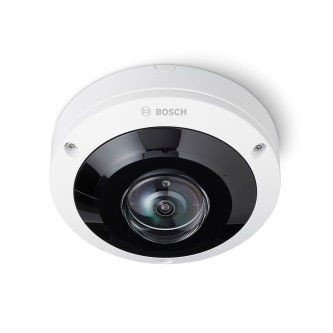
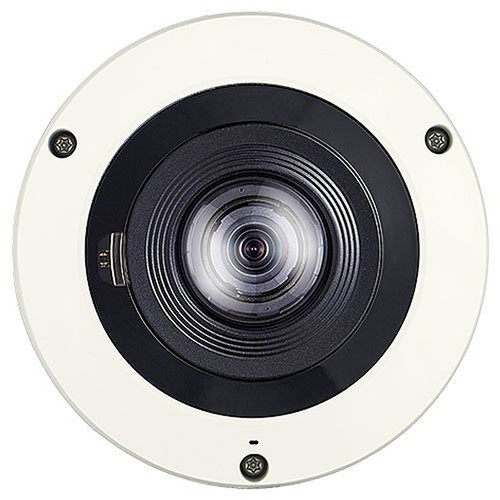
Both the Bosch NDS-5703-F360LE and the Hanwha XNF-8010RVM are 6MP outdoor-rated panoramic/fisheye IP cameras targeting single-camera wide-area coverage in security installations. Each uses a 1/1.8-inch CMOS sensor, delivers 360-degree scene capture, supports H.265/H.264/MJPEG compression, carries IP66 and IK10 ratings, and is powered via PoE. This comparison evaluates their imaging performance, physical installation requirements, and VMS/analytics integration to help installers and IT buyers select the right unit for a given deployment.
In This Guide
How do the imaging specs compare?
Both cameras share a 1/1.8-inch 6MP CMOS sensor and deliver 30 fps at full resolution, placing them in the same imaging tier. The Bosch NDS-5703-F360LE uses a 1.155mm fixed-focus lens and achieves a minimum illumination of 0.099 Lux (color) / 0.008 Lux (B&W), with integrated 850nm IR effective to 20 meters. The Hanwha XNF-8010RVM uses a 1.6mm fixed focal lens at F1.6 aperture, with a minimum illumination of 0.1 Lux (color) / 0 Lux (IR), and integrated IR rated to 15 meters. The Bosch therefore offers a slightly lower color-light threshold and a 5-meter IR advantage; the Hanwha claims 0 Lux IR operation and a wider maximum aperture.
Both cameras specify 120dB Wide Dynamic Range. The Bosch reports native 360-degree panoramic capture at 6MP; the Hanwha specifies a 2048×2048 resolution with a 192° H/V/D angular field of view in fisheye format, supporting circular, panorama, and quad-view dewarping modes. The Hanwha additionally lists digital noise reduction (SSNR V), defog support, BLC/HLC/WDR/SSDR backlight compensation modes, and selectable gain control—features whose equivalents are not enumerated in the provided Bosch spec sheet.
What about installation and environment?
Both cameras are rated IP66 and IK10, making them suitable for outdoor, vandal-resistant deployments. Both operate across an identical temperature range of -40°C to +55°C (-40°F to +131°F). Physical dimensions are close: the Bosch measures Ø148mm × 70mm at 0.82kg; the Hanwha measures Ø146mm × 65.8mm at 0.79kg—essentially the same footprint and mass.
On power, the Bosch spec sheet lists both PoE (802.3af) in the tilde fields and PoE+ (802.3at) in the underscore fields; these two entries are contradictory and buyers should confirm with the Bosch datasheet before specifying switch port budgets. The Hanwha specifies PoE IEEE 802.3af Class 3 with a stated maximum draw of 12.95W, or alternatively 12VDC at up to 12W—a dual-input option the Bosch spec sheet does not mention. The Hanwha's Ethernet connector is specified as M12; the Bosch uses a shielded RJ45. The Bosch lists wall, ceiling, pole, pendant, corner, and rack mount types; the Hanwha's mounting options are not enumerated in the provided specs.
Which fits your VMS and analytics better?
Both cameras declare ONVIF compliance. The Bosch lists ONVIF without specifying a profile level in the provided spec data. The Hanwha lists ONVIF Profile S, G, and T, plus SUNAPI (HTTP API) and the Wisenet open platform—three explicitly named integration paths. The Hanwha also enumerates an extensive protocol stack (IPv4/IPv6, RTSP, SNMPv1/v2c/v3, 802.1X EAP-TLS/EAP-LEAP, SRTP, and others) and supports up to 10 simultaneous streaming profiles. The Bosch spec sheet lists 3 multi-streams; deeper network protocol support is not itemized in the provided data.
On analytics, the Bosch lists IVA Pro and Intelligent Audio as named analytics engines. The Hanwha lists directional detection, motion detection (8 polygonal zones), appear/disappear, enter/exit, loitering, tampering, virtual line, audio detection, and sound classification, plus business intelligence functions (people counting, queue management, heatmap). Audio capabilities differ: the Bosch provides a built-in microphone with two-way audio noted in the spec; the Hanwha offers selectable mic-in/line-in/built-in mic input plus a line output (1Vrms), with G.711/G.726/AAC-LC audio compression options. Edge storage: the Bosch supports a single microSD/SDHC/SDXC slot; the Hanwha provides two microSD/SDHC/SDXC slots supporting up to 512GB total. The Bosch spec also notes NDAA compliance; no equivalent claim appears in the provided Hanwha spec data.
Which should you choose: the NDS-5703-F360LE or the XNF-8010RVM?
Our take: The XNF-8010RVM is the stronger choice when deep VMS integration, richer on-board analytics, and dual-input power flexibility are the primary requirements. The Hanwha explicitly certifies ONVIF Profile S/G/T versus Bosch's unspecified ONVIF level, provides 10 streaming profiles versus 3, offers two SD card slots (up to 512GB) versus one, and supports 12VDC as a PoE fallback. The Bosch NDS-5703-F360LE has the edge in low-light performance—0.099 Lux color versus 0.100 Lux—and in IR throw distance at 20m versus 15m, and uniquely carries a stated NDAA compliance designation, which is a hard requirement for U.S. federal and certain state/local government deployments. Buyers on Bosch VMS ecosystems or those with federal procurement constraints should favor the NDS-5703-F360LE; integrators on Wisenet/third-party VMS platforms needing broader analytics and dual-slot redundant storage will find the XNF-8010RVM the more capable platform.
Side-by-Side Comparison
Spec-for-spec, from manufacturer data.
| Specification | Bosch NDS-5703-F360LE | Hanwha XNF-8010RVM |
|---|---|---|
| Resolution | 6MP (panoramic) | 6MP / 2048×2048 |
| Image Sensor | 1/1.8" CMOS | 1/1.8" 6M CMOS |
| Lens / Focal Length | 1.155mm fixed-focus | 1.6mm fixed focal |
| Max Aperture | — | F1.6 |
| Angular FOV | 360° panoramic | H: 192° / V: 192° / D: 192° |
| Min Illumination (Color / B&W) | 0.099 Lux / 0.008 Lux | 0.1 Lux / 0 Lux (IR) |
| IR Range | 20m | 15m |
| Wide Dynamic Range | 120dB | 120dB |
| Max Frame Rate | 30fps @ 6MP | 30fps |
| Video Compression | H.265, H.264, MJPEG | H.265, H.264, MJPEG |
| Multi-Streaming | 3 streams | Up to 10 profiles |
| IP Rating | IP66 | IP66 |
| IK / Impact Rating | IK10 | IK10 |
| Operating Temperature | -40°C to +55°C | -40°C to +55°C |
| Power Input / PoE Class | PoE 802.3af (spec conflict: also lists 802.3at) | PoE 802.3af Class 3; 12VDC |
| Max Power Draw | — | 12.95W (PoE) / 12W (12VDC) |
| Ethernet Connector | Shielded RJ45 | M12 |
| Edge Storage | 1× microSD/SDHC/SDXC | 2× microSD/SDHC/SDXC up to 512GB |
| Audio | Built-in mic; two-way | Mic-in / Line-in / Built-in mic; Line out 1Vrms |
| Alarm I/O | Yes (count not specified) | 1 input / 1 output |
| ONVIF | Yes (profile not specified) | Profile S / G / T |
| Analytics | IVA Pro, Intelligent Audio | Directional, Enter/Exit, Loitering, People Counting, Heatmap, +more |
| NDAA Compliant | Yes | — |
| Dimensions (Ø × H) | Ø148mm × 70mm | Ø146mm × 65.8mm |
| Weight | 0.82kg (1.81 lb) | 0.79kg (1.74 lb) |
| Housing Color / Material | White | Ivory / Aluminum |
| Warranty | Manufacturer Warranty (duration not specified) | 3-year warranty |
Frequently Asked Questions
Which should you choose: the NDS-5703-F360LE or the XNF-8010RVM?
The XNF-8010RVM is the stronger choice when deep VMS integration, richer on-board analytics, and dual-input power flexibility are the primary requirements. The Hanwha explicitly certifies ONVIF Profile S/G/T versus Bosch's unspecified ONVIF level, provides 10 streaming profiles versus 3, offers two SD card slots (up to 512GB) versus one, and supports 12VDC as a PoE fallback. The Bosch NDS-5703-F360LE has the edge in low-light performance—0.099 Lux color versus 0.100 Lux—and in IR throw distance at 20m versus 15m, and uniquely carries a stated NDAA compliance designation, which is a hard requirement for U.S. federal and certain state/local government deployments. Buyers on Bosch VMS ecosystems or those with federal procurement constraints should favor the NDS-5703-F360LE; integrators on Wisenet/third-party VMS platforms needing broader analytics and dual-slot redundant storage will find the XNF-8010RVM the more capable platform.
Is the NDS-5703-F360LE or XNF-8010RVM better for low-light performance?
The Bosch NDS-5703-F360LE specifies a slightly lower minimum color illumination (0.099 Lux vs. 0.1 Lux for the Hanwha) and a longer IR range (20m vs. 15m). The Hanwha XNF-8010RVM claims 0 Lux IR operation and a wider maximum aperture of F1.6, which can improve passive low-light sensitivity. For scenes relying primarily on IR illumination at longer distances, the Bosch has the specified advantage; for scenes where ambient light is minimal but present, the Hanwha's 0 Lux IR claim and F1.6 aperture are relevant factors to verify against manufacturer datasheets.
Which camera is better suited for U.S. government or federally funded projects?
The Bosch NDS-5703-F360LE is listed as NDAA Compliant in the provided specifications. No equivalent NDAA compliance statement appears in the provided Hanwha XNF-8010RVM spec data. For projects subject to NDAA Section 889 or similar federal procurement restrictions, the Bosch is the camera with a declared compliance claim based on the specs provided.
Does either camera support dual-power input, and does that affect switch selection?
The Hanwha XNF-8010RVM explicitly supports both PoE (IEEE 802.3af, Class 3, max 12.95W) and 12VDC (max 12W), giving installers a direct-power fallback. The Bosch NDS-5703-F360LE spec data contains a conflict: one field lists PoE (802.3af) and another lists PoE+ (802.3at); buyers should consult the Bosch datasheet to confirm the actual PoE class before specifying switch infrastructure, as 802.3at requires a higher-budget port than 802.3af.
Get a Second Opinion on Your Camera Choice
Share your site layout, coverage goals, and budget. Our team will validate the camera selection, flag anything we would change, and recommend products that match the use case.