
Hanwha QNF-8010 vs Hanwha XNF-8010RVM: Specification Comparison
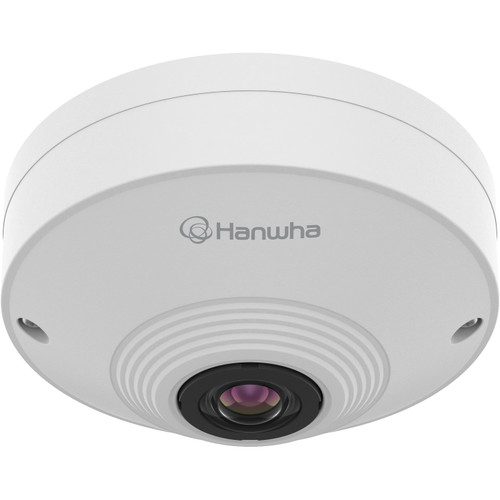
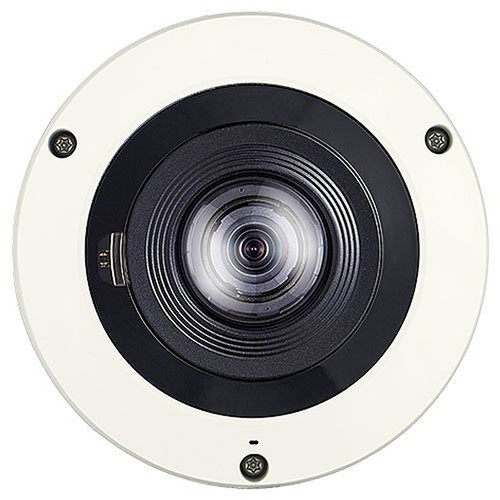
Both the Hanwha QNF-8010 and XNF-8010RVM are 6MP fisheye IP cameras sharing the same 1/1.8" CMOS sensor, 2048×2048 resolution, and 30fps frame rate — making them direct cross-shop candidates for single-camera 360° coverage deployments. The comparison centers on their divergent design targets: the QNF-8010 is a compact indoor-only ceiling unit, while the XNF-8010RVM is an IP66/IK10-rated outdoor model with integrated IR illumination, two-way audio, alarm I/O, and an M12 ruggedized connector.
In This Guide
How do the imaging specs compare?
Both cameras share the same 1/1.8" 6MP CMOS sensor delivering 2048×2048 at 30fps and 120dB WDR via SSDR/HLC/BLC/WDR modes with SSNR V noise reduction. The XNF-8010RVM pulls ahead in low-light performance: its wider F1.6 aperture and built-in 850nm IR illuminators rated to 15m (49ft) allow operation down to 0.1 lux color and 0 lux IR. The QNF-8010's F2.5 aperture produces a minimum illumination of 0.2 lux color, and while it is listed as having IR night vision, no IR distance figure is specified in its datasheet beyond a 0.3m minimum object distance.
The XNF-8010RVM uses a 1.6mm fixed focal lens yielding a 192° H/V/D field of view, while the QNF-8010 uses a 1.14mm lens for a 187° H/V/D coverage angle — a marginal 5° difference unlikely to be decisive in most deployments. The XNF-8010RVM also adds a Defog function and supports ICR-based true Day/Night switching, whereas the QNF-8010 relies on electrical (non-ICR) day/night switching. The XNF-8010RVM supports up to 10 simultaneous stream profiles; the QNF-8010 supports up to 3.
What about installation and environment?
The environmental ratings diverge sharply. The XNF-8010RVM is certified IP66 and IK10, making it suitable for outdoor installation and resistant to vandalism; its operating temperature range extends to -40°C, covering extreme cold-weather sites. It also carries EN50121-3-2:2015 railway EMC certification and a suite of EN61000 surge/ESD certifications, indicating suitability for transit and industrial environments. The QNF-8010 carries only IP42 certification and is rated for indoor use from -10°C to +55°C — not appropriate for outdoor or harsh environments.
Both cameras are PoE Class 3 (IEEE 802.3af), but their power budgets differ: the XNF-8010RVM draws up to 12.95W via PoE (or up to 12W via 12VDC, which is an additional input option the QNF-8010 lacks), while the QNF-8010 draws a maximum of 6.4W. The XNF-8010RVM uses an M12 connector for ruggedized cabling rather than the QNF-8010's standard RJ-45, requiring compatible M12 patch cables or adapters. The XNF-8010RVM is significantly larger and heavier at Ø146×65.8mm and 790g versus the QNF-8010's Ø99×49mm and 320g, and its aluminum housing replaces the plastic construction of the indoor unit.
Which fits your VMS and analytics better?
Both cameras support ONVIF Profile S/G/T, SUNAPI (Wisenet HTTP API), and the Wisenet open platform, ensuring compatibility with Hanwha's own Wisenet WAVE/SSM VMS and most third-party ONVIF-compliant systems. The XNF-8010RVM offers a substantially richer analytics suite: directional detection, appear/disappear, enter/exit, loitering, virtual line, audio detection, and sound classification, in addition to motion detection, tampering, people counting, queue management, and heatmap. The QNF-8010 is limited to people counting, heatmap, motion detection, defocus detection, and tampering.
The XNF-8010RVM adds hardware alarm I/O (1 input / 1 output), two-way audio (selectable mic/line in with built-in mic; line out at 1Vrms), and SRTP unicast support — none of which are present on the QNF-8010. Edge storage also differs: the XNF-8010RVM provides two microSD slots supporting up to 512GB total, versus one slot and 256GB on the QNF-8010. The XNF-8010RVM further adds PPPoE to its protocol list. Both share identical RAM/flash (1024MB/256MB), WiseStream II smart codec, CBR/VBR bitrate control, and the same security feature set including 802.1X (EAP-TLS, EAP-LEAP).
Which should you choose: the QNF-8010 or the XNF-8010RVM?
Our take: The QNF-8010 is the stronger choice when the deployment is strictly indoors, PoE budget is constrained, and a compact low-profile form factor is required. It draws only 6.4W maximum, weighs 320g, and fits neatly into suspended-ceiling or flush-mount indoor scenarios where IP42 protection is sufficient. The XNF-8010RVM is the required option for any outdoor, vandal-prone, or harsh-environment site: it delivers IP66/IK10 protection and -40°C cold-weather operation versus the QNF-8010's IP42 and -10°C floor, provides 15m IR illumination at 0.1 lux versus 0.2 lux with no specified IR range, and nearly doubles edge storage to 512GB across two slots. For integrators needing alarm relay I/O, two-way audio, advanced line-crossing/loitering analytics, or railway-grade EMC compliance, only the XNF-8010RVM supplies those capabilities. Platform fit is identical for both on Wisenet WAVE/SSM and ONVIF-based systems.
Side-by-Side Comparison
Spec-for-spec, from manufacturer data.
| Specification | Hanwha QNF-8010 | Hanwha XNF-8010RVM |
|---|---|---|
| Resolution | 6MP (2048×2048) | 6MP (2048×2048) |
| Image Sensor | 1/1.8" CMOS | 1/1.8" CMOS |
| Lens / Focal Length | 1.14mm fixed | 1.6mm fixed |
| Max Aperture | F2.5 | F1.6 |
| Field of View (H/V/D) | 187° / 187° / 187° | 192° / 192° / 192° |
| Min Illumination (Color) | 0.2 lux | 0.1 lux color / 0 lux IR |
| IR Range | Not specified | 15m (49ft) — 850nm |
| Day/Night Mechanism | Electrical (non-ICR) | Auto ICR |
| WDR | 120dB | 120dB |
| Max Frame Rate | 30fps | 30fps |
| Video Compression | H.265 / H.264 / MJPEG | H.265 / H.264 / MJPEG |
| Stream Profiles | Up to 3 | Up to 10 |
| IP Rating | IP42 | IP66 |
| IK / Vandal Rating | — | IK10 |
| Operating Temperature | -10°C to +55°C | -40°C to +55°C |
| Power Input | PoE IEEE 802.3af Class 3 | PoE IEEE 802.3af Class 3; 12VDC |
| Max Power Draw | 6.4W (PoE) | 12.95W (PoE) / 12W (12VDC) |
| Network Connector | RJ-45 (10/100BASE-T) | M12 |
| Edge Storage | 1× microSD — up to 256GB | 2× microSD — up to 512GB |
| Audio | — | In: selectable mic/line/built-in; Out: line 1Vrms |
| Alarm I/O | — | 1 input / 1 output |
| Analytics | People counting, heatmap, motion, defocus, tampering | Directional, appear/disappear, enter/exit, loitering, virtual line, audio detection, sound classification, people counting, queue management, heatmap, motion, tampering |
| Housing Material | Plastic | Aluminum |
| Dimensions | Ø99×49mm (Ø3.9×1.93") | Ø146×65.8mm (Ø5.75×2.59") |
| Weight | 320g (0.705 lb) | 790g (1.74 lb) |
| Environment Rating | Indoor | Outdoor |
| Warranty | 3 years | 3 years |
Frequently Asked Questions
Which should you choose: the QNF-8010 or the XNF-8010RVM?
The QNF-8010 is the stronger choice when the deployment is strictly indoors, PoE budget is constrained, and a compact low-profile form factor is required. It draws only 6.4W maximum, weighs 320g, and fits neatly into suspended-ceiling or flush-mount indoor scenarios where IP42 protection is sufficient. The XNF-8010RVM is the required option for any outdoor, vandal-prone, or harsh-environment site: it delivers IP66/IK10 protection and -40°C cold-weather operation versus the QNF-8010's IP42 and -10°C floor, provides 15m IR illumination at 0.1 lux versus 0.2 lux with no specified IR range, and nearly doubles edge storage to 512GB across two slots. For integrators needing alarm relay I/O, two-way audio, advanced line-crossing/loitering analytics, or railway-grade EMC compliance, only the XNF-8010RVM supplies those capabilities. Platform fit is identical for both on Wisenet WAVE/SSM and ONVIF-based systems.
Is the QNF-8010 or XNF-8010RVM better for low-light performance?
The XNF-8010RVM is better suited for low-light environments. Its F1.6 aperture and built-in 850nm IR LEDs rated to 15m allow operation down to 0 lux in IR mode and 0.1 lux in color mode. The QNF-8010's F2.5 aperture yields a minimum illumination of 0.2 lux color, and no IR throw distance is specified in its datasheet.
Can the QNF-8010 be used outdoors?
No. The QNF-8010 is rated IP42 and specified for indoor use only, with a lower operating temperature floor of -10°C. The XNF-8010RVM carries IP66 weatherproofing, IK10 vandal resistance, and a -40°C operating temperature rating, making it the appropriate choice for outdoor installations.
Does either camera support two-way audio or alarm I/O?
Only the XNF-8010RVM supports these features. It provides a selectable audio input (mic/line in with built-in mic), a line audio output (1Vrms max), and hardware alarm I/O (1 input, 1 output). The QNF-8010 does not list audio input/output or alarm I/O in its specifications.
Get a Second Opinion on Your Camera Choice
Share your site layout, coverage goals, and budget. Our team will validate the camera selection, flag anything we would change, and recommend products that match the use case.