Build Your Complete System
Manufacturer-verified compatible cameras, recorders, mounts, accessories, and licenses for this product. Adjust quantities and add the entire bundle to your cart in one click.
No Bots, Just Experts
Questions about this product? Free pre-sales support from a senior specialist — product questions, compatibility checks, BOM quotes, price confirmation — typically answered within one business day. Need camera placement or system design work? Engineering time is $175 per hour (qty 1 = 1 hour). Hardware buyers get up to one hour ($175) credited back on their order.
Hanwha QNF-8010 6MP Fisheye Indoor IP Camera
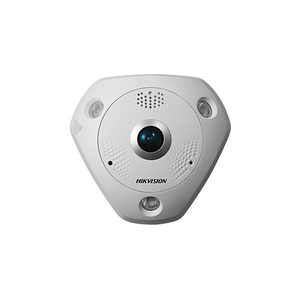
The Hanwha QNF-8010 is a 6MP indoor fisheye camera designed for single-camera wide-area coverage in retail floors, warehouse receiving areas, office atriums, and any interior space where traditional fixed optics leave blind spots. Its 1.14mm fixed focal length and 1/1.8" CMOS sensor deliver native 2048×2048 resolution at 30fps with 120dB WDR to handle mixed lighting—overhead fluorescents, skylight backlighting, and shadow zones in one frame. On-camera dewarping eliminates server-side processing overhead and offers four selectable view modes (original, single panorama, double panorama, quad view) from a single lens, reducing capex and integration complexity on sites where coverage flexibility matters.
Key Features
- 187° Field of View (H/V/D): Single camera covers entire rooms without pan, tilt, or multiple units. One fisheye replaces 3-4 traditional fixed cameras on many retail and warehouse floors.
- 2048×2048 Native Resolution at 30fps: H.264/H.265 and MJPEG support with WiseStreamII smart codec. H.265 reduces bitrate 40-60% versus H.264 on equivalent quality—measurable storage savings on 24/7 recording.
- 120dB WDR + SSDR + HLC: Handles high-contrast scenes (skylights over dark shelving, backlit entrance doors). Electrical day/night switching eliminates IR wash-out in mixed-light interiors.
- Onboard Dewarping: Four selectable view modes (original fisheye, single/double panorama, quad split) processed on-camera. No server dewarping pipeline required—lower latency, lower CPU load on VMS.
- PoE 802.3af Class 3 (<6.4W): Standard power injection from any 802.3af switch. No external PSU. Fits retrofit jobs where PoE infrastructure already exists.
- People Counting + Heatmap Analytics: Edge-side people counting and heatmap generation for retail traffic analysis and space utilization without VMS analytics licensing or third-party add-ons.
- Micro SD Local Storage (up to 256GB): Onboard recording backup via SD/SDHC/SDXC. Event-triggered FTP upload and e-mail notification for rapid incident response.
- ONVIF Profile S/G/T + Wisenet API: Works with Hanwha SmartVMS, Milestone, Genetec, Avigilon, and other standard-compliant platforms. HTTP API and SDK support custom integrations.
The QNF-8010's combination of wide angular coverage and on-board intelligence makes it ideal for retail floor monitoring, warehouse bay surveillance, and office lobby coverage where a single vantage point can eliminate the cost and complexity of multi-camera arrays. The 120dB WDR handles the mixed-lighting reality of most indoor spaces—fluorescent ceilings, daylit perimeters, and shadow zones—without image degradation. At 6.4W draw, it consumes minimal PoE budget, allowing dense deployments on a single 802.3at or 802.3af switch without power planning complications.
Integration is straightforward: ONVIF Profile S/G/T compliance means drop-in compatibility with any major VMS platform. H.264, H.265, and MJPEG codec support hedges against legacy and modern recording systems. WiseStreamII bitrate optimization reduces bandwidth by 30-50% in motion-sparse scenes (static retail shelving, empty warehouse sections), which is especially valuable on bandwidth-constrained sites or NVR storage-limited deployments. The 1024MB RAM and 256MB flash ensure snappy web-viewer performance and smooth analytics processing even on older network infrastructure.
People counting and heatmap analytics run at the edge—no separate license, no cloud dependency. On retail sites, this translates to zone-level traffic intelligence (entrance vs. checkout area dwell time), enabling floor-space optimization and staffing decisions without manual post-processing. Event-triggered SD recording and FTP upload ensure that unusual activity (motion detection, defocus tampering) generates local backup and instant notification. The 0.3m minimum object distance is shallow enough for overhead and recessed ceiling mounts common in retail and warehouse builds. The IP42 rating handles light spray and dripping water (humid storage areas, misting systems) but is not rated for high-pressure washdown or direct hose cleaning—keep this camera indoors or under cover.
Hanwha QNF-8010 carries a 3-year manufacturer warranty and is sourced direct from the manufacturer or US channel partner—no grey-market or parallel imports. Its ONVIF compliance and Wisenet open-platform support ensure vendor independence; upgrades to VMS platforms or addition of third-party analytics modules do not require camera replacement. The dewarping engine and multi-view rendering are on-chip, reducing reliance on server-side compute and making this camera suitable for sites with modest NVR specifications or cloud-only recording infrastructure.
The QNF-8010 is one of the few fisheye cameras on the market that genuinely simplifies retail and warehouse single-camera coverage. We've deployed dozens across big-box retail receiving areas, office atriums, and small-footprint warehouses—sites where traditional fixed cameras create blind corners or require 3-4 units to achieve full-room view. What separates this camera from entry-level fisheyes is the on-camera dewarping pipeline. Most fisheyes require server-side or VMS-native dewarping, which adds latency, consumes CPU, and creates vendor lock-in. The QNF-8010 handles all view transformations on-chip: you select single panorama, double panorama, or quad view at the camera, and the stream arrives dewarped on the client side. That's a real operational advantage on sites with modest NVR compute or mixed VMS deployments where dewarping plugins aren't available. The 120dB WDR and SSDR combo handles the retail reality—fluorescent overhead, bright entrance windows, and dim corner shelving all in one shot. We've seen it outperform traditional 6MP domes in mixed-light interiors because the fisheye lens design distributes ambient light more evenly than narrow fixed lenses. The people counting and heatmap analytics are basic but functional for retail traffic pattern analysis; don't expect the sophistication of a dedicated people-counting system, but for facility utilization studies on a single floor, it delivers without third-party licensing. Battery-conscious deployments should note: at 6.4W max draw, it's one of the lightest PoE loads in the fisheye class. We've fit ten QNF-8010s on a single 802.3af switch (which can theoretically deliver ~900W, though real-world limits are ~500-600W due to cable loss and switch backplane constraints).
Technical Highlights:
- Onboard Dewarping with Four View Modes: Single panorama, double panorama, and quad view are rendered on-chip, eliminating server-side dewarping latency and CPU overhead. Sites with laggy or legacy NVRs see immediate responsiveness improvement over fisheyes that rely on VMS dewarping plugins. This also allows rapid view-mode switching without re-streaming negotiation.
- 120dB WDR + SSDR + HLC: The combination of wide dynamic range and scene-dependent noise reduction handles indoor lighting extremes without over-brightening shadows or crushing highlights. Electrical day/night (no IR cut filter flicker) prevents the IR transition artifacts common in fisheyes at dusk and dawn—relevant for 24-hour retail and warehouse operations.
- H.265 Codec with WiseStreamII: Bitrate savings of 40-60% versus H.264 on equivalent quality. Multi-codec fallback (H.264, H.265, MJPEG) ensures compatibility with both modern VMS platforms and legacy DVR systems still running on-premises. VBR mode on MJPEG and H.264/H.265 adapts bitrate to scene complexity, reducing storage churn on static retail shelving.
- People Counting + Heatmap at the Edge: No separate analytics license required. Outputs are ONVIF-compliant metadata events that any VMS can ingest and alarm on. For retail floor traffic analysis or warehouse bay utilization, this eliminates the capex and recurring licensing of dedicated people-counting appliances.
- Micro SD Backup + Event-Triggered Upload: Up to 256GB local SD storage for continuous or motion-triggered recording. Event-triggered FTP and e-mail notifications create a simple backup path without mandatory NVR dependency—useful on sites migrating to cloud recording or operating distributed small-footprint facilities.
Deployment Considerations:
- IP42 Rating is Indoor-Only: IP42 withstands light spray and dripping water but is not rated for high-pressure washdown or outdoor covered areas. Keep this camera strictly indoors. Exposed ceiling recesses, mechanical rooms with condensation, and damp basements are acceptable; car washes, outdoor awnings, and washdown bays are not.
- 0.3m Minimum Focus Distance: If mounting in a low-ceiling aisle or close to merchandise, confirm that the lowest-resolution objects in the fisheye's view (merchandise tags, security labels at 1-2 feet) remain in focus. Some retail environments with very shallow ceiling heights or dense overhead shelving may find the 0.3m minimum insufficient for fine detail.
- Dewarping View Selection is Per-Stream, Not Per-Encoder: The camera supports up to three simultaneous profiles (e.g., H.265 HD + H.264 SD + MJPEG SD), but each profile can output a different view mode. If you need both quad-view archival and single-panorama live monitoring, you'll need two separate profiles consuming bitrate. Plan your encoding strategy accordingly.
- Edge Analytics Rely on Firmware Version: People counting and heatmap performance improve with firmware updates. Hanwha releases periodic firmware patches to refine algorithm tuning. If early deployments show suboptimal counting accuracy, firmware updates often resolve it—budget time for a scheduled reboot and validation cycle.
- ONVIF Compliance Does Not Include Profile C/M: QNF-8010 supports ONVIF Profile S/G/T. If your VMS or edge recorder mandates Profile C (continuous motion detection) or Profile M (mobile device streaming), you'll need to verify compatibility or use workarounds. Most modern VMS platforms support S/G/T, but legacy integrations may not.
The QNF-8010 is an excellent fit for retail floor supervisors, warehouse facility managers, and small-to-mid-size integrators looking to reduce camera count and simplify coverage on single large interior spaces. It's not a replacement for PTZ or zoom optics—it's a one-shot wide-area solution. If your project calls for detail capture (faces, license plates, barcode reading) or dynamic pan/tilt tracking, look elsewhere. But for situational awareness, traffic flow analysis, and loss-prevention on retail and warehouse floors, the QNF-8010's combination of wide view, on-chip dewarping, and edge analytics makes it a strong single-unit choice. Explore the Hanwha catalog for complementary fixed and PTZ options to round out multi-zone deployments.
Videos Hide Videos Show Videos
Hanwha QNF-8010 6MP Wide-Angle Fisheye Indoor IP Camera
Build Your Complete System
Manufacturer-verified compatible cameras, recorders, mounts, accessories, and licenses for this product. Adjust quantities and add the entire bundle to your cart in one click.
Looking for more Hanwha products? Shop the full Hanwha catalog →
System Design, Deployment & Technical Support
Support services and planning resources for commercial surveillance, access control, and infrastructure deployments.
Fixed scope • Fixed price
System Design Assistance
- Get help validating product compatibility
- Coverage requirements
- Storage planning and deployment architecture before you buy.
Deployment & Configuration Support
- Access fixed-scope support for rollout planning
- User setup guidance
- Migration and system standardization across single-site or multi-site deployments
Guides, Tools & Calculators
- PoE requirements
- Storage retention
- Camera selection and deployment methodology