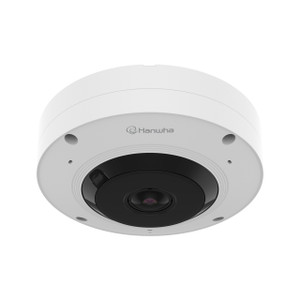
Hanwha QNF-C9010 12MP Indoor AI Fisheye Camera
The QNF-C9010 is a 12MP indoor fisheye camera designed to replace 2–3 conventional cameras by capturing a true 185° horizontal and vertical field of view from a single mounting point. This geometry eliminates blind spots in large open areas while reducing hardware count, installation labor, and network bandwidth demands. The camera pairs a 3008 × 3008 sensor with a fixed 1.76mm lens and integrated AI processing to deliver both security and operational intelligence from a single optical path.
Key Features
- 12MP Resolution (3008 × 3008): Captures enough detail to identify individuals and objects across the entire 185° field of view without needing to tile multiple camera streams. At 20 fps maximum, the camera balances frame rate with storage efficiency—adequate for most indoor monitoring scenarios without driving excessive data volumes.
- 185° Hemispherical Field of View: Covers an entire room or large open space from one location. This single-camera approach eliminates the cost and complexity of multi-camera deployments while removing coverage gaps that traditionally exist between overlapping conventional cameras.
- 120 dB extremeWDR: Handles mixed lighting—bright windows alongside shadowed corners—without overexposing highlights or losing shadow detail. Meaningful in retail, lobbies, and warehouses where direct sunlight and interior lighting create harsh contrasts.
- WiseNR II Noise Reduction: Suppresses luminance and chrominance noise in low-light scenes, preserving edge definition and texture detail without over-smoothing. Works alongside the camera's color sensitivity to maintain usable imagery in dimly lit spaces.
- 0.02 Lux Color Sensitivity: Delivers color video in near-darkness without relying on infrared, preserving clothing colors and vehicle details critical for forensic investigation and suspect identification. This low threshold reduces false-positive motion events triggered by IR reflection artifacts.
- Integrated AI Engine with Edge Analytics: Runs object detection, people counting, virtual line crossing, area monitoring, defocus alerts, and tampering detection on-board. Edge processing eliminates the need for external analytics servers, reduces latency, and minimizes bandwidth consumption on the recorder side. The camera extracts attribute metadata—clothing color, vehicle color, direction of travel—automatically, accelerating forensic search without manual frame-by-frame review.
- H.265 Compression: Reduces file sizes 40–60% compared to H.264 depending on scene complexity, directly lowering storage costs and simplifying multi-camera NVR bandwidth allocation. Particularly effective on stationary, high-resolution scenes typical of fisheye deployments.
- BestShot Image Capture: Extracts and presents the highest-quality still frames from video clips for rapid forensic review and incident documentation, eliminating the need to scrub through recorded video manually.
Deployment Context
The QNF-C9010 suits applications requiring panoramic, fixed-point monitoring: corporate lobbies, retail sales floors, educational facility common areas, warehouse receiving and storage zones, and public gathering spaces. The combination of wide coverage, AI-powered object detection, and low-light sensitivity makes it particularly valuable where single-camera placement is preferred due to architectural constraints or cost considerations. The camera's business intelligence functions—people counting, heatmapping, queue analysis—extend its role beyond security into space utilization and workflow optimization.
Integration & Compatibility
The camera delivers ONVIF-compliant video streams and integrates with standard network video recorders and VMS platforms supporting H.265 and H.264 decoding. Edge analytics output is compatible with ONVIF metadata standards, allowing third-party systems to consume detection events and attribute data. Power delivery via PoE switches eliminates the need for separate power supplies at the camera location, simplifying ceiling or wall installations.
Frequently Asked Questions
Q: Does the QNF-C9010 work with standard IP camera management software?
A: Yes. The camera outputs ONVIF-compliant H.265 and H.264 streams compatible with most commercial and open-source NVR and VMS platforms, including Milestone, Genetec, and vendor-specific systems.
Q: How does the 185° field of view translate to usable forensic image quality?
A: The 12MP sensor and 1.76mm fisheye lens deliver sufficient pixel density across the 185° view to identify individuals and read attributes (clothing color, vehicle badges) in most indoor lighting. Fisheye distortion is inherent but managed by the camera's AI engine, which accounts for lens geometry when extracting metadata.
Q: What is the frame rate, and how does it affect storage?
A: The camera supports up to 20 fps. At 12MP and 20 fps, H.265 compression typically requires 1–2 Mbps depending on scene complexity and motion levels, making 24/7 recording feasible on modest storage allocations compared to multiple conventional cameras.
Q: Does the QNF-C9010 include infrared illumination?
A: No. The camera relies on ambient light and its 0.02 lux color sensitivity for low-light operation. In complete darkness, image quality degrades. If IR capability is required, consider a different model in the Hanwha catalog with integrated IR LEDs.
Q: What are the power requirements?
A: Exact power draw from the source evidence is not specified; however, the QNF-C9010 is designed for PoE delivery and should draw within standard PoE power budgets. Consult the manufacturer datasheet or confirm with your integrator if power budget is critical.
Q: Is the AI processing performed on-board or in the cloud?
A: Analytics processing occurs on the camera's integrated edge AI engine. No cloud dependency is required; all object detection, people counting, and attribute extraction happen locally, reducing latency and bandwidth overhead.
Marty AllisonPerspective based on aggregated IP Security Depot and affiliated engineering team experience.
The QNF-C9010 represents a pragmatic choice for deployments where a single camera must cover a large open area and traditional multi-camera tiling is impractical or cost-prohibitive. The 185° hemispherical field of view genuinely eliminates the need for 2–3 conventional cameras, and at 12MP with H.265 compression, the data footprint remains manageable. The integrated AI engine performing edge-based object detection and attribute extraction—clothing color, vehicle color, direction of travel—is the real value-add here. You get forensic metadata without external analytics servers, which matters in latency-sensitive environments like retail loss prevention or warehouse safety monitoring.
Technical Highlights:
- 12MP @ 20 fps in H.265: Delivers enough resolution density to resolve faces and vehicle details across the 185° view while keeping bitrate modest (typically 1–2 Mbps). H.265 cuts storage costs roughly in half compared to H.264—material when recording 24/7 on modest NVR resources.
- 120 dB extremeWDR with 0.02 lux color sensitivity: Handles the mixed-lighting scenarios common in real indoor deployments—bright lobby windows alongside shadowed alcoves—without sacrificing color fidelity needed for suspect identification and vehicle attribute matching.
- Edge-based AI with metadata extraction: People counting, virtual line crossing, and clothing/vehicle color attribution run locally. No external GPU server required, no cloud dependency, no bandwidth surge from analytics traffic. Critical for time-sensitive investigations and real-time operational dashboards.
Deployment Considerations:
- Fisheye optical distortion is managed by the AI engine but will be visible to human operators reviewing raw video. Train your SOC staff on interpreting the geometry; some organizations find it unintuitive initially.
- No integrated infrared. In spaces with no ambient light at night, image quality drops to black or near-useless noise. If 24/7 color performance in darkness is required, this camera is not the right fit; specify an IR-equipped alternative.
- The 20 fps ceiling is adequate for most indoor monitoring but insufficient for high-speed forensic analysis (athletic events, fast-moving machinery). Accept this tradeoff or choose a higher-frame-rate conventional camera if motion resolution is critical.
Position the QNF-C9010 for retail loss prevention (people counting + clothing color for suspect matching), corporate lobby and common-area surveillance (eliminating blind spots without multi-camera infrastructure), warehouse receiving areas (wide coverage + vehicle color detection for dock operations), and educational facilities (comprehensive floor coverage with minimal hardware footprint and integrated incident analytics). Not a universal camera—it solves a specific problem: one mounting location, comprehensive coverage, edge intelligence. Use it there, and it delivers real ROI.