
Bosch NDS-5703-F360LE vs Hanwha A8014R: Specification Comparison
Both the Bosch NDS-5703-F360LE and the Hanwha XNF-A8014R are 6MP panoramic network cameras targeting single-frame wide-area surveillance, making them genuine cross-shop candidates for installers evaluating panoramic coverage solutions. The Bosch is a 360° outdoor-rated unit with long-range IR and IK10 vandal resistance, while the Hanwha is an indoor fisheye with a 185° field of view and minimal IR reach. This comparison examines imaging performance, installation fit, and VMS/analytics integration based solely on published specifications.
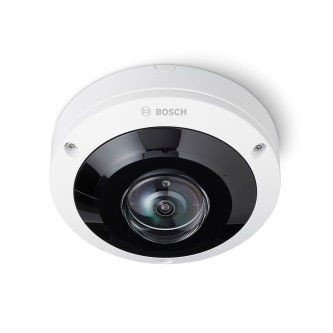
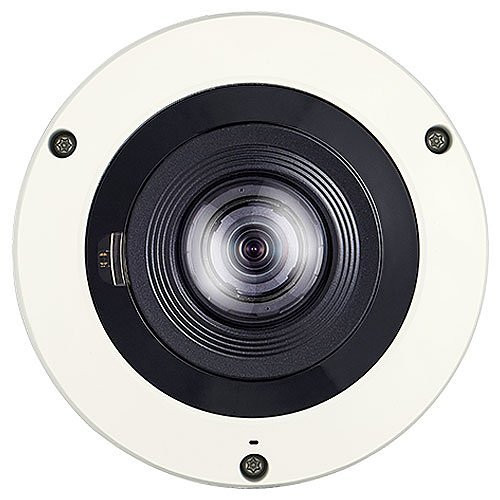
In This Guide
How do the imaging specs compare?
Both cameras deliver 6MP resolution, but their imaging architectures differ meaningfully. The Bosch NDS-5703-F360LE uses a 1/1.8" CMOS sensor with a 1.155mm fixed-focus lens and achieves 30 fps at full 6MP. Its minimum illumination is rated at 0.099 lux in color and 0.008 lux in black-and-white, with integrated 850nm IR illumination reaching 20m. Wide Dynamic Range is specified at 120dB. The Hanwha XNF-A8014R outputs a 2048×2048 resolution image through a 1.76mm fixed fisheye lens delivering a 185° horizontal and vertical field of view. Hanwha's specifications do not list a minimum illumination figure in lux, an image sensor size, or a WDR dB value — only the generic label "WDR" is noted.
The Bosch's 20m IR range is a decisive low-light advantage over the Hanwha's 0.5m IR illumination range, which is suited only for very close-proximity darkness compensation. The Bosch also states explicit Day/Night functionality with a lux floor, while the Hanwha confirms Day/Night capability and built-in IR without publishing quantitative sensitivity data. Bosch's 120dB WDR figure is directly verifiable; Hanwha's WDR claim cannot be compared numerically based on the provided specs.
What about installation and environment?
The Bosch NDS-5703-F360LE carries IP66 and IK10 ratings, qualifies for outdoor deployment, and is specified for an operating temperature range of -40°C to 55°C (-40°F to 131°F). It weighs 0.82 kg and supports wall, ceiling, pole, pendant, corner, and rack mounting. Power is supplied via PoE+ (802.3at). Its dimensions are listed as 148mm diameter × 70mm height. The Hanwha XNF-A8014R is rated IP42 — dust and splash resistant — and is designated for indoor environments only. No operating temperature range is specified in the provided Hanwha data. The Hanwha also uses PoE+ (802.3at, PoE Class 3) and weighs 2.2 lbs (approximately 1.0 kg). No mounting options are enumerated in the provided Hanwha specs.
For any outdoor, harsh-environment, or vandal-prone installation, the Bosch's IP66/IK10 rating and -40°C cold-start capability make it the unambiguous fit. The Hanwha's IP42 rating limits it to sheltered interior spaces free of direct water exposure, consistent with its 0.5m IR range suggesting close-ceiling or tabletop deployment in retail, reception, or similarly controlled environments.
Which fits your VMS and analytics better?
The Bosch NDS-5703-F360LE declares ONVIF conformance and NDAA compliance explicitly. It supports three simultaneous video streams, H.265/H.264/MJPEG compression, on-board microSD/SDHC/SDXC local storage, built-in audio input, alarm inputs/outputs, cloud connectivity, and edge analytics including IVA Pro (Intelligent Video Analysis) and Intelligent Audio. TLS 1.2, TLS 1.3, AES-128, and AES-256 encryption are specified. The Hanwha XNF-A8014R declares ONVIF compatibility, H.265 compression (with H.264 and MJPEG noted in the datasheet-derived fields), microSD local storage, and HTTPS encryption. No edge analytics package, audio capability, alarm I/O, or multi-stream count is listed in the provided Hanwha specifications.
For deployments requiring edge-based video analytics, two-way audio, or alarm integration without a separate controller, the Bosch's published feature set is substantially richer based on the available data. The Hanwha's analytics and audio capabilities — if any — are not disclosed in the provided specs and cannot be assumed.
Which should you choose: the NDS-5703-F360LE or the A8014R?
Our take: The NDS-5703-F360LE is the stronger choice when the installation is outdoors, subject to vandalism, or requires meaningful low-light coverage beyond arm's reach. Three spec deltas drive this conclusion: first, the Bosch's IR reach is 20m versus the Hanwha's 0.5m — a 40× difference that makes the Hanwha unsuitable for any space where the subject is more than a meter from the lens at night; second, the Bosch's IP66/IK10 rating versus the Hanwha's IP42 means the Bosch tolerates direct water jets and deliberate impact while the Hanwha is limited to splash-protected indoor ceilings; third, the Bosch specifies a 120dB WDR figure and a 0.099 lux color floor, whereas Hanwha provides neither metric, making low-light and contrast performance unverifiable for the A8014R. The Hanwha's 185° fisheye geometry and 2048×2048 square frame suit single-room interior overwatch at close range. Choose the Hanwha only for controlled, well-lit, indoor-only environments where a wide fisheye footprint matters more than IR range or environmental hardening.
Side-by-Side Comparison
Spec-for-spec, from manufacturer data.
| Specification | Bosch NDS-5703-F360LE | Hanwha A8014R |
|---|---|---|
| Resolution | 6MP @ 30 fps | 6MP (2048×2048) |
| Image Sensor | 1/1.8" CMOS | — |
| Lens / Focal Length | 1.155mm fixed-focus | 1.76mm fixed fisheye |
| Field of View / Type | 360° panoramic | 185° H & V fisheye |
| Min. Illumination | 0.099 lux color / 0.008 lux B/W | — |
| IR Range | 20m (850nm) | 0.5m |
| Wide Dynamic Range | 120dB | WDR (dB not specified) |
| Max Frame Rate | 30 fps @ 6MP | — |
| Video Compression | H.265, H.264, MJPEG | H.265, H.264, MJPEG |
| IP Rating | IP66 | IP42 |
| IK / Impact Rating | IK10 | — |
| Operating Temperature | -40°C to 55°C | — |
| Power Input / PoE Class | PoE+ (802.3at) | PoE+ (802.3at) / Class 3 |
| Edge Storage | microSD / SDHC / SDXC | microSD |
| Audio | Built-in microphone; two-way | — |
| Alarm I/O | Yes | — |
| Edge Analytics | IVA Pro, Intelligent Audio | — |
| ONVIF | Yes | Yes (compatible) |
| NDAA Compliant | Yes | — |
| Environment Rating | Outdoor | Indoor |
| Weight | 0.82 kg | 2.2 lbs (~1.0 kg) |
| Dimensions | Ø148mm × 70mm | — |
| Warranty | Manufacturer Warranty (term not specified) | 5-Year Warranty |
Frequently Asked Questions
Which should you choose: the NDS-5703-F360LE or the A8014R?
The NDS-5703-F360LE is the stronger choice when the installation is outdoors, subject to vandalism, or requires meaningful low-light coverage beyond arm's reach. Three spec deltas drive this conclusion: first, the Bosch's IR reach is 20m versus the Hanwha's 0.5m — a 40× difference that makes the Hanwha unsuitable for any space where the subject is more than a meter from the lens at night; second, the Bosch's IP66/IK10 rating versus the Hanwha's IP42 means the Bosch tolerates direct water jets and deliberate impact while the Hanwha is limited to splash-protected indoor ceilings; third, the Bosch specifies a 120dB WDR figure and a 0.099 lux color floor, whereas Hanwha provides neither metric, making low-light and contrast performance unverifiable for the A8014R. The Hanwha's 185° fisheye geometry and 2048×2048 square frame suit single-room interior overwatch at close range. Choose the Hanwha only for controlled, well-lit, indoor-only environments where a wide fisheye footprint matters more than IR range or environmental hardening.
Is the NDS-5703-F360LE or XNF-A8014R better for low-light surveillance?
Based on published specifications, the Bosch NDS-5703-F360LE is significantly better for low-light use. It specifies a minimum illumination of 0.099 lux in color and 0.008 lux in black-and-white, with 850nm IR illumination reaching 20m. The Hanwha XNF-A8014R does not publish a minimum lux rating and its IR illumination is specified at only 0.5m range, limiting useful IR assistance to subjects immediately beneath the camera.
Can either camera be installed outdoors?
Only the Bosch NDS-5703-F360LE is rated for outdoor use. It carries an IP66 weatherproof rating and an IK10 vandal-resistance rating, with an operating temperature range of -40°C to 55°C. The Hanwha XNF-A8014R is rated IP42, which covers dust ingress protection and splash resistance only, and its environment rating is listed as Indoor. No operating temperature range is provided for the Hanwha in the available specifications.
Which camera offers better VMS integration and on-board analytics?
The Bosch NDS-5703-F360LE provides explicit ONVIF conformance, NDAA compliance, three simultaneous streams, built-in IVA Pro and Intelligent Audio edge analytics, alarm inputs/outputs, built-in audio, and support for TLS 1.2/1.3 and AES-128/256 encryption. The Hanwha XNF-A8014R declares ONVIF compatibility and HTTPS encryption, but the provided specifications do not list any edge analytics package, audio functionality, or alarm I/O. Buyers who require analytics at the edge should verify Hanwha's capabilities directly against their specific VMS before selecting that model.
Get a Second Opinion on Your Camera Choice
Share your site layout, coverage goals, and budget. Our team will validate the camera selection, flag anything we would change, and recommend products that match the use case.