
APC by Schneider Electric SRT8KXLT-5KTF vs Vertiv GXT5LI-8000GVRT3UXLN: Specification Comparison
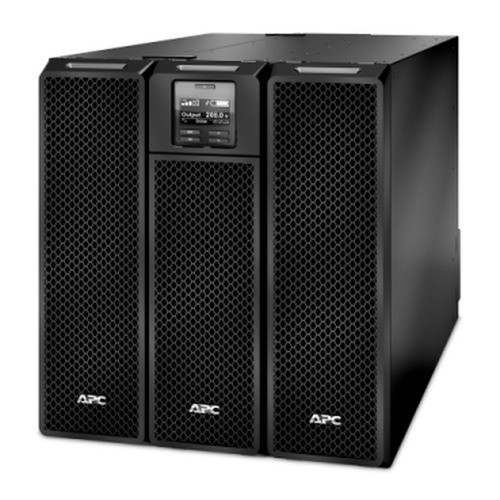
Both the APC Smart-UPS SRT8KXLT-5KTF and the Vertiv Liebert GXT5LI-8000GVRT3UXLN are 8000VA double-conversion online UPS units aimed at data center, server room, and critical IT infrastructure deployments. They share the same VA/watt class and online sine-wave topology, making them direct cross-shop candidates for buyers sizing protection for high-density rack loads. Key differentiators span input/output voltage architecture, battery chemistry (lead-acid vs. lithium-ion), physical footprint, and management integration depth.
In This Guide
- How do the input/output voltage ranges and wiring configurations affect site compatibility?
- What does battery chemistry and form factor mean for runtime, maintenance windows, and lifecycle cost?
- Which unit delivers better output power quality and management integration for IT environments?
- Which should you choose: the SRT8KXLT-5KTF or the GXT5LI-8000GVRT3UXLN?
- Side-by-Side Specs
- FAQ
How do the input/output voltage ranges and wiring configurations affect site compatibility?
The SRT8KXLT-5KTF is designed around a wider input operating range of 100–275 V, accepting 40–70 Hz, and includes an integrated 208/240V-to-120V step-down transformer in the model designation—making it suitable for North American facilities where 120V outlets must be fed from a 208V or 240V PDU or distribution panel. Its output spans 120V–240V, providing flexibility for mixed-voltage load environments.
The GXT5LI-8000GVRT3UXLN targets 200V–240V input (hardwired L1-L2/N-G), with output defaulting to 230VAC but user-configurable between 200–240VAC at ±1% regulation. It does not include a step-down transformer and is therefore not suited for sites requiring 120V output without additional transformation. Its hardwired input is a code-compliance consideration: raceway and disconnect planning is required at installation, unlike a plug-connected unit.
For North American mixed-voltage environments or retrofit deployments where 120V receptacle output is required, the SRT8KXLT-5KTF's built-in transformer is a decisive architectural advantage. For purpose-built international data centers or EU/APAC installations standardized on 200–240V, the GXT5LI-8000GVRT3UXLN's configurable output and hardwired input align directly with local electrical standards.
What does battery chemistry and form factor mean for runtime, maintenance windows, and lifecycle cost?
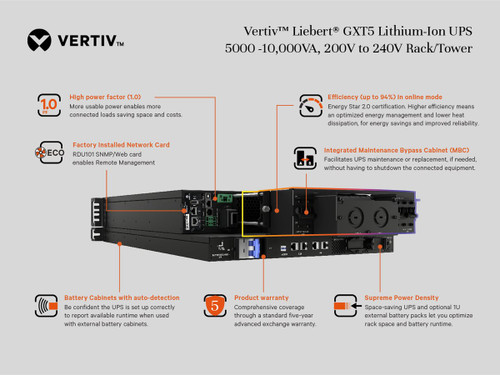
The GXT5LI-8000GVRT3UXLN is specified as a lithium-ion (Li-ion) UPS. Li-ion cells carry well-documented advantages over valve-regulated lead-acid (VRLA) in cycle life (typically 2–3× more charge cycles), weight per stored energy, and tolerance of higher ambient temperatures—the unit is rated to 40°C with a 10% derating noted at 50°C. Its 3U, 35-inch-deep chassis weighs 105 lbs. The datasheet PDF reference is present in the provided specs.
The SRT8KXLT-5KTF's battery chemistry is not explicitly stated in the provided specifications. No weight, depth, or rated operating temperature is provided for this model in the submitted data. The step-down transformer adds mass and depth not captured in the spec set. Buyers should request the SRT8KXLT-5KTF installation guide for physical dimensions and battery replacement intervals before racking.
From the specs as provided, the GXT5LI-8000GVRT3UXLN's Li-ion chemistry is a concrete, documentable differentiator for facilities prioritizing reduced replacement frequency and lower long-term battery operating expense. No equivalent battery chemistry claim can be made for the SRT8KXLT-5KTF from the data supplied.
Which unit delivers better output power quality and management integration for IT environments?
The SRT8KXLT-5KTF provides several quantified power-quality specifications: output voltage THD of 2%, a crest factor of 3:1, a surge energy rating of 480 J, and a noise level of 55 dB. It confirms web-based management, auto-restart capability, and audible alarms—all relevant to remote monitoring in unmanned equipment rooms. Waveform is confirmed as true sine.
The GXT5LI-8000GVRT3UXLN does not supply equivalent THD, crest factor, surge joule rating, or noise level figures in the provided specifications. Its agency approvals list is extensive: IEC 62040-1, IEC 62619, IEC 62040-2, IEC 61000-3-2, IEC 61000-3-12, CISPR 22 Class A, FCC Part 15 Class A, and UL 1778—which satisfies electromagnetic compatibility requirements for Class A commercial environments. Management capability, alarm features, and auto-restart are not specified in the data provided.
On the basis of the submitted specs, the SRT8KXLT-5KTF offers more quantified power-quality data points, giving specifying engineers concrete numbers for load compatibility calculations. The GXT5LI-8000GVRT3UXLN's regulatory approval list is more comprehensive, which is meaningful for facilities with EMC compliance requirements or multi-region deployments.
Which should you choose: the SRT8KXLT-5KTF or the GXT5LI-8000GVRT3UXLN?
Our take: The SRT8KXLT-5KTF is the stronger choice when the installation requires 120V output from a 208/240V feed, quantified output power quality specs, or plug-in connectivity in a North American rack environment. Its built-in step-down transformer, 2% output THD, 3:1 crest factor, 480 J surge rating, and confirmed web-based management give specifiers concrete numbers to work with. The GXT5LI-8000GVRT3UXLN counters with lithium-ion chemistry—a documented advantage in battery cycle life, weight efficiency, and high-ambient-temperature tolerance (rated to 40°C, derated to 50°C)—plus a broader agency approval set (UL 1778, IEC 62619, CISPR 22, FCC Part 15) suited to international or EMC-sensitive deployments. Its 200–240V hardwired input limits it to sites already wired for that voltage. Choose the APC for North American mixed-voltage environments needing 120V loads and granular power-quality data; choose the Vertiv for international standardized 200–240V facilities where Li-ion longevity and regulatory compliance depth are priorities.
Side-by-Side Comparison
Spec-for-spec, from manufacturer data.
| Specification | APC by Schneider Electric SRT8KXLT-5KTF | Vertiv GXT5LI-8000GVRT3UXLN |
|---|---|---|
| UPS Topology | Double-conversion (Online) | Online (Double-conversion implied by product class; not explicitly stated in specs provided) |
| Power Rating (VA) | 8000 VA | 8000 VA |
| Power Rating (Watts) | 8000 W | 8000 W |
| Input Voltage Range | 100–275 V | 200–240 V |
| Input Frequency | 40–70 Hz | — |
| Output Voltage Range | 120–240 V (with step-down transformer) | 200–240 VAC user-configurable; default 230V (±1%) |
| Output Frequency | 50/60 Hz | — |
| Waveform | Sine | — |
| Output Voltage THD | 2% | — |
| Crest Factor | 3:1 | — |
| Surge Energy Rating | 480 J | — |
| Battery Chemistry | — | Lithium-ion |
| Noise Level | 55 dB | — |
| Input Wiring | — | Hardwired (L1-L2/N-G) |
| Operating Temperature | — | 0°C–40°C (10% derating at 50°C) |
| Weight | — | 105 lbs |
| Dimensions (H × W × D) | — | 5.25 in × 16.9 in × 35 in |
| Web-Based Management | Yes | — |
| Auto-Restart | Yes | — |
| Agency Approvals | — | IEC 62040-1, IEC 62619, IEC 62040-2, IEC 61000-3-2, IEC 61000-3-12, CISPR 22 Class A, FCC Part 15 Class A, UL 1778 |
Frequently Asked Questions
Which should you choose: the SRT8KXLT-5KTF or the GXT5LI-8000GVRT3UXLN?
The SRT8KXLT-5KTF is the stronger choice when the installation requires 120V output from a 208/240V feed, quantified output power quality specs, or plug-in connectivity in a North American rack environment. Its built-in step-down transformer, 2% output THD, 3:1 crest factor, 480 J surge rating, and confirmed web-based management give specifiers concrete numbers to work with. The GXT5LI-8000GVRT3UXLN counters with lithium-ion chemistry—a documented advantage in battery cycle life, weight efficiency, and high-ambient-temperature tolerance (rated to 40°C, derated to 50°C)—plus a broader agency approval set (UL 1778, IEC 62619, CISPR 22, FCC Part 15) suited to international or EMC-sensitive deployments. Its 200–240V hardwired input limits it to sites already wired for that voltage. Choose the APC for North American mixed-voltage environments needing 120V loads and granular power-quality data; choose the Vertiv for international standardized 200–240V facilities where Li-ion longevity and regulatory compliance depth are priorities.
Can either UPS support 120V loads directly?
Only the SRT8KXLT-5KTF is specified to output 120V, by virtue of its integrated 208/240V-to-120V step-down transformer. The GXT5LI-8000GVRT3UXLN outputs 200–240VAC (default 230V) and does not include a step-down transformer; it cannot directly feed 120V equipment without additional external transformation.
Is the GXT5LI-8000GVRT3UXLN or SRT8KXLT-5KTF better for a deployment where battery replacement cost and frequency matter most?
The GXT5LI-8000GVRT3UXLN uses lithium-ion chemistry, which is specified in its product name and data. Li-ion cells generally offer more charge cycles and longer service intervals than lead-acid alternatives. The SRT8KXLT-5KTF's battery chemistry is not stated in the specifications provided, so a direct cycle-life comparison cannot be made from the available data; buyers should request that detail from APC before making a lifecycle cost decision.
Which unit has broader agency and EMC certifications?
The GXT5LI-8000GVRT3UXLN lists a wider set of documented approvals: IEC 62040-1:2008+A1 2013, IEC 62619 1st Ed., IEC 62040-2 2nd Ed., IEC 61000-3-2, IEC 61000-3-12, CISPR 22 Class A, FCC Part 15 Class A, and UL 1778. The SRT8KXLT-5KTF's agency certifications are not listed in the specifications provided, so no direct certification comparison can be made from the submitted data.
More UPS Comparisons
- APC by Schneider Electric SRT8KXLT30 vs Vertiv GXT5LI-8000MVRT4UXLN
- APC by Schneider Electric SRT8KXLT30 vs Vertiv GXT5LI-8000GVRT3UXLN
- APC by Schneider Electric SRT8KXLT30 vs APC by Schneider Electric SRT8KRMXLT-IEC
- APC by Schneider Electric DLRT8KRMXLT vs Vertiv GXT5LI-8000MVRT4UXLN
- APC by Schneider Electric DLRT8KRMXLT vs Vertiv GXT5LI-8000GVRT3UXLN
- APC by Schneider Electric DLRT8KRMXLT vs APC by Schneider Electric SRT8KRMXLT-IEC
UPS Buying Guides
Get a Second Opinion on Your Camera Choice
Share your site layout, coverage goals, and budget. Our team will validate the camera selection, flag anything we would change, and recommend products that match the use case.