
APC by Schneider Electric DLRT8KRMXLT vs Vertiv GXT5LI-8000GVRT3UXLN: Specification Comparison
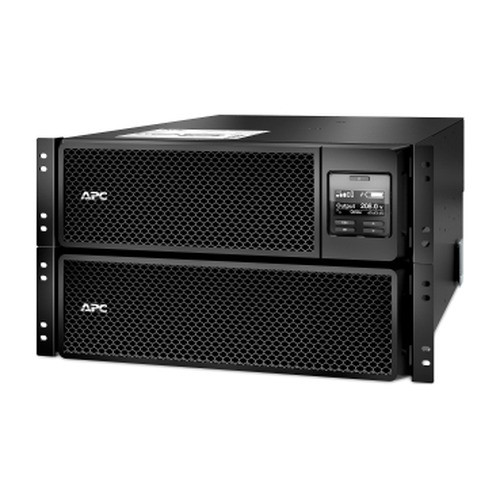
Both the APC by Schneider Electric DLRT8KRMXLT and the Vertiv Liebert GXT5LI-8000GVRT3UXLN are 8000 VA double-conversion online UPS units targeting data center, server room, and critical infrastructure deployments. The DLRT8KRMXLT is a tower/rack-convertible unit with NEMA outlet connections, while the GXT5LI-8000GVRT3UXLN is a 3U rack unit with a lithium-ion battery and hardwired input. Both deliver 8000 W of output power at comparable voltage ranges, making them genuine cross-shop candidates for IT buyers sizing a full-rack or edge-compute power protection solution.
In This Guide
- How do the input voltage range and output power specs compare for real-world installation flexibility?
- What do the battery technology, efficiency ratings, and runtime economics look like across both units?
- How do the physical footprint, environmental ratings, and agency certifications compare for rack and data center deployment?
- Which should you choose: the DLRT8KRMXLT or the GXT5LI-8000GVRT3UXLN?
- Side-by-Side Specs
- FAQ
How do the input voltage range and output power specs compare for real-world installation flexibility?
The DLRT8KRMXLT accepts a notably wider input voltage range of 100 V to 275 V at 40–70 Hz, enabling compatibility with a broader range of utility feeds, international environments, and generator sources without transfer to battery. Its output is selectable between 208 V and 240 V, with six NEMA outlets (L6-20R and L6-30R) for direct plug-in connectivity to 208 V North American rack PDUs and equipment.
The GXT5LI-8000GVRT3UXLN accepts 200 V–240 V input and defaults its output to 230 VAC, with a user-configurable range of 200–240 VAC at ±1% regulation. Input is hardwired (L1-L2/N-G), which eliminates the need for a NEMA plug and suits permanent panel-fed installations but requires licensed electrical work for connection. The output voltage regulation spec of ±1% is explicitly stated; the DLRT8KRMXLT does not specify output voltage regulation tolerance in the provided data.
For North American 208 V environments with plug-in connectivity requirements, the DLRT8KRMXLT's wider input range and NEMA outlets are direct advantages. For permanent, hardwired European or international 200–240 V installations, the GXT5LI-8000GVRT3UXLN's hardwired architecture and configurable output voltage are the more appropriate fit.
What do the battery technology, efficiency ratings, and runtime economics look like across both units?
The DLRT8KRMXLT reports an on-line mode efficiency of 94% and an ECO mode efficiency of 98%. These are the only efficiency figures provided. Battery chemistry is not specified in the provided data for the DLRT8KRMXLT; it does not carry a lithium-ion designation in its specs.
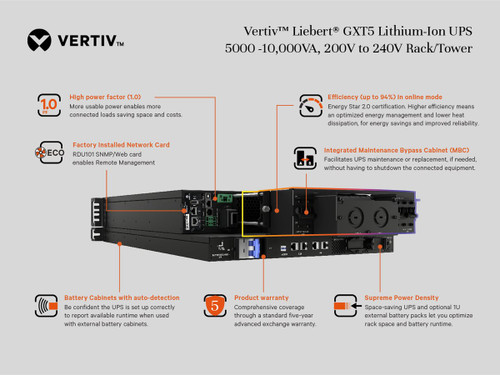
The GXT5LI-8000GVRT3UXLN explicitly uses lithium-ion battery technology, as indicated by 'LI' in the model name and the IEC 62619 1st Ed. safety certification (specific to lithium cells). Lithium-ion batteries typically offer longer cycle life, reduced weight per unit of stored energy, and faster recharge times compared to VRLA lead-acid alternatives—though the provided specs do not state runtime, battery capacity (Ah), or recharge time numerically for either unit. No efficiency figures are provided in the GXT5LI-8000GVRT3UXLN's spec set.
Buyers prioritizing a known-chemistry battery with established lithium-ion longevity characteristics will find the GXT5LI-8000GVRT3UXLN's explicit LI designation relevant. Buyers needing published efficiency figures for energy cost modeling or green building compliance will find only the DLRT8KRMXLT's 94%/98% data available from the provided specs.
How do the physical footprint, environmental ratings, and agency certifications compare for rack and data center deployment?
The GXT5LI-8000GVRT3UXLN provides explicit physical dimensions: 5.25 in (3U) height, 16.9 in width, 35 in depth, and a weight of 105 lbs. Its operating temperature range is 32°F to 104°F (0°C to 40°C), with a noted 10% derating at 50°C. Agency approvals are fully enumerated: IEC 62040-1:2008+A1 2013, IEC 62619 1st Ed., IEC 62040-2 2nd Ed., IEC 61000-3-2, IEC 61000-3-12, CISPR 22 Class A, FCC Part 15 Class A, and UL 1778.
The DLRT8KRMXLT is described as a tower/rack convertible unit but no physical dimensions, weight, rack unit count, or operating temperature range are present in the provided specifications. No agency certifications are listed in the provided data. Its surge energy rating of 480 J is stated; no equivalent spec is provided for the GXT5LI-8000GVRT3UXLN.
For rack space planning, thermal management budgeting, compliance documentation (UL, FCC, IEC), and logistics, the GXT5LI-8000GVRT3UXLN's complete physical and certification data gives installers and IT buyers the information needed without additional research. The DLRT8KRMXLT's physical and compliance specs are absent from the provided data and cannot be evaluated here.
Which should you choose: the DLRT8KRMXLT or the GXT5LI-8000GVRT3UXLN?
Our take: The GXT5LI-8000GVRT3UXLN is the stronger choice when the installation is a permanently wired 200–240 V rack environment where battery longevity, physical footprint certainty, and full agency certification documentation are required. Three concrete spec deltas support this: first, the GXT5LI-8000GVRT3UXLN explicitly uses lithium-ion chemistry (IEC 62619-certified), while the DLRT8KRMXLT's battery type is not stated in the provided data; second, the GXT5LI-8000GVRT3UXLN supplies verified physical dimensions (3U, 35 in deep, 105 lbs) and a comprehensive certification list (UL 1778, FCC Part 15, IEC 62040-1/2), none of which appear in the DLRT8KRMXLT's provided spec set; third, the DLRT8KRMXLT offers a wider input range (100–275 V) and discrete NEMA outlet connectivity (6 outlets: L6-20R/L6-30R) with published efficiency figures (94% online / 98% ECO), advantages that matter specifically for North American 208 V plug-in deployments or multi-voltage environments. Choose the DLRT8KRMXLT for flexible North American outlet-based installations; choose the GXT5LI-8000GVRT3UXLN for hardwired international or data center panel-fed racks.
Side-by-Side Comparison
Spec-for-spec, from manufacturer data.
| Specification | APC by Schneider Electric DLRT8KRMXLT | Vertiv GXT5LI-8000GVRT3UXLN |
|---|---|---|
| UPS Topology | Double-conversion (Online) | Double-conversion (Online, implied by GXT5 series) |
| Power Rating (VA) | 8000 VA | 8000 VA |
| Power Rating (W) | 8000 W | 8000 W |
| Input Voltage Range | 100 V – 275 V | 200 V – 240 V |
| Input Frequency | 40 – 70 Hz | — |
| Output Voltage | 208 V – 240 V | 230 VAC default; 200–240 VAC configurable |
| Output Voltage Regulation | — | ±1% |
| Output Frequency | 50 / 60 Hz | — |
| Waveform | Sine | — |
| Input Connection | NEMA (plug-in) | Hardwired (L1-L2/N-G) |
| Output Outlets | 6 (NEMA L6-20R, L6-30R) | — |
| Battery Technology | — | Lithium-ion |
| Efficiency (Online) | 94% | — |
| Efficiency (ECO Mode) | 98% | — |
| Surge Energy Rating | 480 J | — |
| Form Factor | Tower / Rack convertible | 3U Rack (5.25 in H × 16.9 in W × 35 in D) |
| Weight | — | 105 lbs |
| Operating Temperature | — | 32°F – 104°F (0°C – 40°C); 10% derate at 50°C |
| Agency Certifications | — | UL 1778, FCC Part 15 Class A, IEC 62040-1, IEC 62040-2, IEC 62619, IEC 61000-3-2, IEC 61000-3-12, CISPR 22 Class A |
| Audible Alarm | Yes | — |
| Auto-Restart | Yes | — |
| Surge Protection | Yes | — |
Frequently Asked Questions
Which should you choose: the DLRT8KRMXLT or the GXT5LI-8000GVRT3UXLN?
The GXT5LI-8000GVRT3UXLN is the stronger choice when the installation is a permanently wired 200–240 V rack environment where battery longevity, physical footprint certainty, and full agency certification documentation are required. Three concrete spec deltas support this: first, the GXT5LI-8000GVRT3UXLN explicitly uses lithium-ion chemistry (IEC 62619-certified), while the DLRT8KRMXLT's battery type is not stated in the provided data; second, the GXT5LI-8000GVRT3UXLN supplies verified physical dimensions (3U, 35 in deep, 105 lbs) and a comprehensive certification list (UL 1778, FCC Part 15, IEC 62040-1/2), none of which appear in the DLRT8KRMXLT's provided spec set; third, the DLRT8KRMXLT offers a wider input range (100–275 V) and discrete NEMA outlet connectivity (6 outlets: L6-20R/L6-30R) with published efficiency figures (94% online / 98% ECO), advantages that matter specifically for North American 208 V plug-in deployments or multi-voltage environments. Choose the DLRT8KRMXLT for flexible North American outlet-based installations; choose the GXT5LI-8000GVRT3UXLN for hardwired international or data center panel-fed racks.
Is the DLRT8KRMXLT or GXT5LI-8000GVRT3UXLN better for a permanent data center rack installation requiring full compliance documentation?
Based on the provided specifications, the GXT5LI-8000GVRT3UXLN is better documented for that use case. It lists UL 1778, FCC Part 15 Class A, IEC 62040-1, IEC 62040-2, IEC 62619, and EMC standards. The DLRT8KRMXLT does not include agency certifications or compliance listings in its provided spec data, so a direct comparison cannot be made on that dimension.
Which unit is easier to connect in a North American 208 V environment with existing rack PDUs?
The DLRT8KRMXLT provides six NEMA outlets (L6-20R and L6-30R), which are standard North American 208 V locking connections compatible with common rack PDUs and server power supplies. The GXT5LI-8000GVRT3UXLN uses a hardwired input (L1-L2/N-G) and does not list output outlet types in the provided specs, meaning it requires direct electrical panel wiring and a separate distribution solution for connected loads.
Does either UPS support lithium-ion batteries, and does that matter for my deployment?
Yes—the GXT5LI-8000GVRT3UXLN explicitly uses lithium-ion batteries, confirmed by its model designation and IEC 62619 1st Ed. certification (a lithium battery safety standard). Lithium-ion offers advantages in cycle life and weight, though runtime and Ah capacity are not stated in the provided specs for either unit. The DLRT8KRMXLT's battery chemistry is not specified in its provided data, so no comparison can be made on that point.
More UPS Comparisons
- APC by Schneider Electric SRT8KXLT30 vs Vertiv GXT5LI-8000MVRT4UXLN
- APC by Schneider Electric SRT8KXLT30 vs Vertiv GXT5LI-8000GVRT3UXLN
- APC by Schneider Electric SRT8KXLT30 vs APC by Schneider Electric SRT8KRMXLT-IEC
- APC by Schneider Electric DLRT8KRMXLT vs Vertiv GXT5LI-8000MVRT4UXLN
- APC by Schneider Electric DLRT8KRMXLT vs APC by Schneider Electric SRT8KRMXLT-IEC
- APC by Schneider Electric SRT8KRMXLT-IEC vs Vertiv GXT5LI-8000MVRT4UXLN
UPS Buying Guides
Get a Second Opinion on Your Camera Choice
Share your site layout, coverage goals, and budget. Our team will validate the camera selection, flag anything we would change, and recommend products that match the use case.