
APC by Schneider Electric SMT3000RMUS vs APC by Schneider Electric SMX3000LV: Specification Comparison
Both the SMT3000RMUS and SMX3000LV are APC by Schneider Electric line-interactive UPS units in the 2700 W / ~2880–3000 VA class, sharing a sine-wave output, VRLA battery chemistry, and a NEMA L5-30P input plug — making them direct cross-shop candidates for rackmount server-room and data-center edge deployments. The comparison turns on form-factor flexibility, input tolerance window, outlet count and layout, surge capacity, and site-safety features such as Emergency Power Off, all of which differ meaningfully between the two models.
In This Guide
- Which unit delivers broader input tolerance and stronger surge protection?
- How do outlet count, receptacle types, and physical form factor differ between the two models?
- Which model offers stronger site-safety and management features?
- Which should you choose: the SMT3000RMUS or the SMX3000LV?
- Side-by-Side Specs
- FAQ
Which unit delivers broader input tolerance and stronger surge protection?
The SMX3000LV accepts input voltage as low as 70 V versus the SMT3000RMUS's floor of 75 V, giving it a 5 V wider low-end tolerance before the unit switches to battery — a marginal but real advantage in facilities with known sag events. The high-end ceiling is nearly identical (153 V vs 154 V), so neither unit has a meaningful upper-voltage edge.
On surge energy absorption the gap is clearer: the SMX3000LV is rated at 540 J versus 459 J for the SMT3000RMUS — an 18% advantage. For environments where lightning-coupled transients or utility switching surges are a recurring concern, the SMX3000LV's higher joule rating provides a larger margin before clamping components are degraded.
Both models specify 5% output voltage THD and a 50/60 Hz input frequency range, so neither holds an advantage in power-quality filtering. Efficiency sits at 98% for the SMT3000RMUS and 97.5% for the SMX3000LV — a 0.5-percentage-point edge for the SMT3000RMUS that translates to fractionally lower heat output and operating cost at continuous load.
How do outlet count, receptacle types, and physical form factor differ between the two models?
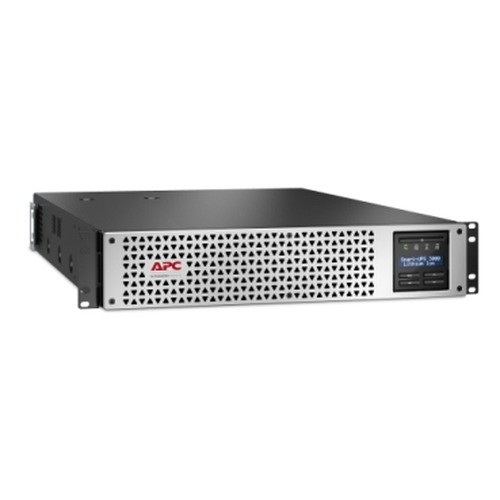
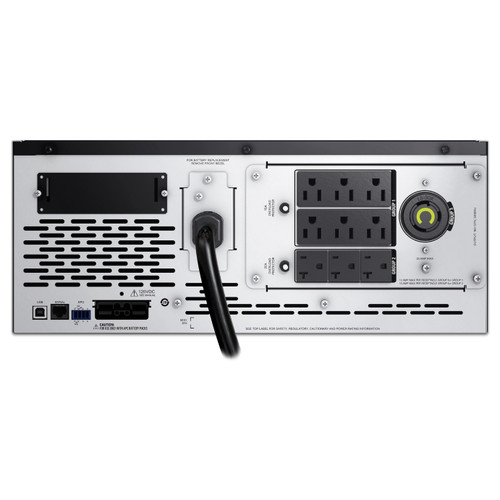
The SMT3000RMUS ships with 8 AC outlets in NEMA 5-15R and NEMA 5-20R configurations and occupies 2U of rack space. The SMX3000LV provides 10 AC outlets across NEMA 5-15R, NEMA 5-20R, and NEMA L5-30R receptacles, and is rated as a 4U rack/tower unit — meaning it can be rack-mounted or used in a tower orientation.
The addition of NEMA L5-30R outlets on the SMX3000LV is significant: those locking receptacles allow direct connection of devices with L5-30 plugs (such as PDUs or certain server PSUs) without an adapter, reducing a potential failure point. The SMT3000RMUS, limited to straight-blade outlets, would require an adapter for the same load.
The 2U versus 4U footprint is a direct trade-off: the SMT3000RMUS consumes half the rack space, which matters in dense 42U cabinets. The SMX3000LV's tower option adds placement flexibility for wiring closets or under-desk deployments where rack space is unavailable.
Which model offers stronger site-safety and management features?
The most consequential feature difference in this dimension is Emergency Power Off (EPO): the SMX3000LV specifies EPO support; the SMT3000RMUS spec does not list EPO. EPO is a code requirement in many data-center and raised-floor environments (NEC Article 645), allowing a single switch to de-energize all UPS output circuits — critical for emergency egress and fire-suppression system compatibility. Buyers in regulated or larger facilities must account for this gap.
Both units share audible alarms; however, the SMT3000RMUS specifically calls out a 'Battery replacement' alarm mode, while the SMX3000LV's spec lists audible alarms without detailing modes. Both carry a single USB 2.0 management port. Neither spec lists network (SNMP) card slots, serial ports, or relay contacts, so any intelligent monitoring would depend on separately purchased accessories not reflected in the provided specs.
The SMX3000LV spec notes support for external battery modules ('Number of batteries supported: 1' implies an external battery port), which could extend runtime beyond the base unit. The SMT3000RMUS spec lists a typical backup time of 3.4 minutes at full load but does not reference external battery expansion, and the SMX3000LV spec does not provide a baseline runtime figure — preventing a direct runtime comparison.
Which should you choose: the SMT3000RMUS or the SMX3000LV?
Our take: The SMX3000LV is the stronger choice when site-safety compliance, outlet flexibility, and surge headroom are the primary requirements. It delivers 540 J of surge protection versus 459 J on the SMT3000RMUS (+18%), adds two more AC outlets (10 vs 8) including locking NEMA L5-30R receptacles absent on the SMT3000RMUS, and uniquely offers EPO — a hard requirement in many NEC 645-governed server rooms. The SMT3000RMUS counters with a 0.5-percentage-point efficiency advantage (98% vs 97.5%), a 2U versus 4U rack footprint (critical in dense cabinets), and a specified full-load runtime of 3.4 minutes (the SMX3000LV runtime is not stated in the provided specs). Choose the SMT3000RMUS for space-constrained racks where efficiency and a known baseline runtime matter most. Choose the SMX3000LV for new data-center builds, raised-floor environments with EPO mandates, or sites that need locking L5-30R receptacles and higher surge absorption.
Side-by-Side Comparison
Spec-for-spec, from manufacturer data.
| Specification | APC by Schneider Electric SMT3000RMUS | APC by Schneider Electric SMX3000LV |
|---|---|---|
| Output Power Capacity | 2.88 kVA | 3 kVA |
| Output Power | 2700 W | 2700 W |
| Waveform | Sine | Sine |
| Input Voltage Min | 75 V | 70 V |
| Input Voltage Max | 154 V | 153 V |
| Input Frequency | 50/60 Hz | 50/60 Hz |
| Surge Energy Rating | 459 J | 540 J |
| Efficiency | 98% | 97.5% |
| Output Voltage THD | 5% | 5% |
| Emergency Power Off (EPO) | — | Yes |
| AC Outlets | 8 | 10 |
| Outlet Types | NEMA 5-15R, NEMA 5-20R | NEMA 5-15R, NEMA 5-20R, NEMA L5-30R |
| Power Plug | NEMA L5-30P | NEMA L5-30P |
| Form Factor | 2U Rackmount | 4U Rack/Tower |
| Noise Level | 55 dB | 55 dB |
| Battery Technology | Sealed Lead Acid (VRLA) | Sealed Lead Acid (VRLA) |
| Typical Backup Time (Full Load) | 3.4 min | — |
| USB 2.0 Ports | 1 | 1 |
Frequently Asked Questions
Which should you choose: the SMT3000RMUS or the SMX3000LV?
The SMX3000LV is the stronger choice when site-safety compliance, outlet flexibility, and surge headroom are the primary requirements. It delivers 540 J of surge protection versus 459 J on the SMT3000RMUS (+18%), adds two more AC outlets (10 vs 8) including locking NEMA L5-30R receptacles absent on the SMT3000RMUS, and uniquely offers EPO — a hard requirement in many NEC 645-governed server rooms. The SMT3000RMUS counters with a 0.5-percentage-point efficiency advantage (98% vs 97.5%), a 2U versus 4U rack footprint (critical in dense cabinets), and a specified full-load runtime of 3.4 minutes (the SMX3000LV runtime is not stated in the provided specs). Choose the SMT3000RMUS for space-constrained racks where efficiency and a known baseline runtime matter most. Choose the SMX3000LV for new data-center builds, raised-floor environments with EPO mandates, or sites that need locking L5-30R receptacles and higher surge absorption.
Does either UPS support Emergency Power Off (EPO) for data-center code compliance?
Yes — but only the SMX3000LV. Its spec explicitly lists EPO support, which is required under NEC Article 645 in many dedicated computer-room environments. The SMT3000RMUS spec does not include EPO, so it may not satisfy that code requirement without additional external equipment.
Can I connect devices with locking L5-30 plugs directly to either UPS?
Only the SMX3000LV provides NEMA L5-30R locking receptacles. The SMT3000RMUS is limited to straight-blade NEMA 5-15R and 5-20R outlets; connecting an L5-30 device to it would require a separate adapter not covered by either spec.
Which model takes up less rack space, and does the SMX3000LV work outside a rack?
The SMT3000RMUS is a 2U rackmount unit, consuming half the rack space of the SMX3000LV's 4U. However, the SMX3000LV is specified as a rack/tower unit, meaning it can be oriented as a tower for wiring-closet or floor placement without a rack — an option the rackmount-only SMT3000RMUS does not provide.
More UPS Comparisons
- APC by Schneider Electric SMT3000RMUS vs APC by Schneider Electric SMTL3000RM2UC
- APC by Schneider Electric SMTL3000RM2UC vs APC by Schneider Electric SMX3000LV
UPS Buying Guides
Get a Second Opinion on Your Camera Choice
Share your site layout, coverage goals, and budget. Our team will validate the camera selection, flag anything we would change, and recommend products that match the use case.