
APC by Schneider Electric SMT3000RMUS vs APC by Schneider Electric SMTL3000RM2UC: Specification Comparison
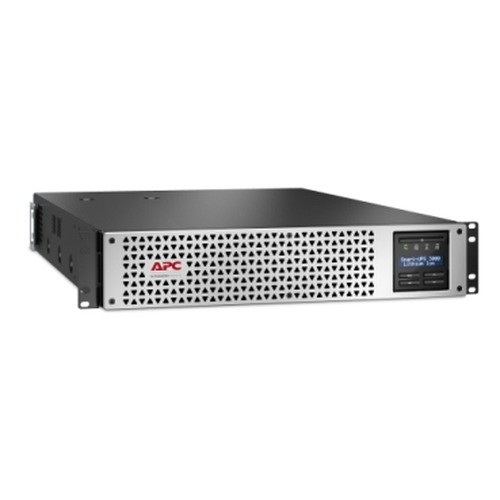
Both the SMT3000RMUS and SMTL3000RM2UC are APC by Schneider Electric 2U rackmount, line-interactive UPS units rated at 2,880 VA / 2,700 W output, designed for protecting IT and physical-security rack equipment in data closets and server rooms. The comparison covers runtime and power conditioning, input voltage tolerance and connectivity, and efficiency with audible alarm features—the three axes that most directly affect deployment suitability in a 1U/2U rack environment drawing continuous loads.
In This Guide
- How does each UPS perform on runtime, waveform quality, and output power conditioning?
- Which unit accepts a wider input voltage range, and how do their connectivity options compare?
- How do efficiency ratings, noise output, and audible alarm features compare between the two units?
- Which should you choose: the SMT3000RMUS or the SMTL3000RM2UC?
- Side-by-Side Specs
- FAQ
How does each UPS perform on runtime, waveform quality, and output power conditioning?
Both units deliver identical rated output power of 2,700 W and share the same pure sine-wave waveform, which is critical for protecting sensitive electronics such as IP cameras, NVRs, and managed switches that require clean AC. Output voltage THD is specified at 5% on both models.
The SMT3000RMUS provides a specified typical backup time of 3.4 minutes at full load. No equivalent runtime figure is listed in the SMTL3000RM2UC specifications, so a direct runtime comparison cannot be made from the data provided. Buyers requiring a confirmed runtime figure should request that data from APC directly for the SMTL3000RM2UC.
The SMTL3000RM2UC specifies its output voltage regulation at 5% and defines a fixed 120 V output range (min 120 V / max 120 V), indicating tightly regulated output under AVR. The SMT3000RMUS does not list output voltage min/max or a voltage regulation figure in the provided specs.
Which unit accepts a wider input voltage range, and how do their connectivity options compare?
Input voltage tolerance is a key differentiator. The SMT3000RMUS accepts input from 75 V to 154 V—a window of 79 V. The SMTL3000RM2UC accepts 82 V to 144 V—a window of 62 V. The SMT3000RMUS therefore tolerates lower sag (75 V vs. 82 V) and higher surge (154 V vs. 144 V) without switching to battery, which extends battery life in environments with chronic voltage fluctuation.
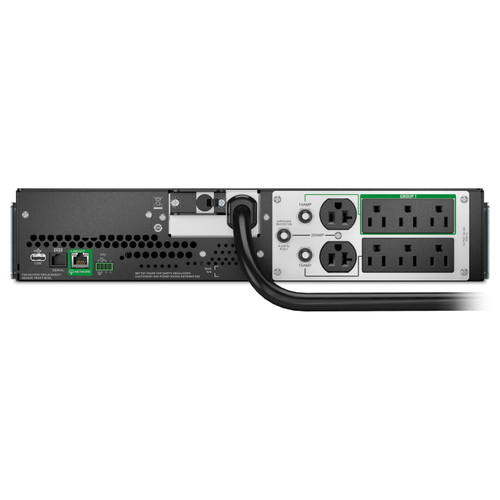
For connectivity, the SMT3000RMUS specifies a USB 2.0 port (quantity: 1) and its power plug is a NEMA L5-30P twist-lock connector. The SMTL3000RM2UC notes a USB port is present but does not specify USB version or power-plug type in the provided specs. Both units offer 8 AC outlets with NEMA 5-15R and NEMA 5-20R receptacles.
The SMT3000RMUS lists a surge energy rating of 459 J. The SMTL3000RM2UC matches this at 459 J. Neither specification set includes network management card slot details or SmartSlot information, so remote management capability cannot be compared from the data provided.
How do efficiency ratings, noise output, and audible alarm features compare between the two units?
Efficiency is a meaningful operating cost factor for always-on UPS hardware. The SMT3000RMUS is rated at 98% efficiency; the SMTL3000RM2UC is rated at 96%. A 2-percentage-point difference at 2,700 W continuous output translates to approximately 54 W of additional heat dissipation for the SMTL3000RM2UC under full load—relevant in thermally constrained enclosures.
Both units specify a noise level of 55 dB, making them acoustically equivalent for shared office or data-closet deployments where noise is a concern.
The SMT3000RMUS explicitly lists audible alarms as present, with a documented alarm mode of 'Battery replacement.' The SMTL3000RM2UC does not list audible alarm types or modes in the provided specifications. This does not mean alarms are absent, but the capability cannot be confirmed or compared from the available data.
Which should you choose: the SMT3000RMUS or the SMTL3000RM2UC?
Our take: The SMT3000RMUS is the stronger choice when input voltage stability is poor and efficiency matters most. It tolerates a wider input voltage window (75–154 V vs. 82–144 V), runs at 98% efficiency versus the SMTL3000RM2UC's 96%—saving roughly 54 W of wasted heat at full load—and provides a confirmed full-load runtime of 3.4 minutes, a figure absent from the SMTL3000RM2UC spec sheet. The SMTL3000RM2UC, by contrast, specifies a tighter regulated output voltage (fixed 120 V ±5%) and lists a nominal 3 kVA capacity label versus 2.88 kVA for the SMT3000RMUS, though both share the same 2,700 W real-power ceiling. The SMTL3000RM2UC is better suited to environments where output voltage regulation precision is the primary requirement and input conditions are relatively stable. The SMT3000RMUS fits deployments on brownout-prone circuits or where the NEMA L5-30P twist-lock input plug matches existing PDU infrastructure.
Side-by-Side Comparison
Spec-for-spec, from manufacturer data.
| Specification | APC by Schneider Electric SMT3000RMUS | APC by Schneider Electric SMTL3000RM2UC |
|---|---|---|
| UPS Topology | Line-Interactive | Line-Interactive |
| Output Power Capacity | 2.88 kVA | 3 kVA |
| Output Power | 2700 W | 2700 W |
| Waveform | Sine | Sine |
| Input Voltage Min | 75 V | 82 V |
| Input Voltage Max | 154 V | 144 V |
| Input Voltage Window | 79 V | 62 V |
| Input Frequency | 50/60 Hz | 50/60 Hz |
| Output Voltage THD | 5% | 5% |
| Output Voltage Regulation | — | 5% |
| Efficiency | 98% | 96% |
| Surge Energy Rating | 459 J | 459 J |
| Noise Level | 55 dB | 55 dB |
| AC Outlets | 8 (NEMA 5-15R, NEMA 5-20R) | 8 (NEMA 5-15R, NEMA 5-20R) |
| Power Plug | NEMA L5-30P | — |
| USB Port | USB 2.0 x1 | Yes (version not specified) |
| Battery Technology | Sealed Lead Acid (VRLA) | — |
| Typical Runtime at Full Load | 3.4 min | — |
| Audible Alarm | Yes (Battery replacement mode) | — |
Frequently Asked Questions
Which should you choose: the SMT3000RMUS or the SMTL3000RM2UC?
The SMT3000RMUS is the stronger choice when input voltage stability is poor and efficiency matters most. It tolerates a wider input voltage window (75–154 V vs. 82–144 V), runs at 98% efficiency versus the SMTL3000RM2UC's 96%—saving roughly 54 W of wasted heat at full load—and provides a confirmed full-load runtime of 3.4 minutes, a figure absent from the SMTL3000RM2UC spec sheet. The SMTL3000RM2UC, by contrast, specifies a tighter regulated output voltage (fixed 120 V ±5%) and lists a nominal 3 kVA capacity label versus 2.88 kVA for the SMT3000RMUS, though both share the same 2,700 W real-power ceiling. The SMTL3000RM2UC is better suited to environments where output voltage regulation precision is the primary requirement and input conditions are relatively stable. The SMT3000RMUS fits deployments on brownout-prone circuits or where the NEMA L5-30P twist-lock input plug matches existing PDU infrastructure.
Which unit—SMT3000RMUS or SMTL3000RM2UC—handles brownouts better?
Based on the provided specifications, the SMT3000RMUS handles a wider input voltage range (75 V–154 V) compared to the SMTL3000RM2UC (82 V–144 V). That 7 V lower sag floor means the SMT3000RMUS will continue regulating utility power through deeper brownouts before switching to battery, which preserves battery cycle life in chronically unstable utility environments.
Do both UPS units support pure sine-wave output for sensitive network equipment?
Yes. Both the SMT3000RMUS and SMTL3000RM2UC are specified with a sine waveform output and 5% output voltage THD. Either unit is appropriate for protecting sine-wave-sensitive loads such as active PFC power supplies found in modern servers, NVRs, and managed switches.
Is there a meaningful difference in operating efficiency between the SMT3000RMUS and the SMTL3000RM2UC?
Yes. The SMT3000RMUS is rated at 98% efficiency versus 96% for the SMTL3000RM2UC. At continuous full load (2,700 W), that 2-point gap equals approximately 54 W of additional heat generated by the SMTL3000RM2UC. Over a full year of 24/7 operation this adds roughly 473 kWh of extra energy consumption—a tangible operating cost and thermal load difference for densely populated racks.
More UPS Comparisons
- APC by Schneider Electric SMT3000RMUS vs APC by Schneider Electric SMX3000LV
- APC by Schneider Electric SMTL3000RM2UC vs APC by Schneider Electric SMX3000LV
UPS Buying Guides
Get a Second Opinion on Your Camera Choice
Share your site layout, coverage goals, and budget. Our team will validate the camera selection, flag anything we would change, and recommend products that match the use case.