
APC by Schneider Electric GVMPB160KHS vs APC by Schneider Electric GVMSB160KG65S: Specification Comparison
Both the GVMPB160KHS and GVMSB160KG65S are APC by Schneider Electric Galaxy VM series three-phase, double-conversion online UPS systems rated at 160 kVA, placing them in the same large-scale critical-power class. Despite sharing a platform family and capacity rating, they differ in input/output voltage configuration, installation topology, interrupt-current rating, and available spec disclosures. This comparison is intended for data-center engineers and electrical contractors evaluating which unit fits a specific facility's voltage infrastructure, fault-current exposure, and management requirements.
In This Guide
- How do the input/output voltage ratings and power architecture differ between the GVMPB160KHS and GVMSB160KG65S?
- What are the environmental and physical installation constraints for each unit?
- Which unit offers more management and connectivity capability?
- Which should you choose: the GVMPB160KHS or the GVMSB160KG65S?
- Side-by-Side Specs
- FAQ
How do the input/output voltage ratings and power architecture differ between the GVMPB160KHS and GVMSB160KG65S?
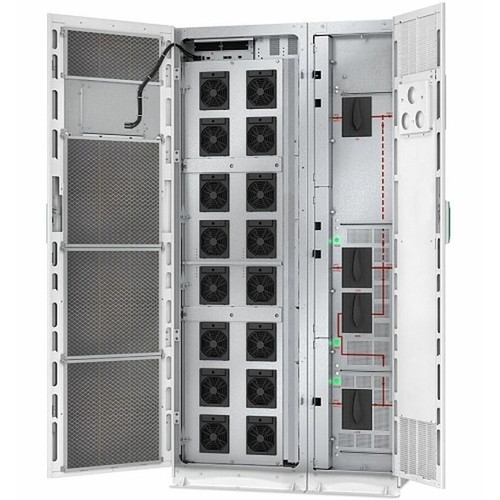
The GVMPB160KHS is specified for a 400 V input / 400 V output configuration, with an unusually wide input operating range of 250 V–600 V and an output band of 380 V–415 V, making it well-suited to European and international 400 V distribution systems. Output power is explicitly stated as 144,000 W (144 kW), yielding a power factor of 0.90. Input frequency acceptance spans 40–70 Hz, providing tolerance for generator sources that may drift from nominal. The product name includes 'with Backfeed,' indicating integrated backfeed protection is part of the unit's hardware specification.
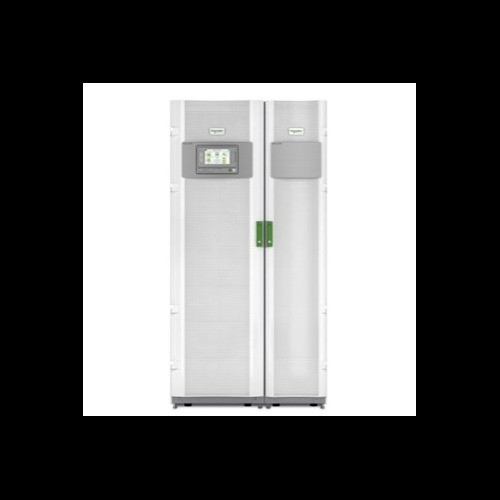
The GVMSB160KG65S is specified for a 480 V input / 480 V output topology, which is the North American large-facility standard. Its max power draw is listed as 160,000 W. The '65kAIC' designation in the product name indicates a 65 kA interrupting current rating, a critical parameter for fault-current coordination in high-fault-current services. No output voltage band, input voltage range, or input frequency tolerance is provided in the available specifications for Product B, limiting direct comparison on those axes.
What are the environmental and physical installation constraints for each unit?
For the GVMPB160KHS, the available specifications do not disclose operating temperature range, humidity range, or altitude rating. The noise level is stated as 65 dB. No form factor designation is provided, and the unit is described as a parallel-capable system ('Parallel' in the product name), implying it is designed for N+1 or parallel-redundant configurations across multiple physical frames.
The GVMSB160KG65S provides a full environmental envelope: operating temperature 0 °C–65 °C, relative humidity 5 %–95 %, and altitude up to 1,000 m. The form factor is listed as 0U, half-depth, which is a meaningful physical-footprint differentiator for constrained floor-plan data centers or retrofit installations. Noise level is 55 dBA, 10 dB lower than the GVMPB160KHS's stated 65 dB. The product name specifies 'Single,' meaning it is not configured for parallel operation in this SKU.
Which unit offers more management and connectivity capability?
The GVMPB160KHS explicitly lists web-based management and audible alarms as included features. Output connection types are specified as Hard Wire 4-wire (3PH + G) and Hard Wire 5-wire (3PH + N + G) via a terminal power plug, which is the standard for hardwired critical-power integration. Input power factor is listed as 1.0, and output voltage THD is stated at 3%, both relevant to downstream load compatibility and generator sizing.
The GVMSB160KG65S lists one network interface with a 1000BASE-T (Gigabit Ethernet) management interface, which is a concrete connectivity specification not disclosed for Product A. However, the available specs for Product B do not confirm web-based management software, output connection types, output THD, or input power factor. The 1000BASE-T interface suggests network card inclusion, but the management feature set beyond that is not specified in the provided data.
Which should you choose: the GVMPB160KHS or the GVMSB160KG65S?
Our take: The GVMPB160KHS is the stronger choice when the installation is a 400 V three-phase European or international distribution system requiring parallel-redundant UPS topology, backfeed protection, and verified power-quality output. Key differentiators: its output power is explicitly confirmed at 144 kW (0.90 PF) versus the GVMSB160KG65S's unspecified real-power figure; it documents output voltage THD at 3% and input power factor at 1.0, specs absent from Product B; and it supports parallel configuration while Product B is single-unit only. Conversely, the GVMSB160KG65S is the appropriate selection for 480 V North American facilities requiring a 65 kAIC fault-current-rated unit with a documented half-depth 0U footprint, a cooler 55 dBA noise floor, and a defined environmental envelope (0–65 °C, 5–95 % RH, 1,000 m altitude). Choose the GVMPB160KHS for European/international 400 V parallel installations; choose the GVMSB160KG65S for North American 480 V single-frame deployments in space-constrained or high-fault-current services.
Side-by-Side Comparison
Spec-for-spec, from manufacturer data.
| Specification | APC by Schneider Electric GVMPB160KHS | APC by Schneider Electric GVMSB160KG65S |
|---|---|---|
| UPS Topology | Double-conversion (Online) | — |
| Rated Capacity | 160 kVA | 160 kVA |
| Output Real Power | 144,000 W (144 kW) | 160,000 W (max power draw) |
| Input Voltage Range | 250 V – 600 V | — |
| Input/Output Voltage Config | 400 V / 400 V | 480 V / 480 V |
| Output Voltage Band | 380 V – 415 V | — |
| Input Frequency Range | 40 – 70 Hz | — |
| Output Frequency | 50 / 60 Hz | — |
| Input Power Factor | 1.0 | — |
| Output Voltage THD | 3 % | — |
| Fault-Current Rating (AIC) | — | 65 kA |
| Topology / Redundancy | Parallel-capable | Single |
| Backfeed Protection | Included (per product name) | — |
| Form Factor | — | 0U, half-depth |
| Noise Level | 65 dB | 55 dBA |
| Network Management Interface | Web-based management (Yes) | 1000BASE-T (Gigabit Ethernet) |
| Operating Temperature | — | 0 °C – 65 °C |
| Operating Humidity | — | 5 % – 95 % |
| Operating Altitude | — | 1,000 m |
| AC Outlet / Connection Type | Hard Wire 4-wire (3PH+G); Hard Wire 5-wire (3PH+N+G) | — |
| Audible Alarm | Yes | — |
Frequently Asked Questions
Which should you choose: the GVMPB160KHS or the GVMSB160KG65S?
The GVMPB160KHS is the stronger choice when the installation is a 400 V three-phase European or international distribution system requiring parallel-redundant UPS topology, backfeed protection, and verified power-quality output. Key differentiators: its output power is explicitly confirmed at 144 kW (0.90 PF) versus the GVMSB160KG65S's unspecified real-power figure; it documents output voltage THD at 3% and input power factor at 1.0, specs absent from Product B; and it supports parallel configuration while Product B is single-unit only. Conversely, the GVMSB160KG65S is the appropriate selection for 480 V North American facilities requiring a 65 kAIC fault-current-rated unit with a documented half-depth 0U footprint, a cooler 55 dBA noise floor, and a defined environmental envelope (0–65 °C, 5–95 % RH, 1,000 m altitude). Choose the GVMPB160KHS for European/international 400 V parallel installations; choose the GVMSB160KG65S for North American 480 V single-frame deployments in space-constrained or high-fault-current services.
Can either of these units be paralleled for redundancy?
Only the GVMPB160KHS is specified for parallel operation — the product name explicitly states 'Parallel' and the unit includes backfeed protection consistent with a parallel-capable design. The GVMSB160KG65S is designated 'Single' in its product name, and its available specifications do not describe parallel capability.
Which unit is rated for higher fault-current environments?
The GVMSB160KG65S carries a 65 kAIC interrupting current rating, stated in its product name and SKU. The GVMPB160KHS specifications do not disclose an AIC or short-circuit current rating, so a direct numeric comparison cannot be made from the available data.
Is the GVMPB160KHS or GVMSB160KG65S better suited to a North American 480 V data center?
The GVMSB160KG65S is specifically configured for 480 V input/output, which is the North American large-facility standard. The GVMPB160KHS is configured for 400 V input/output and is suited to European or international 400 V distribution. Installing the GVMPB160KHS in a 480 V facility would require infrastructure changes not supported by its stated output voltage range of 380 V–415 V.
Get a Second Opinion on Your Camera Choice
Share your site layout, coverage goals, and budget. Our team will validate the camera selection, flag anything we would change, and recommend products that match the use case.