
Aiphone NI-JA vs Aiphone IX-SSA: Specification Comparison
Both the Aiphone NI-JA and Aiphone IX-SSA are outdoor audio door stations designed for access-control entry points — the same product class a buyer would evaluate side by side. The NI-JA is an analog, wired station built for Aiphone's NI-series master-station ecosystem, while the IX-SSA is an IP/SIP-based station that rides a standard network infrastructure with PoE power. The comparison centers on network architecture, environmental resilience, and system integration depth.
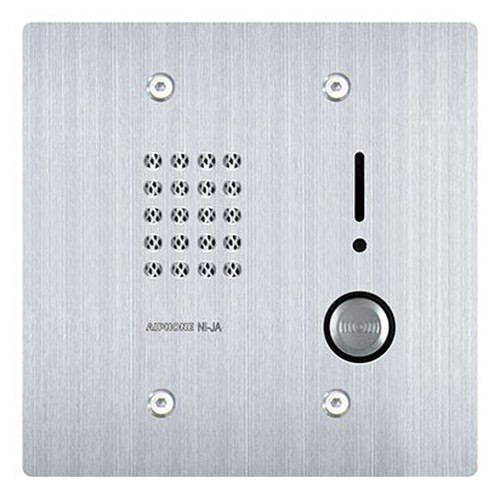

In This Guide
- How do the NI-JA and IX-SSA differ in communication architecture and protocol support?
- Which station offers stronger environmental and vandal protection for harsh outdoor installations?
- How do the two stations compare on power delivery, I/O, and system integration flexibility?
- Which should you choose: the NI-JA or the IX-SSA?
- Side-by-Side Specs
- FAQ
How do the NI-JA and IX-SSA differ in communication architecture and protocol support?
The NI-JA is a purely analog station. It communicates over a dedicated 3-conductor shielded cable (18 AWG, Aiphone #821803) up to a specified maximum run of 650 feet. No IP address, no SIP registration, no network switch is involved. Audio is hands-free and two-way, but no codec standard is published in the provided specs.
The IX-SSA is a full IP station supporting SIP, enabling registration with any SIP-compliant call server or IP PBX in addition to Aiphone IX-series hardware. Published audio codecs are G.711 and G.722 (wideband). The protocol stack covers IPv4, IPv6, TCP, UDP, HTTP, HTTPS, RTSP, RTP, RTCP, IGMP, MLD, SMTP, SFTP, DHCP, NTP, and DNS. Port security extends to IEEE 802.1x for network authentication. Maximum communication distance is not stated as a cable-run figure; it is bounded instead by the IP network infrastructure.
For buyers already running IP networks, the IX-SSA integrates without a separate cable home-run to a master station. For buyers with an existing Aiphone NI-series analog plant, the NI-JA is the native fit; the IX-SSA would require a parallel IP network.
Which station offers stronger environmental and vandal protection for harsh outdoor installations?
The NI-JA's specs cite weather and vandal-resistant construction in stainless steel (described as 300-series). No IP ingress-protection rating and no IK impact rating are provided in the supplied specifications. The listing notes outdoor suitability and UL compliance. Operating temperature range is not specified in the provided data.
The IX-SSA carries an IP65 ingress-protection rating (dust-tight, protected against water jets) and an IK08 impact rating (withstands 5 joules of impact energy per IEC 62262). Operating temperature is stated as -40°F to 140°F (-40°C to 60°C). Compliance certifications include UL 62368-1 and cUL 62368-1.
For installations where quantified ingress and impact resistance are required by a specification or local code, the IX-SSA provides documented ratings. The NI-JA's protection level is described qualitatively only; no equivalent IEC or NEMA numerical ratings appear in the provided specs.
How do the two stations compare on power delivery, I/O, and system integration flexibility?
The NI-JA draws power and signal over the same 3-conductor cable run from a compatible NI-series master station (NIM-20B or NIM-40B per specs). No discrete power specification (wattage, voltage) is published in the provided data. There are no listed digital inputs, relay outputs, or expansion ports beyond the audio path.
The IX-SSA accepts IEEE 802.3af Class 0 PoE (3.36W draw) or 24V DC as a secondary power option. The RJ45 interface includes PoE passthrough, allowing a downstream device to be chained. On-board I/O consists of six trigger inputs and two contact outputs, enabling door-strike or auxiliary device control directly at the station. A microSD card slot is provided for local storage. Audio output impedance is 600Ω.
The IX-SSA's six inputs and two outputs make it a functional edge controller at the door, not just a talk station. The NI-JA provides no equivalent I/O capability per the supplied specifications, and its integration is limited to the Aiphone NI master-station family.
Which should you choose: the NI-JA or the IX-SSA?
Our take: The NI-JA is the stronger choice when the installation is built on an existing Aiphone NI-series analog plant and a dedicated cable home-run of up to 650 feet is acceptable. The IX-SSA is the stronger choice for IP-networked facilities: it carries IP65/IK08 environmental ratings versus no published numerical ratings for the NI-JA, delivers six trigger inputs and two contact outputs versus none on the NI-JA, and supports SIP plus G.711/G.722 codecs for interoperability with any standards-based call server rather than being locked to NIM-20B/NIM-40B masters. PoE power at 3.36W eliminates a separate power run. Buyers replacing analog infrastructure or specifying a vandal-rated, temperature-rated (-40°F to 140°F) outdoor station with documented IK08 impact resistance should select the IX-SSA. Buyers expanding an installed Aiphone NI analog system where network infrastructure is absent should select the NI-JA.
Side-by-Side Comparison
Spec-for-spec, from manufacturer data.
| Specification | Aiphone NI-JA | Aiphone IX-SSA |
|---|---|---|
| Station Type | Analog Audio Door Station | IP/SIP Audio Door Station |
| Communication Protocol | Proprietary analog (NI-series) | SIP, IPv4/IPv6, TCP/UDP, RTP/RTCP, RTSP |
| Audio Codec | — | G.711, G.722 |
| Power Source | — | PoE IEEE 802.3af Class 0 or 24V DC |
| Power Draw | — | 3.36W |
| Max Cable Run | 650 feet | — |
| Network Interface | — | RJ45 with PoE passthrough |
| Ingress Protection | — | IP65 |
| Impact Rating | — | IK08 |
| Operating Temperature | — | -40°F to 140°F (-40°C to 60°C) |
| Contact Outputs | — | 2 |
| Trigger Inputs | — | 6 |
| Local Storage | — | microSD card slot |
| Audio Direction | Two-way hands-free | Two-way (hands-free implied by SIP station class; not explicitly stated in specs) |
| Mounting | Flush (2-gang box) or surface (SBX-2G/A) | Flush-mount |
| Material | 300-series stainless steel | Stainless steel |
| Compatible Systems | Aiphone NIM-20B, NIM-40B | SIP-compliant systems; Aiphone IX-series |
| Compliance | UL | UL 62368-1, cUL 62368-1, IEEE 802.1x |
| Warranty | 2-Year | — |
Frequently Asked Questions
Which should you choose: the NI-JA or the IX-SSA?
The NI-JA is the stronger choice when the installation is built on an existing Aiphone NI-series analog plant and a dedicated cable home-run of up to 650 feet is acceptable. The IX-SSA is the stronger choice for IP-networked facilities: it carries IP65/IK08 environmental ratings versus no published numerical ratings for the NI-JA, delivers six trigger inputs and two contact outputs versus none on the NI-JA, and supports SIP plus G.711/G.722 codecs for interoperability with any standards-based call server rather than being locked to NIM-20B/NIM-40B masters. PoE power at 3.36W eliminates a separate power run. Buyers replacing analog infrastructure or specifying a vandal-rated, temperature-rated (-40°F to 140°F) outdoor station with documented IK08 impact resistance should select the IX-SSA. Buyers expanding an installed Aiphone NI analog system where network infrastructure is absent should select the NI-JA.
Can the NI-JA or IX-SSA work with a third-party SIP phone system?
Only the IX-SSA supports SIP. Its published protocol list explicitly includes SIP alongside the full IP stack, meaning it can register with a SIP-compliant PBX or call server. The NI-JA is an analog station with no IP or SIP capability per its specifications; it works exclusively with Aiphone NIM-series master stations.
Which station is better suited for an exposed outdoor location subject to physical attack?
The IX-SSA has a published IK08 impact rating (5 joules per IEC 62262) and an IP65 ingress-protection rating. The NI-JA is described as weather and vandal-resistant with stainless steel construction, but no equivalent numerical IK or IP rating is provided in its specifications. Where a written spec or insurance requirement calls out a specific IK or IP class, only the IX-SSA's documentation satisfies it.
Does either station require a dedicated cable run back to a head-end unit?
Yes for the NI-JA: it requires an 18 AWG shielded 3-conductor cable (Aiphone #821803) running up to 650 feet to an Aiphone NIM-20B or NIM-40B master station. The IX-SSA connects over a standard Cat-rated Ethernet cable to any PoE-capable switch on the IP network; no dedicated home-run to a proprietary master station is required, though it is also compatible with Aiphone IX-series IP masters.
More Intercom Comparisons
- Ubiquiti UA-G3-INTERCOM vs SDC IPDSE
- Ubiquiti UA-G3-INTERCOM vs Comelit TP6842
- Ubiquiti UA-G3-INTERCOM vs ACTi Q950
- Axis 03448-001 vs Axis 02892-001
- Comelit TP6842 vs ACTi Q950
- Comelit TP6842 vs Comelit 3460HEV
Intercom Buying Guides
Get a Second Opinion on Your Camera Choice
Share your site layout, coverage goals, and budget. Our team will validate the camera selection, flag anything we would change, and recommend products that match the use case.