
Aiphone DA-1DS vs Aiphone IX-SSA: Specification Comparison
The Aiphone DA-1DS and IX-SSA are both door stations designed to grant visitor audio access at a building entry point, making them genuine cross-shop candidates for installers evaluating door station hardware. The DA-1DS is a conventional analog, single-call audio unit suited to simple one-tenant applications, while the IX-SSA is an IP/SIP-based audio door station built for networked intercom systems. This comparison examines connectivity and communication architecture, environmental protection and physical build, and I/O integration capabilities — the three axes most relevant to door station selection.

In This Guide
How do the DA-1DS and IX-SSA differ in connectivity and communication architecture?
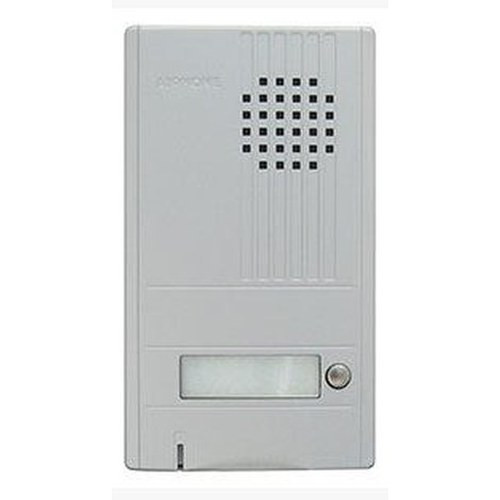
The DA-1DS is a purely analog device. It operates over a 2-conductor shielded or unshielded wire run, supports hands-free two-way audio on a single call path, and is wired directly to a compatible Aiphone analog master station. Maximum wiring distance is 1,020 feet using 18 AWG or 360 feet using 22 AWG cable. There is no network interface, no IP address, and no protocol stack — integration is limited to the Aiphone DA-series analog system.
The IX-SSA connects via an RJ45 port with PoE passthrough, meaning it can daisy-chain power to a downstream device while drawing only 3.36W itself under IEEE 802.3af Class 0. It supports SIP, enabling registration with any SIP-compliant call server or PBX, and its protocol list includes IPv4, IPv6, TCP, UDP, HTTP, HTTPS, RTSP, RTP, RTCP, IGMP, MLD, SMTP, SFTP, DHCP, NTP, and DNS. Audio codecs are G.711 and G.722, with G.722 providing wideband audio quality unavailable on the DA-1DS. Port security is enforced via IEEE 802.1x. The IX-SSA is inherently multi-tenant capable through SIP routing; the DA-1DS is spec'd for single-call, single-tenant use only.
Which unit offers stronger environmental protection and physical durability?
The DA-1DS carries an aluminum weather-resistant housing and an outdoor environment rating. Its operating temperature range is 14°F to 140°F (-10°C to 60°C). No IP ingress protection rating or impact resistance rating is stated in the provided specifications.
The IX-SSA is rated IP65 for dust-tight and water-jet protection, and IK08 for impact resistance — the latter indicating it withstands 5 joules of impact energy, which satisfies vandal-resistant requirements in many codes. Its operating temperature extends to -40°F / -40°C at the cold end, a 26°F / 14°C improvement over the DA-1DS at the lower boundary, with the same 140°F / 60°C upper limit. The IX-SSA housing is stainless steel; the DA-1DS uses an aluminum cover. For high-abuse or extreme-cold outdoor deployments, the IX-SSA's quantified IP65/IK08 ratings and broader thermal floor are materially stronger credentials than the DA-1DS's unrated aluminum housing.
What I/O and integration options does each door station provide?
The DA-1DS provides no documented I/O beyond its audio path and door strike voltage output (9.5–20V AC at 70Ω or higher), which supports a connected electric strike or mag-lock within that voltage window. Integration is limited to the Aiphone DA analog master ecosystem; no third-party control system, access-control panel, or VMS connection is spec'd.
The IX-SSA offers two contact outputs and six trigger inputs. These allow direct wiring to electric strikes, mag-locks, REX buttons, motion sensors, or third-party access control panels without an additional relay module. A microSD card slot enables local audio event storage. Combined with its SIP compatibility and SMTP/SFTP support for event notification, the IX-SSA integrates broadly with IP access control platforms, SIP PBX systems, and network management tools. IEEE 802.1x port security further supports deployment in managed-network environments with NAC policies. The DA-1DS offers none of these integration paths.
Which should you choose: the DA-1DS or the IX-SSA?
Our take: The DA-1DS is the stronger choice when the installation is a straightforward single-tenant analog intercom using existing Aiphone DA-series infrastructure, 2-conductor wiring is already in place, and budget simplicity outweighs future scalability. The IX-SSA is the stronger choice in virtually every other scenario. Specifically: the IX-SSA operates down to -40°C versus the DA-1DS's -10°C floor — a 30-degree cold-weather advantage; it carries quantified IP65 and IK08 ratings where the DA-1DS lists no ingress or impact rating at all; and it provides six trigger inputs plus two contact outputs versus the DA-1DS's single door-strike output. Platform qualifier: if the target site runs a SIP PBX, an IP access control system, or requires multi-tenant call routing, the IX-SSA is the correct specification. The DA-1DS is appropriate only for legacy or new Aiphone DA analog system deployments.
Side-by-Side Comparison
Spec-for-spec, from manufacturer data.
| Specification | Aiphone DA-1DS | Aiphone IX-SSA |
|---|---|---|
| Device Type | Analog audio door station | IP/SIP audio door station |
| Communication Architecture | 2-conductor wired analog | IP network via RJ45 |
| SIP Support | — | Yes |
| Audio Codec | — | G.711, G.722 |
| Power Source | — | PoE IEEE 802.3af Class 0 or 24V DC |
| Power Draw | — | 3.36W |
| Operating Temp (Low) | 14°F / -10°C | -40°F / -40°C |
| Operating Temp (High) | 140°F / 60°C | 140°F / 60°C |
| Ingress Protection Rating | — | IP65 |
| Impact Resistance Rating | — | IK08 |
| Housing Material | Aluminum | Stainless steel |
| Trigger Inputs | — | 6 |
| Contact Outputs | Door strike (9.5–20V AC) | 2 contact outputs |
| Max Wiring Distance | 1,020 ft (18 AWG) / 360 ft (22 AWG) | — |
| Port Security | — | IEEE 802.1x |
| Local Storage | — | microSD card slot |
| Compliance | — | UL 62368-1, cUL 62368-1 |
| Mounting | Surface wall mount | Flush mount |
| Warranty | 2-Year | — |
Frequently Asked Questions
Which should you choose: the DA-1DS or the IX-SSA?
The DA-1DS is the stronger choice when the installation is a straightforward single-tenant analog intercom using existing Aiphone DA-series infrastructure, 2-conductor wiring is already in place, and budget simplicity outweighs future scalability. The IX-SSA is the stronger choice in virtually every other scenario. Specifically: the IX-SSA operates down to -40°C versus the DA-1DS's -10°C floor — a 30-degree cold-weather advantage; it carries quantified IP65 and IK08 ratings where the DA-1DS lists no ingress or impact rating at all; and it provides six trigger inputs plus two contact outputs versus the DA-1DS's single door-strike output. Platform qualifier: if the target site runs a SIP PBX, an IP access control system, or requires multi-tenant call routing, the IX-SSA is the correct specification. The DA-1DS is appropriate only for legacy or new Aiphone DA analog system deployments.
Can the DA-1DS or IX-SSA connect to a third-party access control system?
Only the IX-SSA is spec'd for third-party integration. It provides two contact outputs and six trigger inputs for direct wiring to access control panels, plus SIP compatibility for call-server registration. The DA-1DS specs describe no such I/O and no third-party protocol support — it is designed to work within the Aiphone DA analog master system only.
Is the DA-1DS or IX-SSA better suited to harsh outdoor environments with vandalism risk?
The IX-SSA. It carries a rated IP65 ingress protection and IK08 impact resistance designation, uses stainless steel construction, and operates down to -40°F / -40°C. The DA-1DS has an aluminum weather-resistant cover and an outdoor rating, but no IP or IK rating is stated in its specifications, and its cold-temperature floor is 14°F / -10°C — 30 degrees warmer than the IX-SSA's lower limit.
Do both units support video, or is this audio-only comparison?
Both the DA-1DS and IX-SSA are audio-only door stations per the provided specifications. Neither unit lists a camera, video codec, or video output in its spec data. Buyers requiring video should evaluate a different product class.
More Intercom Comparisons
- Ubiquiti UA-G3-INTERCOM vs SDC IPDSE
- Ubiquiti UA-G3-INTERCOM vs Comelit TP6842
- Ubiquiti UA-G3-INTERCOM vs ACTi Q950
- Axis 03448-001 vs Axis 02892-001
- Comelit TP6842 vs ACTi Q950
- Comelit TP6842 vs Comelit 3460HEV
Intercom Buying Guides
Get a Second Opinion on Your Camera Choice
Share your site layout, coverage goals, and budget. Our team will validate the camera selection, flag anything we would change, and recommend products that match the use case.