
ACTi B57 vs Hanwha XND-8083RV: Specification Comparison
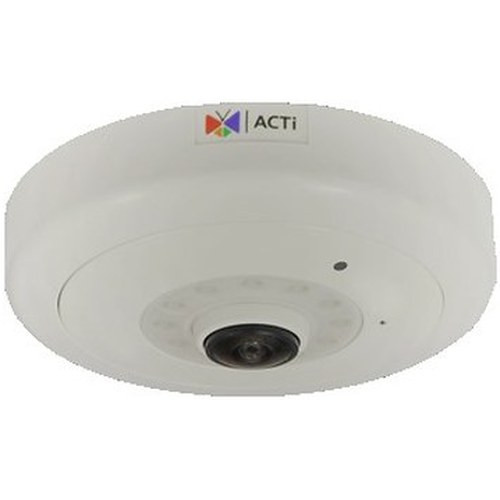
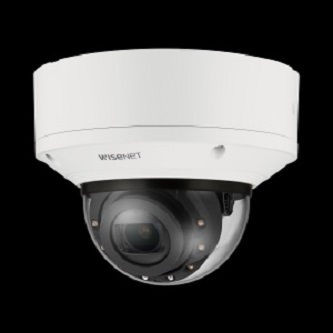
Both the ACTi B57 and Hanwha XND-8083RV are 6MP indoor IP cameras positioned for commercial surveillance, but they serve meaningfully different use cases. The B57 is a fixed fisheye hemispheric dome delivering 360° coverage via a 1.3mm lens, while the XND-8083RV is a conventional vandal dome with a 2.1× motorized varifocal lens (4.4–9.3mm). Buyers cross-shopping these are typically deciding between wide-area omnidirectional coverage and a directional, adjustable-zoom install with IK10 impact resistance and deeper AI analytics.
In This Guide
How do the imaging specs compare?
Both cameras use a 1/1.8" progressive CMOS sensor at approximately 6MP, but their native resolutions differ: the B57 outputs 3096×2080 (6.4MP effective) at up to 20fps in full resolution, while the XND-8083RV outputs 3328×1872 (6.2MP effective) at a full 30fps. The B57's fixed 1.3mm lens delivers a 360° hemispheric field of view with ePTZ capability; the XND-8083RV's 4.4–9.3mm P-iris motorized varifocal provides a 112.1° wide to approximately 48° tele horizontal field of view with simple focus and a minimum object distance of 0.5m. Maximum aperture on the XND-8083RV is F1.3 wide and F2.15 tele; the B57 specifies F2.6 for its color illumination figure.
For low-light and WDR performance, the B57 specifies 0.003 lux color minimum illumination and 0 lux with its 850nm IR active at up to 20m range, backed by 130dB WDR. The XND-8083RV specifies 0.04 lux color and 0 lux with IR active at up to 50m range, with Hanwha's extremeWDR rated at 120dB. The B57 edges the XND-8083RV on WDR rating (130dB vs. 120dB) and raw color sensitivity (0.003 vs. 0.04 lux), but the XND-8083RV more than doubles the IR throw distance (50m vs. 20m) and adds hardware-based digital image stabilization via a built-in gyro sensor—a spec not present on the B57.
What about installation and environment?
The XND-8083RV carries an IP52 ingress-protection rating and IK10 vandal resistance, making it suitable for environments where physical impact is a concern. The B57 lists no IP or IK rating in the provided specifications. Both cameras are rated for indoor use and share the same upper operating temperature of 50°C, but the XND-8083RV extends to -25°C at the low end versus the B57's -10°C, giving it a broader thermal envelope for unconditioned spaces. The XND-8083RV weighs 1,600g versus the B57's 461g, reflecting its aluminum hard-coated housing.
Power inputs are comparable at the class level—both accept PoE+ (IEEE 802.3at)—but the PoE class differs: the B57 is specified as Class 3 (up to ~15.4W budget) and also accepts DC 12V, while the XND-8083RV is Class 4 (up to ~30W budget) with a stated maximum draw of 22.5W, also accepting DC 12V. The B57 supports five mounting orientations (wall, pole, pendant, corner, rack); the XND-8083RV does not list specific mount types in the provided specs but includes pan 0–360°, tilt -45°–85°, and rotate 0–355° physical adjustment ranges.
Which fits your VMS and analytics better?
Both cameras declare ONVIF Profile S, G, and T compliance. The XND-8083RV additionally exposes Hanwha's SUNAPI (HTTP API) and the Wisenet open platform for third-party app integration. The B57 lists compatibility with Milestone XProtect and Axis Camera Station by name, and notes Profile Q support is pending a future firmware upgrade. Video compression on the XND-8083RV includes H.265 in addition to H.264 and MJPEG, offering bandwidth and storage efficiency gains not available on the B57, which is limited to H.264 and MJPEG. The XND-8083RV also supports WiseStream II/III smart codec and CBR/VBR bitrate control; the B57's bitrate control options are not specified in the provided data.
Analytics depth favors the XND-8083RV materially: it offers AI-engine object detection (person, face, vehicle sub-types, license plate), IVA with virtual lines, loitering, intrusion, and appear/disappear events, plus business intelligence functions (people counting, queue management, heatmap). The B57 provides video motion detection and people counting only. For audio, both cameras support two-way audio with built-in microphone, mic-in, and line-out; the XND-8083RV adds audio compression via G.711/G.726. Edge storage is a significant differentiator: the XND-8083RV supports dual microSD slots up to 512GB each (1TB total) and includes 4GB RAM and 512MB flash; the B57's on-board storage support is not specified in the provided data. The XND-8083RV also includes TPM 2.0 (FIPS 140-2 Level 2) hardware security; the B57 lists no equivalent.
Which should you choose: the B57 or the XND-8083RV?
Our take: The XND-8083RV is the stronger choice when the installation demands directional coverage with adjustable zoom, IK10 vandal resistance, H.265 compression, or deep AI analytics. Three concrete spec deltas illustrate the gap: the XND-8083RV delivers 50m IR range versus the B57's 20m, supports dual-slot edge storage up to 1TB versus no specified on-board storage on the B57, and adds H.265 encoding that the B57 lacks entirely. The B57 holds an edge on WDR rating (130dB vs. 120dB) and color low-light sensitivity (0.003 lux vs. 0.04 lux), and its 360° fisheye coverage can replace multiple fixed cameras in open-floor environments. Choose the B57 for wide-area omnidirectional monitoring in well-lit interiors where a single-camera footprint matters; choose the XND-8083RV for directional installs requiring varifocal flexibility, physical hardening, richer AI event triggers, or bandwidth-efficient H.265 recording.
Side-by-Side Comparison
Spec-for-spec, from manufacturer data.
| Specification | ACTi B57 | Hanwha XND-8083RV |
|---|---|---|
| Resolution | 3096×2080 (6MP) | 3328×1872 (6MP) |
| Image Sensor | 1/1.8" progressive CMOS | 1/1.8" progressive CMOS |
| Lens / Focal Length | Fixed 1.3mm (fisheye 360°) | 4.4–9.3mm motorized varifocal (2.1×) |
| Max Frame Rate | 20fps @ 3072×2048; 30fps @ 1024×768 | 30fps |
| Min. Illumination (Color) | 0.003 lux | 0.04 lux |
| Min. Illumination (IR on) | 0 lux | 0 lux |
| IR Range | 20m | 50m (WiseIR) |
| WDR | 130dB | 120dB (extremeWDR) |
| Video Compression | H.264 (Baseline/Main/High); MJPEG | H.265/H.264 (Main/High); MJPEG |
| IP Rating | — | IP52 |
| IK / Impact Rating | — | IK10 |
| Operating Temperature | -10°C to +50°C | -25°C to +50°C |
| Power Input / PoE Class | PoE+ 802.3at Class 3; DC 12V | PoE+ 802.3at Class 4 (22.5W max); DC 12V |
| Edge Storage | — | Dual microSD up to 1TB (512GB × 2) |
| Audio | Built-in mic; mic-in; line-in; line-out (two-way) | Built-in mic; mic-in (selectable); line-out (two-way) |
| Analytics | VMD; People Counting | AI object detection (person/face/vehicle/LP); IVA; people counting; queue mgmt; heatmap |
| ONVIF | Profile S, G, T (Q via future firmware) | Profile S, G, T |
| Weight | 461g (1.016 lb) | 1,600g (3.53 lb) |
| Warranty | — | 3 years |
Frequently Asked Questions
Which should you choose: the B57 or the XND-8083RV?
The XND-8083RV is the stronger choice when the installation demands directional coverage with adjustable zoom, IK10 vandal resistance, H.265 compression, or deep AI analytics. Three concrete spec deltas illustrate the gap: the XND-8083RV delivers 50m IR range versus the B57's 20m, supports dual-slot edge storage up to 1TB versus no specified on-board storage on the B57, and adds H.265 encoding that the B57 lacks entirely. The B57 holds an edge on WDR rating (130dB vs. 120dB) and color low-light sensitivity (0.003 lux vs. 0.04 lux), and its 360° fisheye coverage can replace multiple fixed cameras in open-floor environments. Choose the B57 for wide-area omnidirectional monitoring in well-lit interiors where a single-camera footprint matters; choose the XND-8083RV for directional installs requiring varifocal flexibility, physical hardening, richer AI event triggers, or bandwidth-efficient H.265 recording.
Is the B57 or XND-8083RV better for low-light performance?
The B57 specifies a lower color minimum illumination (0.003 lux vs. 0.04 lux on the XND-8083RV) and a higher WDR rating (130dB vs. 120dB), so it captures more detail in dimmer ambient light. However, the XND-8083RV's IR illuminator reaches 50m compared to the B57's 20m, so in complete darkness the XND-8083RV covers a much larger scene. If the space has some ambient light, the B57 has a sensitivity advantage; if IR throw distance matters, the XND-8083RV wins.
Can both cameras record locally without an NVR?
The XND-8083RV supports dual microSD/SDHC/SDXC slots up to 512GB each (1TB combined) for on-board edge recording triggered by events or schedule. The B57's provided specifications do not list any on-board storage support. Buyers who require NVR-independent edge recording should choose the XND-8083RV.
Which camera is easier to aim and install in a fixed corridor or entrance?
The XND-8083RV is purpose-built for directional installs: its 4.4–9.3mm motorized varifocal lens adjusts remotely, and the pan/tilt/rotate mechanism (0–360° / -45°–85° / 0–355°) allows precise scene framing after mounting. It also includes hallway view (90°/270° rotation) and IK10 impact protection. The B57 uses a fixed 1.3mm fisheye lens that covers 360° by design and cannot be narrowed to a single corridor without relying on ePTZ cropping, which reduces effective resolution. For a corridor or entrance requiring a tight field of view, the XND-8083RV is the more practical choice.
Get a Second Opinion on Your Camera Choice
Share your site layout, coverage goals, and budget. Our team will validate the camera selection, flag anything we would change, and recommend products that match the use case.