
ACTi B57 vs Hanwha PNM-12082RVD: Specification Comparison
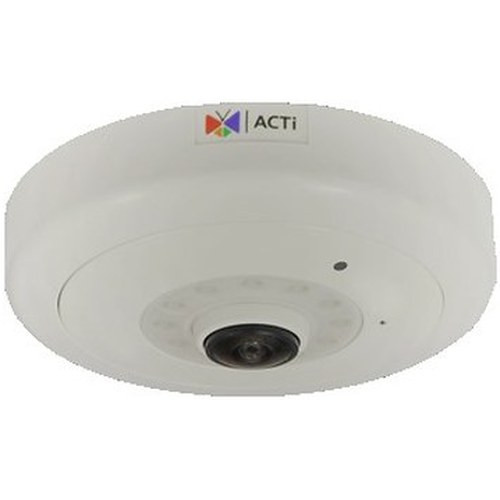
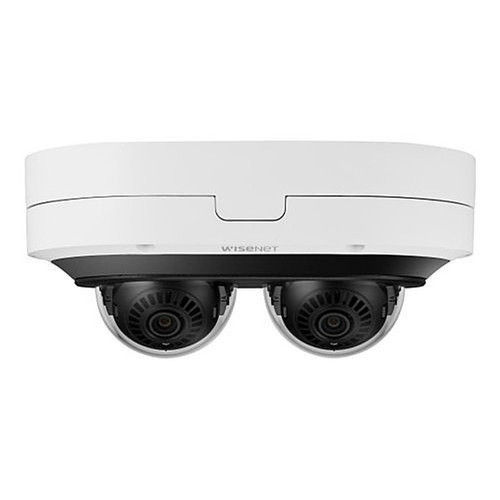
Both the ACTi B57 and Hanwha PNM-12082RVD are 6MP IP cameras, but they serve fundamentally different deployment scenarios: the B57 is a fixed-lens indoor hemispheric dome designed for wide-area coverage and edge analytics, while the PNM-12082RVD is a dual-channel outdoor dome with a motorized varifocal lens built for weather-hardened perimeter and entrance monitoring. Despite sharing a resolution class, buyers cross-shopping these would be weighing 360° fisheye interior coverage against dual-sensor outdoor surveillance—a legitimate trade-off comparison worth examining across imaging, installation, and integration dimensions.
In This Guide
How do the imaging specs compare?
The ACTi B57 uses a 1/1.8-inch sensor resolving 3072×2048 at 20 fps (or 30 fps at lower resolutions) through a fixed f/1.3mm fisheye lens, delivering full 360° hemispheric coverage with ePTZ dewarping. Its WDR rating is 130dB, and minimum illumination is 0.003 lux in color mode (F2.6, spec-stated) or 0 lux with its 850nm IR illuminator active at a range of 20m. The 1/1.8-inch sensor is notably larger than the Hanwha's, which generally benefits low-light performance.
The Hanwha PNM-12082RVD uses a 1/2.8-inch sensor resolving 3328×1872 per channel at a maximum of 15 fps at 6MP. Its motorized varifocal lens covers 3.54–6.69mm (1.9× optical zoom) with remote focus capability—a meaningful installation advantage over the B57's fixed lens. WDR is rated at 120dB versus the B57's 130dB. Minimum illumination is 0.16 lux in color mode and 0.016 lux in B/W, reaching 0 lux with IR on; IR range is specified at 25m (82 ft), extending 5m beyond the B57's 20m. The B57 holds the edge in WDR headroom (+10dB) and sensor size; the PNM-12082RVD offers longer IR throw and optical zoom flexibility.
What about installation and environment?
The ACTi B57 is rated for indoor use only with no IP or IK rating listed in its specs. It operates from -10°C to 50°C and is powered via PoE Class 3 (IEEE 802.3af) or DC 12V. Mounting options include wall, pole, pendant, corner, and rack via optional camera mount accessories. Weight is 461g (1.016 lb). Its indoor-only designation makes it unsuitable for any exposed or outdoor deployment.
The Hanwha PNM-12082RVD carries IP66, IP67, and NEMA 4X environmental ratings, plus IK10 vandal resistance—making it fully rated for outdoor installation in rain, dust, and salt-spray environments. It operates over the same -10°C to 50°C temperature range as the B57. Power is PoE+ Class 4 (802.3at), requiring a Class 4-capable switch or injector. The aluminum housing is available in multiple color options. Mounting supports ceiling, wall, and pendant configurations. Audio input requires an optional external I/O box; the B57 includes a built-in microphone and dedicated audio I/O ports natively.
Which fits your VMS and analytics better?
The ACTi B57 supports ONVIF Profile S, G, and T (Profile Q noted as pending future firmware), and is explicitly listed as compatible with Milestone XProtect and Axis Camera Station. Edge analytics include video motion detection (VMD) and people counting, both running on-camera without server load. Two-way audio is fully integrated: built-in microphone, mic-in, line-in, and line-out ports are all present. On-board storage is not specified in the provided specs.
The Hanwha PNM-12082RVD supports ONVIF Profile S and Profile T. No edge analytics are listed in the provided specifications. Audio input requires an optional I/O accessory box—no built-in microphone or audio port is native to the camera body itself. On-board storage is supported via microSD with 512MB of onboard memory noted. The camera includes cybersecurity features: TPM 2.0 (FIPS 140-2), encrypted firmware, secure boot, and signed firmware—none of which are specified for the B57. VMS compatibility beyond ONVIF is not stated in the provided Hanwha specs. A 5-year warranty is listed for the PNM-12082RVD; no warranty term is provided in the B57 specs.
Which should you choose: the B57 or the PNM-12082RVD?
Our take: The B57 is the stronger choice when the deployment is indoor, analytics-driven, and requires native two-way audio with wide-area 360° coverage. Key spec deltas: the B57's 130dB WDR outrates the PNM-12082RVD's 120dB by 10dB, its 1/1.8-inch sensor is physically larger than the PNM-12082RVD's 1/2.8-inch sensor (a low-light advantage), and it delivers on-board people counting and VMD without an analytics server—capabilities not listed for the PNM-12082RVD. Conversely, the PNM-12082RVD is the correct choice for any outdoor or semi-exposed installation: its IP66/IP67/NEMA 4X/IK10 ratings, 25m IR throw (versus 20m), dual-channel architecture, motorized varifocal lens with remote focus, and FIPS 140-2 cybersecurity posture address requirements the B57 cannot meet. Choose the B57 for indoor analytics; choose the PNM-12082RVD for hardened outdoor perimeter work.
Side-by-Side Comparison
Spec-for-spec, from manufacturer data.
| Specification | ACTi B57 | Hanwha PNM-12082RVD |
|---|---|---|
| Resolution | 6MP (3072×2048) | 6MP (3328×1872) |
| Max Channels | 1 | 2 (dual-channel) |
| Image Sensor Size | 1/1.8 inch | 1/2.8 inch |
| Lens Type | Fixed f/1.3mm fisheye | Motorized varifocal 3.54–6.69mm |
| Min Illumination (Color) | 0.003 lux | 0.16 lux |
| Min Illumination (IR on) | 0 lux | 0 lux |
| IR Range | 20m | 25m (82 ft) |
| WDR | 130dB | 120dB |
| Max Frame Rate | 20 fps @ 6MP | 15 fps @ 6MP |
| Video Compression | H.264; MJPEG | H.265; H.264; MJPEG |
| IP Rating | — | IP66 / IP67 / NEMA 4X |
| IK / Impact Rating | — | IK10 |
| Operating Temperature | -10°C to 50°C | -10°C to 50°C |
| Power Input / PoE Class | PoE Class 3 (802.3af) or DC 12V | PoE+ Class 4 (802.3at) |
| Edge Analytics | VMD; People Counting | — |
| Audio | Built-in mic; mic-in; line-in; line-out | Optional I/O box required |
| Edge Storage | — | microSD supported |
| ONVIF Profiles | S, G, T (Q via future firmware) | S, T |
| Cybersecurity | — | TPM 2.0 (FIPS 140-2); Secure boot; Encrypted firmware |
| Application Environment | Indoor only | Indoor / Outdoor |
| Warranty | — | 5 years |
Frequently Asked Questions
Which should you choose: the B57 or the PNM-12082RVD?
The B57 is the stronger choice when the deployment is indoor, analytics-driven, and requires native two-way audio with wide-area 360° coverage. Key spec deltas: the B57's 130dB WDR outrates the PNM-12082RVD's 120dB by 10dB, its 1/1.8-inch sensor is physically larger than the PNM-12082RVD's 1/2.8-inch sensor (a low-light advantage), and it delivers on-board people counting and VMD without an analytics server—capabilities not listed for the PNM-12082RVD. Conversely, the PNM-12082RVD is the correct choice for any outdoor or semi-exposed installation: its IP66/IP67/NEMA 4X/IK10 ratings, 25m IR throw (versus 20m), dual-channel architecture, motorized varifocal lens with remote focus, and FIPS 140-2 cybersecurity posture address requirements the B57 cannot meet. Choose the B57 for indoor analytics; choose the PNM-12082RVD for hardened outdoor perimeter work.
Is the B57 or PNM-12082RVD better for low-light performance?
The B57 reaches 0.003 lux in color mode with a larger 1/1.8-inch sensor, compared to the PNM-12082RVD's 0.16 lux color minimum illumination on a 1/2.8-inch sensor. Both reach 0 lux with IR active. The B57's IR range is 20m; the PNM-12082RVD's is 25m. For indoor low-light sensitivity, the B57 has the spec advantage; for outdoor IR throw distance, the PNM-12082RVD reaches farther.
Can either camera be used outdoors?
The PNM-12082RVD is rated IP66, IP67, NEMA 4X, and IK10—fully suitable for outdoor installation in rain, dust, salt-spray, and vandal-risk environments. The ACTi B57 carries no IP or IK rating in its specifications and is explicitly listed as an indoor-only camera. It should not be deployed outdoors.
Which camera is better for people counting and on-camera analytics?
The ACTi B57 explicitly lists on-board people counting and video motion detection (VMD) as built-in edge analytics. No analytics capabilities are listed in the provided specifications for the Hanwha PNM-12082RVD. If edge analytics are a requirement, the B57 is the only one of the two with those features confirmed in spec.
Get a Second Opinion on Your Camera Choice
Share your site layout, coverage goals, and budget. Our team will validate the camera selection, flag anything we would change, and recommend products that match the use case.