
ACTi A87 vs ACTi E54: Specification Comparison
Both the ACTi A87 and ACTi E54 are 5MP dome cameras from the same manufacturer, making them a plausible cross-shop for buyers deciding between an outdoor-rated varifocal unit and an indoor fixed-lens alternative. This comparison examines how their imaging capabilities, environmental ratings, power requirements, mounting options, and VMS integration differ — giving installers and IT buyers the spec-level data needed to match the right camera to the right deployment scenario.
In This Guide
How do the imaging specs compare?
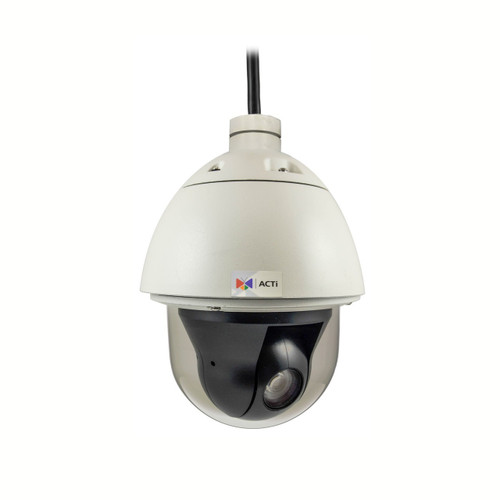
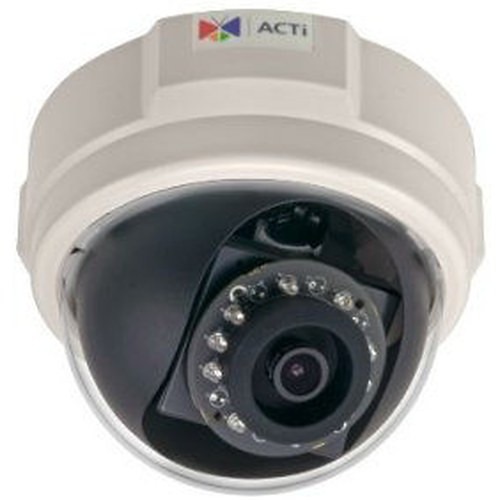
Both cameras share a 5MP resolution, but their lens configurations diverge significantly. The A87 uses a 2.8–12mm varifocal lens (specified alternately as 3x and 4.3x optical zoom depending on the source field), providing adjustable coverage from wide-angle to telephoto — useful for perimeter or detail zones where focal length must be set at commissioning. The E54 uses a fixed 3.6mm F1.8 lens, which is optimized for a single field of view typical of ceiling-mounted indoor overwatch. The A87's maximum frame rate is explicitly documented at 30 fps across three resolutions (2592×1944, 1920×1080, and 1280×720); the E54's maximum frame rate is not specified in the provided data.
On low-light performance, the A87 specifies a 1/2.9-inch sensor, a minimum illumination of 0.15 lux in color mode and 0 lux in B/W with IR active, and an IR range of 30m using adaptive IR LEDs (700–1150nm). The E54 lists IR and Day/Night switching but provides no minimum illumination figure, no IR range, and no sensor size in the provided specifications. The A87 also carries Advanced WDR rated at 120 dB; the E54 lists WDR without a dB rating. Compression on the A87 includes H.265, H.264 (Baseline/Main/High), and MJPEG. The E54's compression codecs are not specified in the provided data.
What about installation and environment?
The A87 is rated IP66 (dust-tight and protected against powerful water jets), IK10 (impact-resistant to 20 joules), NEMA 4X, and is certified CE Class A, FCC Class A, EAC, CB, and UL Listed (UL 62368-1). Its operating temperature range is −40°C to +50°C (−40°F to +122°F), and it weighs 858g. Mount options include wall, pole, pendant, corner, and rack configurations. The E54 carries no IP or IK rating in the provided specifications and is described as an indoor dome with ceiling-mount configuration only; no operating temperature range or weight is specified for it.
Power input also differs: the A87 accepts DC 12V or PoE Class 3 (IEEE 802.3af per one field, PoE+ 802.3at Class 3 per another — the spec data contains an internal inconsistency on this point and buyers should verify with the datasheet). The E54 is specified for PoE 802.3af only. For new deployments where standard 802.3af switches are already in place, the E54's requirement is unambiguous. The A87's power draw is listed at up to 30W maximum, which aligns with PoE+ (802.3at); buyers should confirm their switch port budget accordingly.
Which fits your VMS and analytics better?
The A87 supports ONVIF Profile S, Profile G, Profile T, and Profile Q, as well as Pelco-D and Pelco-P protocols — giving it the broadest VMS compatibility of the two. It also includes edge analytics (VMD and People Counting) and two-way audio with mic-in, line-in, and line-out connections. The E54 supports ONVIF Profile S only, with no additional VMS protocols, no edge analytics, and audio is not specified in the provided data. On-board/edge storage is not specified for either model in the provided data.
Which should you choose: the A87 or the E54?
Our take: The A87 is the stronger choice when the deployment demands outdoor survivability, flexible focal coverage, or richer VMS and analytics integration. Concretely: the A87 carries IP66/IK10/NEMA 4X ratings versus no environmental rating for the E54; its IR system is specified at 30m range with 0 lux B/W minimum illumination versus no illumination figure provided for the E54; and its ONVIF compliance extends to Profiles S, G, T, and Q plus Pelco-D/P versus Profile S alone on the E54. The A87 also adds People Counting analytics and two-way audio not documented on the E54. The E54's simpler profile — fixed 3.6mm lens, 802.3af PoE, ceiling-mount only — suits straightforward indoor overwatch on standard switch infrastructure where those advanced capabilities are unnecessary. Buyers should confirm the A87's PoE class (af vs. at) against their switch spec before ordering, as the provided data contains conflicting values on that point.
Side-by-Side Comparison
Spec-for-spec, from manufacturer data.
| Specification | ACTi A87 | ACTi E54 |
|---|---|---|
| Resolution | 5 MP | 5 MP |
| Image Sensor Size | 1/2.9 inch | — |
| Lens / Focal Length | 2.8–12mm varifocal | 3.6mm fixed F1.8 |
| Optical Zoom | 3x – 4.3x (spec inconsistency; verify datasheet) | — |
| Min Illumination | 0.15 lux (color); 0 lux (B/W with IR) | — |
| IR Range | 30m | — |
| WDR | Advanced WDR 120 dB | WDR (dB not specified) |
| Max Frame Rate | 30 fps @ 2592×1944 / 1920×1080 / 1280×720 | — |
| Video Compression | H.265; H.264 (Baseline/Main/High); MJPEG | — |
| IP Rating | IP66 | — |
| IK / Impact Rating | IK10 | — |
| Operating Temperature | -40°C to +50°C (-40°F to 122°F) | — |
| Power Input / PoE Class | DC 12V or PoE (af/at inconsistency; verify datasheet); 30W max | PoE 802.3af |
| Mount Type | Wall; Pole; Pendant; Corner; Rack | Ceiling |
| ONVIF Profiles | Profile S; G; T; Q; Pelco-D; Pelco-P | Profile S |
| Edge Analytics | VMD; People Counting | — |
| Audio | Two-way; Mic-in; Line-in; Line-out | — |
| Weight | 858g (1.892 lb) | — |
| Certifications | CE Class A; FCC Class A; EAC; CB; UL (UL 62368-1); NEMA 4X | — |
Frequently Asked Questions
Which should you choose: the A87 or the E54?
The A87 is the stronger choice when the deployment demands outdoor survivability, flexible focal coverage, or richer VMS and analytics integration. Concretely: the A87 carries IP66/IK10/NEMA 4X ratings versus no environmental rating for the E54; its IR system is specified at 30m range with 0 lux B/W minimum illumination versus no illumination figure provided for the E54; and its ONVIF compliance extends to Profiles S, G, T, and Q plus Pelco-D/P versus Profile S alone on the E54. The A87 also adds People Counting analytics and two-way audio not documented on the E54. The E54's simpler profile — fixed 3.6mm lens, 802.3af PoE, ceiling-mount only — suits straightforward indoor overwatch on standard switch infrastructure where those advanced capabilities are unnecessary. Buyers should confirm the A87's PoE class (af vs. at) against their switch spec before ordering, as the provided data contains conflicting values on that point.
Is the A87 or E54 better for low-light performance?
Based on the provided specifications, the A87 is better documented for low-light use: it specifies 0 lux minimum illumination in B/W mode with IR active, a 30m IR range, and a 120 dB Advanced WDR rating. The E54 lists IR and Day/Night switching and WDR, but no minimum illumination figure, IR range, or WDR dB value is provided in its specifications, making a direct numeric comparison impossible.
Can I use either camera in an outdoor enclosure?
The A87 is rated IP66, IK10, and NEMA 4X with an operating range of −40°C to +50°C, and is designed for direct outdoor installation without a separate enclosure. The E54 has no IP or IK rating listed in the provided specifications and is described as an indoor dome; it would require a separate rated enclosure for outdoor use, and suitability would need to be confirmed with ACTi.
Will both cameras work with my existing VMS?
That depends on your VMS. The A87 supports ONVIF Profiles S, G, T, and Q, plus Pelco-D and Pelco-P, covering the majority of enterprise and mid-market VMS platforms. The E54 supports ONVIF Profile S only. If your VMS relies on Profile G (for on-board recording) or Profile T (for H.265 and metadata), or uses Pelco protocols, only the A87 is confirmed compatible based on the provided specifications.
Get a Second Opinion on Your Camera Choice
Share your site layout, coverage goals, and budget. Our team will validate the camera selection, flag anything we would change, and recommend products that match the use case.