
ACTi A76 vs ACTi Z87: Specification Comparison
The ACTi A76 and ACTi Z87 are both 4MP outdoor dome cameras running on 802.3af PoE, aimed at commercial and light-industrial deployments where a single network cable handles both power and data. Despite sharing the same resolution class and dome form factor, they diverge significantly in lens design, environmental ratings, analytics capability, and mount flexibility — making the choice between them primarily a function of site conditions and post-installation adjustability requirements.
In This Guide
How do the imaging specs compare?
The A76 uses a 1/2.7" sensor with a fixed 2.8mm board-mount lens, delivering a wide field of view at a maximum of 30 fps at 2688×1520 (4MP). Its low-light floor is specified at 0.003 lux in color mode and 0 lux in B/W with IR active, supported by an 850nm IR LED array rated to 65m range. The WDR is specified as Extreme WDR at 150 dB, a notably high figure for scenes with simultaneous bright and shadowed zones. The Z87 uses a varifocal 2.8–12mm lens (4.3× optical zoom), covering a range from approximately 99.8° wide-angle down to 30.7° telephoto without remounting. Its minimum illumination, IR wavelength, IR range, sensor size, and WDR dB value are not specified in the provided data.
For fixed wide-angle coverage with quantified low-light and WDR performance, the A76 provides more verifiable imaging data. The Z87's varifocal lens is a material advantage where scene width and subject distance are not finalized at installation time, but buyers cannot directly compare its low-light or WDR performance against the A76 from the available specifications.
What about installation and environment?
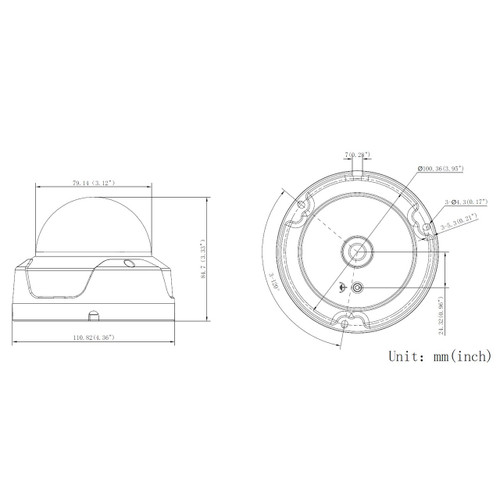
The A76 carries IP68 and IK10 ratings, meaning it is rated for continuous submersion beyond 1m and for IK10 vandal resistance (20-joule impact). Its operating temperature range spans -40°C to 60°C (-40°F to 140°F), making it suitable for extreme cold climates and high-heat enclosures. It is powered by PoE Class 3 (802.3af) or DC 12V, and its mounting options include wall, pole, pendant, and corner configurations via accessory brackets. The connector is an RJ-45 pigtail. Dimensions are 110.82mm × 84.7mm (Ø × H).
The Z87 is rated IP67, which covers temporary immersion to 1m but not continuous submersion, and no IK impact rating is specified. Its operating temperature range, weight, and dimensions are not provided in the available specifications. It supports ceiling mounting; wall, pole, pendant, and corner options are not listed. It is powered by PoE 802.3af, but the PoE class is not specified beyond the standard designation. For installations exposed to flooding risk, freeze-thaw cycling, or vandal threat, the A76's IP68/IK10 rating and wider stated temperature range represent a measurable advantage.
Which fits your VMS and analytics better?
The A76 supports ONVIF Profile S, Profile G, Profile T, and Profile M, providing broad VMS compatibility including event-triggered recording (Profile G) and metadata streaming (Profile M). It includes built-in deep learning analytics — Face Detection and People Detection — alongside VMD, and supports two-way audio via line-in and line-out. It holds Taiwan IoT Cybersecurity Certification Level 1 (TAICS, CNS-16120). On-board storage is not mentioned in the provided specifications.
The Z87 declares ONVIF Profile S only, limiting native event and metadata integration on VMS platforms that require Profile G or T. It includes a built-in microphone (one-way audio; no line-out or two-way capability listed). It supports MicroSDHC on-board storage, which the A76 does not list. The Z87's analytics capabilities beyond basic IR day/night switching are not specified. Buyers needing edge AI analytics, two-way audio, or multi-profile ONVIF compliance should note these gaps against the A76.
Which should you choose: the A76 or the Z87?
Our take: The A76 is the stronger choice when environmental durability, verified low-light performance, and edge analytics are the primary drivers. It exceeds the Z87 on ingress protection (IP68 vs IP67), adds a specified IK10 vandal rating the Z87 does not list, and documents a 150 dB Extreme WDR value and 0.003 lux minimum illumination where the Z87 provides no equivalent figures. The A76 also supports four ONVIF profiles (S, G, T, M) versus the Z87's Profile S alone, and includes deep learning Face and People Detection plus two-way audio — neither of which is listed for the Z87. The Z87's clear advantage is its 2.8–12mm varifocal lens, which allows field-of-view adjustment after mounting without repositioning the camera — an important benefit on retrofit jobs or sites where optimal framing is uncertain at install time. It also adds MicroSDHC edge storage not listed on the A76. Specify the Z87 when lens flexibility and on-board storage matter more than rated environmental extremes or analytics depth.
Side-by-Side Comparison
Spec-for-spec, from manufacturer data.
| Specification | ACTi A76 | ACTi Z87 |
|---|---|---|
| Resolution | 4MP (2688×1520) | 4MP |
| Lens / Focal Length | 2.8mm fixed (board mount) | 2.8–12mm varifocal (4.3× zoom) |
| Sensor Size | 1/2.7" | — |
| Min Illumination | 0.003 lux (color); 0 lux (B/W with IR) | — |
| IR Wavelength | 850nm | — |
| IR Range | 65m | — |
| WDR | Extreme WDR (150 dB) | WDR (dB value not specified) |
| Max Frame Rate | 30 fps @ 2688×1520 | — |
| Video Compression | H.265; H.264; MJPEG | H.265; H.264 |
| IP Rating | IP68 | IP67 |
| IK / Impact Rating | IK10 | — |
| Operating Temperature | -40°C to 60°C | — |
| Power Input / PoE Class | PoE Class 3 (802.3af); DC 12V | PoE 802.3af (class not specified) |
| ONVIF Profiles | Profile S, G, T, M | Profile S |
| Edge Analytics | Face Detection; People Detection; VMD (Deep Learning) | — |
| Audio | Two-way (line-in, line-out) | Built-in microphone (one-way) |
| Edge Storage | — | MicroSDHC |
| Mount Types | Wall; Pole; Pendant; Corner | Ceiling |
| Dimensions | Ø 110.82mm × H 84.7mm | — |
| Warranty | 3 years | — |
| Certifications | CE Class B; FCC Class B; IP68; IK10; TAICS CNS-16120 Level 1 | — |
Frequently Asked Questions
Which should you choose: the A76 or the Z87?
The A76 is the stronger choice when environmental durability, verified low-light performance, and edge analytics are the primary drivers. It exceeds the Z87 on ingress protection (IP68 vs IP67), adds a specified IK10 vandal rating the Z87 does not list, and documents a 150 dB Extreme WDR value and 0.003 lux minimum illumination where the Z87 provides no equivalent figures. The A76 also supports four ONVIF profiles (S, G, T, M) versus the Z87's Profile S alone, and includes deep learning Face and People Detection plus two-way audio — neither of which is listed for the Z87. The Z87's clear advantage is its 2.8–12mm varifocal lens, which allows field-of-view adjustment after mounting without repositioning the camera — an important benefit on retrofit jobs or sites where optimal framing is uncertain at install time. It also adds MicroSDHC edge storage not listed on the A76. Specify the Z87 when lens flexibility and on-board storage matter more than rated environmental extremes or analytics depth.
Is the A76 or Z87 better for low-light and backlit scenes?
Based on the provided specifications, only the A76 has quantified low-light and WDR figures: 0.003 lux color minimum illumination, 0 lux in B/W with IR, an 850nm IR LED array rated to 65m, and 150 dB Extreme WDR. The Z87's minimum illumination, IR range, and WDR dB value are not specified in the available data, so a direct numeric comparison cannot be made.
Can I adjust the field of view on the A76 after installation?
No. The A76 uses a fixed 2.8mm board-mount lens, so the field of view is set at the factory. The Z87 uses a 2.8–12mm varifocal lens (4.3× optical zoom), which allows installers to adjust framing from approximately 99.8° wide-angle to 30.7° telephoto on site without remounting the camera.
Which camera is better suited for outdoor installations in harsh or vandal-prone environments?
The A76 specifies IP68 (continuous submersion) and IK10 (20-joule vandal resistance) ratings, and a documented operating range of -40°C to 60°C. The Z87 is rated IP67 (temporary immersion to 1m), does not list an IK impact rating, and its operating temperature range is not provided in the available specifications. For flood-prone, extreme-cold, or vandal-risk locations, the A76's published ratings provide stronger documentation.
Get a Second Opinion on Your Camera Choice
Share your site layout, coverage goals, and budget. Our team will validate the camera selection, flag anything we would change, and recommend products that match the use case.