
ACTi A422 vs Hanwha C7083R: Specification Comparison
Both the ACTi A422 and Hanwha XNO-C7083R are outdoor-rated 4MP varifocal bullet cameras aimed at perimeter and general surveillance applications. The comparison covers sensor and optics performance, environmental and installation characteristics, and platform integration features including analytics, edge storage, and VMS compatibility — factors that typically drive selection decisions for installers and IT buyers in commercial and industrial deployments.
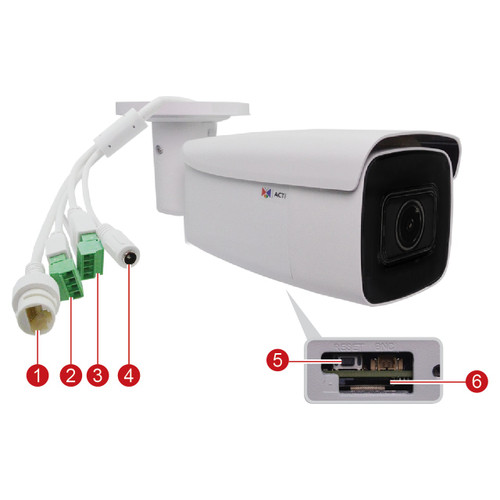
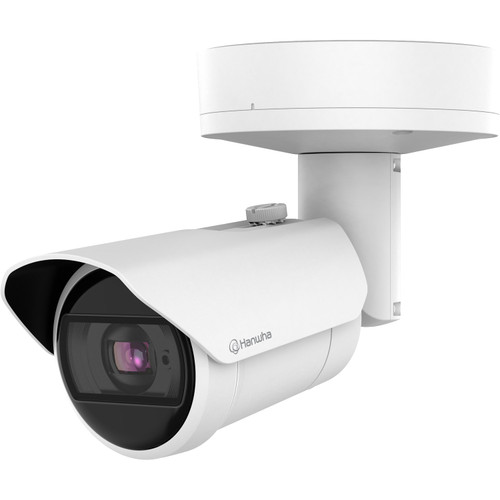
In This Guide
How do the imaging specs compare?
The A422 resolves at 2688×1520 on a 1/2.7" sensor with a 2.7–13.5mm motorized varifocal lens delivering 5x optical zoom, reaching a minimum illumination of 0.003 lux in color mode and 0 lux with IR active. Its IR illuminators are rated to 85m at 850nm. WDR is specified at 150dB. The XNO-C7083R resolves at 2592×1520 on a 1/2.8" sensor with a 2.8–10mm motorized varifocal lens at 3.6x zoom, a minimum color illumination of 0.038 lux, and 0 lux with IR active. Its WiseIR illuminators reach 40m. WDR is rated at 120dB.
The A422 holds meaningful advantages in low-light sensitivity (0.003 lux vs. 0.038 lux), IR throw distance (85m vs. 40m), WDR headroom (150dB vs. 120dB), and zoom range (5x vs. 3.6x). The XNO-C7083R counters with a higher maximum frame rate — 60fps at full 4MP resolution versus 30fps on the A422 — and a wider maximum aperture of F1.4 at the wide end, which aids low-light performance beyond what the lux spec alone conveys. Built-in digital image stabilization via gyro sensor is available on the XNO-C7083R; this feature is not specified for the A422.
What about installation and environment?
The A422 carries an IP68 ingress rating — full continuous submersion protection — along with IK10 impact resistance. The XNO-C7083R is rated IP66/IP67 and NEMA 4X with IK10. Both withstand -40°C at the low end; the A422 operates to 60°C while the XNO-C7083R is rated to 55°C. The A422 weighs 1410g versus the XNO-C7083R at 1640g.
Both cameras accept 12VDC and PoE. The A422 specifies PoE++ (802.3bt) Class 3 in its headline spec but also references IEEE 802.3af Class 3 in the power supply field — this inconsistency in the provided specs should be verified with the manufacturer before deploying on 802.3af-only switches. The XNO-C7083R clearly specifies IEEE 802.3af Class 3 with a maximum power draw of 12.95W, presenting no ambiguity. The A422 supports pole and corner mount types; the XNO-C7083R mount compatibility is not detailed in the provided specs. The XNO-C7083R body is aluminum and PC with a hard-coated window; A422 housing material is not specified.
Which fits your VMS and analytics better?
Both cameras support ONVIF Profile S, G, T, and M. The XNO-C7083R additionally supports SUNAPI and Wisenet protocols, which provide deeper integration with Hanwha's Wisenet VMS ecosystem. Analytics differ substantially: the A422 offers Deep Learning (DLPU)-based video motion detection. The XNO-C7083R's AI engine provides object detection with person, face, vehicle, and license plate classification; vehicle type attribute recognition; virtual line crossing and direction detection; virtual area intrusion; plus business intelligence functions including people counting, queue management, and heatmap — a materially broader analytics set per the provided specs.
Edge storage is available only on the XNO-C7083R, which includes a single microSD/SDHC/SDXC slot supporting up to 512GB; the A422 does not specify edge storage capability. Both cameras provide two-way audio with line-in and line-out. The XNO-C7083R specifies detailed audio input parameters (2.5VDC supply, 2K Ohm impedance, 1Vrms output) and supports WiseStream II and III smart codecs for bandwidth efficiency. Security protocol support on the XNO-C7083R includes HTTPS/SSL, Digest Auth, IP filtering, 802.1X (EAP-TLS/LEAP/PEAP), SRTP, and MQTT; equivalent protocol details are not provided in the A422 spec sheet. The A422 holds a UL Taiwan IoT Cybersecurity Certification; the XNO-C7083R carries FCC, CE/UKCA, UL 62368-1, CAN/CSA, and multiple additional regional certifications.
Which should you choose: the A422 or the C7083R?
Our take: The A422 is the stronger choice when long-range IR coverage, extreme low-light sensitivity, or deep submersion protection are primary requirements. Its 85m IR throw is more than double the XNO-C7083R's 40m, its minimum color illumination of 0.003 lux versus 0.038 lux represents a meaningful sensitivity advantage, and its IP68 rating exceeds the XNO-C7083R's IP66/IP67. The XNO-C7083R is the stronger fit when advanced AI analytics, edge recording, or integration into a Hanwha Wisenet VMS environment drive the decision — it delivers object classification, license plate detection, people counting, and 60fps at full resolution versus the A422's 30fps, plus onboard microSD storage up to 512GB that the A422 does not offer. The A422's PoE power class inconsistency in the provided specs warrants clarification with the manufacturer before deployment on standard 802.3af infrastructure.
Side-by-Side Comparison
Spec-for-spec, from manufacturer data.
| Specification | ACTi A422 | Hanwha C7083R |
|---|---|---|
| Resolution | 2688×1520 (4MP) | 2592×1520 (4MP) |
| Image Sensor | 1/2.7" CMOS | 1/2.8" progressive CMOS |
| Lens / Focal Length | 2.7–13.5mm, 5x optical zoom | 2.8–10mm, 3.6x motorized varifocal |
| Max Aperture | — | F1.4 (Wide) – F3.0 (Tele) |
| Min. Illumination (Color) | 0.003 lux | 0.038 lux |
| Min. Illumination (IR) | 0 lux (IR on) | 0 lux (IR on) |
| IR Range | 85m (850nm) | 40m (WiseIR) |
| WDR | 150dB Extreme WDR | 120dB extremeWDR |
| Max Frame Rate | 30fps @ 4MP | 60fps @ 4MP |
| Video Compression | H.265, H.264, MJPEG | H.265, H.264 (Main/Baseline/High), MJPEG |
| IP Rating | IP68 | IP66 / IP67 / NEMA 4X |
| IK / Impact Rating | IK10 | IK10 |
| Operating Temperature | -40°C to 60°C | -40°C to 55°C |
| Power Input / PoE Class | DC 12V; PoE++ 802.3bt Class 3 (also references 802.3af — verify with manufacturer) | DC 12V; PoE IEEE 802.3af Class 3, max 12.95W |
| Digital Image Stabilization | — | Yes (built-in gyro sensor) |
| Edge Storage | — | MicroSD/SDHC/SDXC, 1 slot, 512GB max |
| Audio | Line-in, Line-out; two-way | Mic in / Line in selectable; Line out; two-way |
| Analytics | Deep Learning (DLPU); VMD | AI: person/face/vehicle/LPR classification; virtual line/area; people counting; queue mgmt; heatmap |
| ONVIF / VMS Protocols | ONVIF Profile S, G, T, M | ONVIF Profile S, G, T, M; SUNAPI; Wisenet |
| Weight | 1410g (3.11 lb) | 1640g (3.62 lb) |
| Warranty | 3 years | 3 years |
Frequently Asked Questions
Which should you choose: the A422 or the C7083R?
The A422 is the stronger choice when long-range IR coverage, extreme low-light sensitivity, or deep submersion protection are primary requirements. Its 85m IR throw is more than double the XNO-C7083R's 40m, its minimum color illumination of 0.003 lux versus 0.038 lux represents a meaningful sensitivity advantage, and its IP68 rating exceeds the XNO-C7083R's IP66/IP67. The XNO-C7083R is the stronger fit when advanced AI analytics, edge recording, or integration into a Hanwha Wisenet VMS environment drive the decision — it delivers object classification, license plate detection, people counting, and 60fps at full resolution versus the A422's 30fps, plus onboard microSD storage up to 512GB that the A422 does not offer. The A422's PoE power class inconsistency in the provided specs warrants clarification with the manufacturer before deployment on standard 802.3af infrastructure.
Is the A422 or XNO-C7083R better for low-light and long-distance IR coverage?
The A422 has the advantage on both counts. Its minimum color illumination is 0.003 lux versus 0.038 lux for the XNO-C7083R, and its IR range reaches 85m compared to 40m on the XNO-C7083R's WiseIR system. If the application involves long corridors, parking lots, or perimeter fencing beyond 40m, the A422's IR throw is the deciding factor.
Which camera supports onboard recording if the network goes down?
Only the XNO-C7083R includes edge storage — a single microSD/SDHC/SDXC slot supporting cards up to 512GB. The A422 does not specify any onboard storage capability. If local redundant recording is a requirement, the XNO-C7083R is the only option of the two.
Can either camera integrate with third-party VMS platforms beyond Hanwha's own system?
Both cameras support ONVIF Profile S, G, T, and M, which provides broad compatibility with third-party VMS platforms that implement those profiles. The XNO-C7083R additionally supports SUNAPI and Wisenet for deeper native integration with Hanwha's VMS. The A422 does not list proprietary VMS extensions beyond ONVIF in the provided specs.
Get a Second Opinion on Your Camera Choice
Share your site layout, coverage goals, and budget. Our team will validate the camera selection, flag anything we would change, and recommend products that match the use case.