
ACTi A313 vs ACTi Z317: Specification Comparison
Both the ACTi A313 and ACTi Z317 are 4MP fixed mini bullet IP cameras designed for outdoor or discreet surveillance deployments. This comparison examines how the two models differ across imaging performance, installation requirements, and VMS/analytics integration so installers and IT buyers can determine which unit best fits a given project's technical and environmental demands. Neither model is a PTZ; both share the same brand, resolution class, and bullet form factor, making them direct cross-shop candidates.
In This Guide
How do the imaging specs compare?
The A313 uses a 1/2.7" sensor and delivers 4MP (2688×1520) at up to 30 fps, with a minimum illumination of 0.003 lux in color and 0 lux in B/W when the three 850 nm IR LEDs are active. The stated IR working distance is 65 m. ACTi rates the A313's WDR at 150 dB and markets it as 'Extreme WDR,' which is a meaningfully higher figure than conventional wide dynamic range implementations. The Z317 sensor size is not specified in the available data; it outputs at 1440p (approximately 2560×1440) at 25 fps. Minimum illumination, IR range, and WDR dB figures are not disclosed for the Z317, so a direct numeric low-light or dynamic-range comparison cannot be made.
Both cameras use a 2.8 mm fixed lens. The Z317 specifies an F2.0 aperture; the A313's aperture is not listed in the provided specs. Compression on the A313 covers H.265, H.264, and MJPEG, while the Z317 supports H.265 and H.264 but MJPEG is not listed. The A313's deep-learning processing unit (DLPU) enables on-camera face detection and people counting; the Z317's analytics capabilities beyond basic video motion detection are not specified.
What about installation and environment?
Both cameras carry an IP68 ingress protection rating. The A313 adds an IK10 impact resistance rating, meaning it is tested to withstand 20-joule mechanical impacts — the Z317's IK rating is not specified. The A313's operating temperature range is documented as -40 °C to 60 °C (-40 °F to 140 °F), making it suitable for extreme cold or heat environments; the Z317's operating temperature range is not provided.
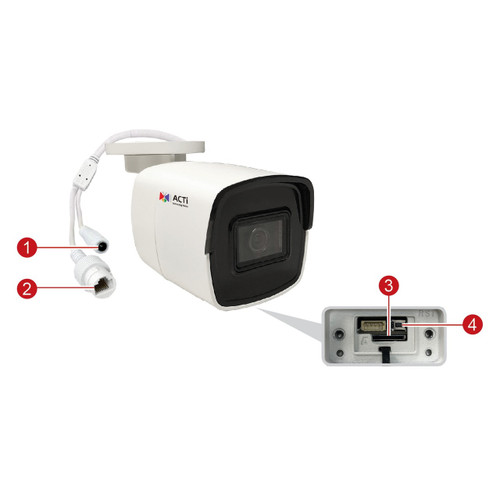
Power requirements differ materially: the A313 accepts DC 12 V or PoE Class 3 per IEEE 802.3af, while the listing also references PoE++ (802.3bt). The Z317 draws under 13 W over standard PoE (802.3af), which simplifies switch selection and reduces per-port power budget. The A313 connects via an RJ-45 pigtail and supports pole, wall, and board mounting; the Z317 is listed for wall and ceiling mounting. The A313 weighs 490 g (1.1 lb); Z317 weight is not specified.
Which fits your VMS and analytics better?
The A313 is ONVIF Profile S, G, T, and M compliant and is explicitly listed as compatible with Milestone, Axis Camera Station, and Genetec in addition to ONVIF-generic platforms. It also carries a UL Taiwan IoT Cybersecurity Certification. The Z317 is ONVIF Profile S compliant and is listed for mainstream NVR platforms; named VMS certifications beyond ONVIF Profile S are not provided in the available data.
The A313 includes a deep-learning processing unit supporting face detection and people counting, which reduces server-side analytics load on supported VMS platforms. The Z317 includes a built-in microphone for on-camera audio capture — audio capability is not specified for the A313. Edge storage support is not confirmed for either model in the provided specifications, though the A313's ONVIF Profile G compliance implies recording-to-edge-storage support per that profile's definition.
Which should you choose: the A313 or the Z317?
Our take: The A313 is the stronger choice when the deployment demands verified impact resistance, extreme-temperature operation, named VMS certification, or on-camera deep-learning analytics. The A313's IK10 rating versus the Z317's unspecified impact rating, its documented -40 °C to 60 °C operating range versus no stated range for the Z317, and its 150 dB WDR versus an unquantified WDR figure are three concrete spec advantages. The A313 also holds ONVIF Profile G and M alongside S and T, broadening VMS compatibility. The Z317 holds an edge where standard PoE (under 13 W, 802.3af) infrastructure is fixed and cannot supply higher wattage, and where built-in audio is required without adding an external microphone. Buyers on a tight per-port power budget or needing native audio in a compact bullet form will find the Z317's footprint appropriate; those specifying hardened outdoor or high-analytics deployments should favor the A313.
Side-by-Side Comparison
Spec-for-spec, from manufacturer data.
| Specification | ACTi A313 | ACTi Z317 |
|---|---|---|
| Resolution | 4MP (2688×1520) | 4MP (1440p / ~2560×1440) |
| Image Sensor Size | 1/2.7" | — |
| Lens / Focal Length | 2.8 mm fixed | 2.8 mm fixed, F2.0 |
| Min Illumination | Color: 0.003 lux; B/W: 0 lux (IR on) | — |
| IR Range | 65 m (850 nm LEDs ×3) | — |
| WDR | 150 dB (Extreme WDR) | WDR (dB not specified) |
| Max Frame Rate | 30 fps @ 2688×1520 | 25 fps @ 1440p |
| Video Compression | H.265, H.264, MJPEG | H.265, H.264 |
| Audio | — | Built-in microphone |
| IP Rating | IP68 | IP68 |
| IK / Impact Rating | IK10 | — |
| Operating Temperature | -40°C to 60°C (-40°F to 140°F) | — |
| Power Input / PoE Class | DC 12V or PoE 802.3af Class 3 (PoE++ ref. noted) | PoE 802.3af, under 13W |
| ONVIF Profiles | S, G, T, M | S |
| Edge Analytics | Face detection, people counting (DLPU) | — |
| VMS Compatibility | Milestone, Axis Camera Station, Genetec, ONVIF | Mainstream NVR platforms, ONVIF Profile S |
| Weight | 490 g (1.1 lb) | — |
| Warranty | 3 years | — |
Frequently Asked Questions
Which should you choose: the A313 or the Z317?
The A313 is the stronger choice when the deployment demands verified impact resistance, extreme-temperature operation, named VMS certification, or on-camera deep-learning analytics. The A313's IK10 rating versus the Z317's unspecified impact rating, its documented -40 °C to 60 °C operating range versus no stated range for the Z317, and its 150 dB WDR versus an unquantified WDR figure are three concrete spec advantages. The A313 also holds ONVIF Profile G and M alongside S and T, broadening VMS compatibility. The Z317 holds an edge where standard PoE (under 13 W, 802.3af) infrastructure is fixed and cannot supply higher wattage, and where built-in audio is required without adding an external microphone. Buyers on a tight per-port power budget or needing native audio in a compact bullet form will find the Z317's footprint appropriate; those specifying hardened outdoor or high-analytics deployments should favor the A313.
Is the A313 or Z317 better for low-light performance?
The A313 publishes a minimum illumination of 0.003 lux color and 0 lux B/W (IR on) with an IR range of 65 m using 850 nm LEDs. The Z317 lists adaptive IR and Day/Night switching but does not disclose minimum illumination or IR distance figures, so a numeric comparison is not possible. Based on available data, the A313 provides more verifiable low-light credentials.
Can I power the Z317 from a standard 802.3af PoE switch?
Yes. The Z317 draws under 13 W, which falls within the 802.3af Class 3 limit of 15.4 W at the port. The A313 is also listed as IEEE 802.3af Class 3 compatible alongside its PoE++ (802.3bt) reference, so both cameras can run on a standard PoE switch — though confirm the A313's actual draw against your switch's per-port budget before deployment.
Does either camera support on-board edge recording?
Neither camera's edge storage capability is confirmed in the provided specifications. The A313's ONVIF Profile G compliance typically indicates support for on-board recording to a local storage device per the ONVIF standard, but no SD card slot or storage spec is explicitly listed. The Z317's specs do not reference edge storage at all. Verify with ACTi's datasheets before relying on local recording for either model.
Get a Second Opinion on Your Camera Choice
Share your site layout, coverage goals, and budget. Our team will validate the camera selection, flag anything we would change, and recommend products that match the use case.