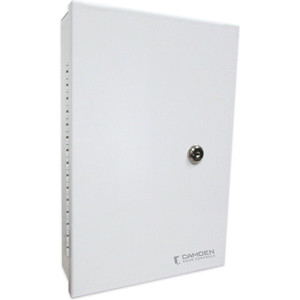
Camden CX-IRB Isolation Relay Module
Overview
The Camden CX-IRB is a Double Pole Double Throw (DPDT) isolation relay designed to solve a specific and recurring problem in access control and door automation installations: excessive power sources and electrical noise that can corrupt signals or damage sensitive equipment. When your integration layer (a controller, card reader, or access management system) needs to drive a door operator, mag lock, or auxiliary device but the power source introduces ground loops, induced voltages, or incompatible voltage levels, the CX-IRB sits between them and isolates the noise. It accepts 12 or 24 VDC input—jumper-selectable—and draws only 40 mA, making it safe to power from low-power access control buses. The compact form factor (1.5" W × 2.76" L × 0.79" H) means it fits inside existing electrical enclosures, door operator cabinets, or panel cutouts without redesign.
Key Features
- DPDT relay architecture: Two independent poles, each offering normally open (N.O.) and normally closed (N.C.) contacts, give you 4 state-change options from a single relay—useful when you need to drive two independent devices (a strike and a status light) or handle both energize-to-unlock and energize-to-lock strike types without extra wiring.
- 12/24 VDC input selection via jumper: Set JP1 for your control voltage at installation time; no need to stock two SKUs or request a custom model. Both levels draw the same 40 mA, so a 24VDC system can power it without oversizing the bus.
- 8-amp relay contacts (30VDC/120VAC rated): Handles standard electromagnetic locks (most require 200–500 mA), solenoid strikes, and auxiliary circuits. Not suitable for high-power motors or inductive loads without a suppression diode, but well-suited for access control's typical 200–400 mA loads.
- Red status LED (energized state): Visual feedback that the relay is receiving power and that the coil is active. On-site diagnostics without a meter—critical when troubleshooting a stuck strike or testing a new installation in the field.
- Operating temperature range −40°C to +70°C: Supports outdoor enclosures, stairwell cabinets, and mechanical rooms where ambient temperature swings. If your door controller sits in an unheated vestibule or above a loading dock, this rating ensures the relay doesn't chatter or fail during winter cold snaps.
- Compact DIN-rail or board-mount footprint: Mounts flush inside a metal enclosure, door operator housing, or small electrical cabinet without taking up valuable panel real estate. Ideal for retrofit installations where space is constrained.
Integration & Compatibility
The CX-IRB is a passive isolation device—it has no firmware, no network connection, and no protocol dependencies. It works with any access control system that can supply 12 or 24 VDC and accept a relay contact closure: legacy magnetic stripe readers, modern wiegand controllers, access management platforms (such as Milestone, Genetec, or on-premise systems), and custom integrations. Because it isolates the load circuit from the control circuit, it prevents ground-loop hum that can corrupt reader signals or cause false denial-of-access events. It is particularly useful when integrating third-party door operators or auxiliary devices rated for a different voltage or power signature than your control system expects.
What's in the Box
The CX-IRB ships with the relay module itself and one DIN-rail mounting clip (for panel installation). Wiring terminals are standard screw-clamp type—26–12 AWG wire supported. You will need to source wire and terminal blocks if installing into a new enclosure.
Frequently Asked Questions
Q: Can the CX-IRB handle both a door strike and a status relay at the same time?
A: Yes. The DPDT design gives you two independent poles. Wire the strike (typically 200–300 mA draw) to one pole's N.O. contacts and a 24VDC status indicator to the other pole's N.O. contacts. Both energize together when control voltage is applied to the coil.
Q: What happens if I wire the CX-IRB for 12VDC but the control system is only 5VDC?
A: The relay will not energize. The jumper must match your control voltage supply. If you have a mixed-voltage environment, you will need a separate CX-IRB set for each voltage, or use a 24VDC supply as the common bus.
Q: Is the CX-IRB suitable for outdoor enclosures?
A: The relay itself is rated −40°C to +70°C and will function in outdoor cabinets. However, the enclosure must provide IP65 or better protection; the CX-IRB module itself is not sealed against moisture or dust. Place it inside a NEMA 4X or IP66-rated cabinet.
Q: How much power does the CX-IRB draw from the control circuit?
A: 40 mA at either 12 or 24 VDC. This is a very light load—most access control buses rated for 1–2 amps can power multiple relays without stress.
Q: Can I use the CX-IRB with a wiegand reader that has a relay output?
A: Yes. If the reader supplies a 12 or 24 VDC relay-drive output, connect it to the CX-IRB coil terminals (V+ and V−) and set the jumper accordingly. The isolated contacts then drive your door operator or auxiliary load.
Q: What is the warranty on the CX-IRB?
A: Consult the original product documentation or contact the manufacturer at 1.877.226.3369 or 905.366.3377 for warranty terms.
I reach for the CX-IRB when an integrator tells me they're fighting ground loops between a legacy access controller and a new mag lock, or when a third-party door operator is causing false reads on a wiegand reader. The CX-IRB is one of those small, humble devices that saves a troubleshooting call. The DPDT architecture and jumper-selectable 12/24 VDC input mean you configure it once at the panel and it handles the isolation cleanly.
Technical Highlights:
- DPDT relay (two independent poles): Eliminates the need for two separate single-pole relays when you must drive both a strike and a status device. Four distinct state changes from one coil—N.O. and N.C. on each pole—gives you routing flexibility without extra board space.
- 40 mA coil draw (12 or 24VDC): Light enough to power from a standard 2-amp access control bus without overload risk. In retrofit scenarios, this means you often don't need to upgrade the power supply.
- 8-amp contacts at 30VDC/120VAC: Handles 300–400 mA electromagnetic locks and solenoid strikes without derating. Not designed for motor loads, but more than adequate for access control's typical devices.
- −40°C to +70°C operating range: Door operators mounted in unheated vestibules or outdoor enclosures won't cause relay chatter during winter temperature swings—a real concern with cheaper relays that lose sensitivity in cold.
Deployment Considerations:
- The CX-IRB is passive—no firmware updates, no compatibility matrix to check. It works with any 12 or 24 VDC source and any load under 8 amps. But you must set the JP1 jumper before installation; there is no field-selectable option.
- Wiring terminals are screw-clamp type (26–12 AWG). If you're integrating into a cramped door operator cabinet, ensure you have enough clearance to land wire and torque the terminals without pinching insulation.
- The red LED status indicator is valuable for field diagnostics, but it also means the device is drawing power continuously when energized. In very low-power remote deployments (battery-backed systems), account for the 40 mA draw in your power budget.
The CX-IRB shines in mixed-vendor integrations and retrofit projects where you need to isolate a messy power environment without adding complexity. If you're building a new access system and your control and load circuits are on the same clean 24VDC bus, you may not need isolation—but the moment you're bridging legacy gear, outdoor cabinets, or long cable runs prone to noise, the compact form factor and bulletproof DPDT design make this a pragmatic choice.