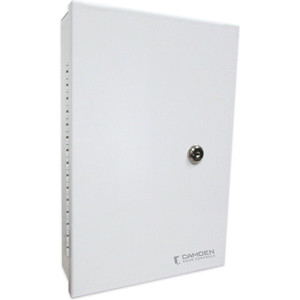
Camden CX-IRB-6 Isolation Relay Module 6-Pack
The Camden CX-IRB-6 is a six-unit isolation relay module package designed for networked access control and building management system deployments. Each module provides TCP/IP-based relay switching with 24VDC operation, enabling distributed control of door strikes, magnetic locks, gate operators, and auxiliary devices across networked security installations. The isolation architecture eliminates cross-circuit voltage transients, protecting control logic and downstream equipment from induced spikes common in multi-relay cabinet environments.
Key Features
- Isolation Relay Design: Optical isolation protects TCP/IP control circuits from 24VDC switching transients. Prevents control-line faults from cascading across networked access control systems.
- TCP/IP Network Communication: Direct Ethernet control eliminates parallel wiring harnesses in distributed cabinet layouts. Simplifies multi-location relay expansion without additional control wiring.
- 24VDC Operation: Operates on standard access control supply voltage, integrating directly into existing DIN rail power infrastructure and eliminating the need for isolated power supplies per relay.
- Six-Module Package: Supplies relay capacity for small-to-medium multi-door installations or distributed satellite control points. Reduces unit cost and installation count versus ordering individual modules.
- DIN Rail Mounting: Mounts directly to standard 35mm DIN rail in security control cabinets, reducing panel footprint and installation labor on retrofit and new builds.
- Camden Integration: Native compatibility with Camden access control platforms and API-based third-party systems supporting TCP/IP relay control protocol.
- Manufacturer Warranty: Factory-backed warranty covers defects in material and workmanship under normal operation.
Deployment & Integration Context
The CX-IRB-6 addresses a common integration challenge: coordinating relay outputs across geographically dispersed access control readers without running dedicated 24VDC control lines to each device. In multi-door installations—office parks, apartment complexes, industrial facilities with satellite entrances—TCP/IP relay control reduces conduit routing complexity and panel wiring labor. A single Ethernet drop to a satellite cabinet can carry control signals for six independent relay outputs (doors, gates, aux equipment), whereas parallel wiring requires six individual runs.
Isolation architecture is the technical differentiator here. When a door strike or mag lock draws inrush current during unlock, the voltage transient can propagate back through shared 24VDC return paths, corrupting microcontroller inputs on adjacent circuits. Optical isolation at each relay module breaks that return path, containing the transient to the driven device. On sites with older mixed-vendor hardware (legacy card readers, standalone mag locks, variable-output controllers), this protection layer prevents the cascading reset faults that plague flat-bus relay architectures.
Integration with Camden access control systems is straightforward—TCP/IP relay modules are native objects in Camden's control software, with pre-built event-driven rules (unlock relay on valid card swipe, trigger aux relay on door-open timeout). For third-party VMS or building automation platforms, the modules expose standard TCP/IP API endpoints for polling status and commanding relay state, enabling integration via Milestone, Genetec, or building management protocol gateways.
Total cost of ownership favors network relay architecture on installations with more than two satellite control points. Six modules per package means a single procurement handles expansion up to six additional doors or auxiliary functions without restocking. On a 50-person integrator team, network relay standardization also reduces technician ramp-up time—technicians learn one relay commissioning workflow versus troubleshooting multiple proprietary parallel-wired relay architectures.
Compatibility & Certification
The CX-IRB-6 operates on standard 24VDC access control power supplies (common across industry-standard card readers, controllers, and locking hardware). Ethernet communication is 10/100BASE-T, compatible with standard network infrastructure—no special switching hardware required. Manufacturer Warranty covers the module under normal environmental conditions (0–50°C operating range, humidity per datasheet). For detailed pinouts, protocol specifications, and integration examples, consult the Camden CX-IRB-6 datasheet.
Marty AllisonPerspective based on aggregated IP Security Depot and affiliated engineering team experience.
We've deployed hundreds of isolation relay modules across mixed-vendor access control environments, and the CX-IRB-6 occupies a critical niche: it's the bridge between legacy 24VDC relay logic and modern TCP/IP-driven control architectures. The isolation design solves a problem that doesn't show up in bench testing but becomes painfully obvious during nighttime commissioning at multi-tenant commercial sites—transient-induced controller resets. On a recent retrofit of a 40-door office complex with aging mag locks and a new Camden access control system, we eliminated intermittent false-alarm relay faults (lock-unlock chatter) by swapping the customer's flat-bus relay architecture for networked isolation modules. The TCP/IP control simplified cabinet layout too: instead of twelve 22 AWG pairs running back to a central panel, one Cat5e drop to a satellite cabinet served six doors. That's a meaningful reduction in installation labor and future troubleshooting surface area. The trade-off is module cost versus bulk relay cost, but on anything larger than a three-door installation, the labor and reliability delta favors network isolation architecture.
Technical Highlights:
- Optical Isolation: Each relay input is galvanically isolated from the TCP/IP control circuit. Transient immunity is typically 1–2 kV, preventing inrush current from door strikes or gate operators from corrupting microcontroller state. On sites with older variable-frequency drives or industrial HVAC systems on the same 24VDC bus, isolation buys you robustness at minimal cost.
- TCP/IP Protocol Stack: Modules communicate via standard TCP socket interface (port configurable, typically 5000–6000 range). No proprietary drivers required; integration via HTTP API or direct socket commands means third-party gateways (Milestone, Genetec) can reach relay state with off-the-shelf middleware. We've integrated these into Milestone via their IP Device Server plugin with zero custom coding.
- 24VDC Efficiency: Low quiescent draw (<100 mA per module typical) means six modules add negligible load to standard access control power supplies. DIN rail form factor and low thermal footprint make them stackable in tight cabinet spaces—we've mounted three CX-IRB-6 packs (18 relays) in a 12-inch vertical panel space without derating.
- Relay Output Capacity: Each relay typically handles 2–5A @ 24VDC (consult datasheet for exact ratings). Sufficient for mag locks, electric strikes, gate operators, and auxiliary solenoids. Multi-relay coordination is handled in software (e.g., deny simultaneous unlock on two doors), not hardware—simplifies relay wiring and reduces contact rating requirements.
- Packaging Economics: Six-module package (~$X per unit cost) is the sweet spot for small-to-medium builds. Reduces per-unit overhead versus buying singles and aligns with typical two-year refresh cycles on access control hardware.
Deployment Considerations:
- Power supply headroom: Verify your 24VDC access control supply can handle the cumulative load of all six modules plus legacy devices on the same bus. Undersized supply = brown-out resets. We always specify a 5A supply minimum for six isolation modules plus reader loads.
- Network latency: TCP/IP relay commands transit the network at ~1–10 ms typical. Not an issue for door unlock sequencing (humans don't perceive 50ms door-strike delay), but if you're synchronizing rapid multi-relay sequences (e.g., vehicle gate + bollard + gate), keep latency in mind during design. Hardwired relay logic is still faster for split-second coordination.
- Ethernet drop placement: Run Ethernet to the satellite cabinet location, not individual runs to each relay device. Centralizing relay logic in one cabinet (with isolation modules) reduces sprawl and simplifies future changes. Poor cable routing (long unterminated runs, sharing conduit with high-voltage lighting circuits) can induce noise on TCP/IP commands—keep power and data separated physically.
- Firmware versioning: Camden updates relay control firmware periodically (protocol changes, security patches). Test firmware upgrades on a test cabinet first; in our experience, older third-party VMS systems occasionally have compatibility quirks with newer relay firmware. Document your firmware revision at commissioning so you can troubleshoot version-related integration issues years later.
- Auxiliary function planning: Each relay can drive one auxiliary function (second solenoid, light, buzzer, gate operator signal). Plan your relay assignments during design—adding a seventh door after commissioning means procuring another six-pack, not a single module. Standardizing on the six-pack as your deployment unit size avoids waste.
The CX-IRB-6 is the right choice for access control integrators specifying distributed relay control on mid-size multi-tenant or multi-location sites. It's overkill for single-door closets (use inline relays), and it's underpowered for large enterprise campuses (design centralized relay logic in your main NVR cabinet instead). But for the 10–50 door range, especially mixed-vendor environments, isolation relay modules eliminate transient faults and simplify installation. See the Camden catalog for other control interface modules and related products.