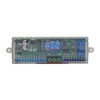
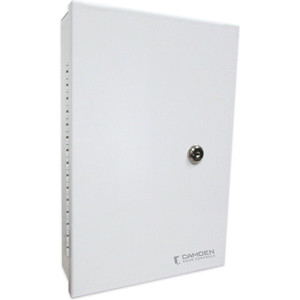
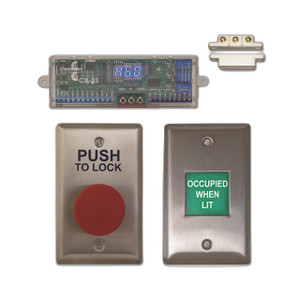
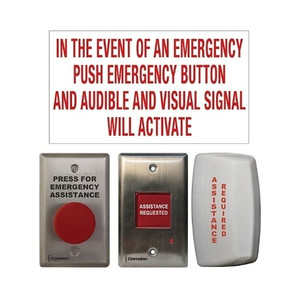
Camden CX-33 Advanced Logic Relay Controller
The Camden CX-33 is a dedicated relay controller designed for small-to-mid-scale access control installations requiring straightforward multi-door logic. Operating at 24VDC, it coordinates keypad credential readers with magnetic strike locks across up to three doors simultaneously, making it well-suited for office buildings, facilities management, institutional environments, and retrofit projects where simplicity and reliability outweigh the overhead of networked access platforms.
Key Features
- 3-Door Capacity: Manages up to three independent door access points from a single controller, reducing deployment footprint and simplification of wiring versus separate relay modules per door.
- Keypad Reader Integration: Native support for keypad-based credential entry — no card reader complexity or enrollment database — lowering total cost of ownership on small deployments.
- 24VDC Magnetic Lock Control: Direct relay output for standard electromagnetic strike locks; integrates with standard 24VDC power supplies and battery backup systems.
- Backup Battery Support: Built-in battery connector allows failsafe hold-open or secure lock-down mode during power loss, configurable per site requirements.
- Wall-Mount Enclosure: Compact form factor fits standard electrical boxes; reduces installation labor versus DIN-rail or panel-mount alternatives on retrofit jobs.
- Lock-Down Mode: Hardwired fail-secure operation — locks remain energized until power is restored, maintaining access control integrity during outages or tampering attempts.
- Wide Operating Temperature: −20°C to 70°C (−4°F to 158°F) rated, suitable for unheated lobbies, exterior vestibules, and warehouse environments without climate control.
- 3-Year Manufacturer Warranty: Factory warranty covers defects in materials and workmanship; streamlines risk allocation on capital projects.
The CX-33 operates as a pure logic relay device — no software licensing, no VMS integration overhead, and no network dependency. This makes it ideal for access control scenarios where a facility has simple, fixed entry rules (e.g., "this keypad code opens Door A and Door C during business hours") and does not require remote audit logging or real-time monitoring. The keypad-only credential model avoids the capex and operational complexity of card reader hardware, credential management software, and card issuance workflows that plague larger deployments.
Installation is straightforward: mount the CX-33 in a wall enclosure near the secured door(s), run low-voltage wiring (24VDC power, keypad signal, strike lock outputs) to each reader and lock, and configure the relay logic per the site access policy. Backup battery connections allow graceful degradation during power loss — either maintain unlock state for emergency egress or enforce lock-down to prevent unauthorized entry. The device operates independently of network infrastructure; no Ethernet, no configuration software, no firmware updates. That isolation is both a strength (simplicity, resilience) and a limitation (no centralized audit trail, no remote unlock capability).
Because the CX-33 relies on relay-based switching rather than intelligent access control software, credential management is manual — staff must physically modify keypad codes or physically wire logic changes if access policies change. For facilities with stable tenant occupancy and fixed security rules, this poses minimal operational friction. For larger or more dynamic environments requiring frequent credential revocation, remote unlock capability, or detailed audit reporting, a networked access control platform (Axis A8004-VE, Hanwha SmartAccess, or equivalent) would be more appropriate despite higher upfront cost.
The CX-33 complies with standard electrical safety codes and integrates seamlessly with commodity 24VDC power supplies, battery backup modules, and electromagnetic strike locks available from any security distributor. No proprietary ecosystem, no vendor lock-in — this is a relay module designed for mechanical robustness and long-term field reliability. For integrators servicing small office complexes, retrofit projects, or facilities with simple fixed access rules, the CX-33 delivers straightforward multi-door control without the software and licensing overhead of modern IP-based systems. Review the Camden CX-33 datasheet for detailed wiring diagrams, relay output specifications, and battery backup configuration options.
Marty AllisonPerspective based on aggregated IP Security Depot and affiliated engineering team experience.
We've deployed the Camden CX-33 across dozens of small-office retrofits and institutional facilities where the simplicity of relay-based logic outweighs the sophistication of networked access platforms. The real operational win is what the CX-33 doesn't have: no database schema, no software licensing fees, no network dependency, no firmware patching cycles. On a three-door office vestibule retrofit — where the facility manager wants "Conference Room A unlocks 8am–6pm weekdays, visitor door unlocks 9am–5pm, and emergency egress is always free" — the CX-33 lets you wire the logic once, walk away, and not touch it for five years. Compare that to a modern IP access control system where you're managing credential databases, enforcing software support contracts, and coordinating network infrastructure. For that use case, the CX-33's simplicity is a massive competitive advantage.
The keypad-only credential model is a double-edged sword. On the plus side, no card reader hardware to maintain, no lost-card replacement friction, and no credential management software overhead. On the minus side, you have no audit trail — no timestamped log of who unlocked which door, when. If your facility needs evidentiary access records (healthcare, banking, law enforcement), you'll need to pair the CX-33 with a separate video surveillance system that logs entry/exit visually. The relay controller itself logs nothing.
Technical Highlights:
- 24VDC Relay Switching: Direct 24VDC output to electromagnetic strike locks eliminates the need for intermediate power supplies on each lock. One 24VDC transformer powers the controller and all three locks simultaneously — straightforward load calculation, reduced wiring complexity, and measurable savings on installation labor for retrofit jobs.
- Lock-Down Mode Configuration: Fail-secure energization means locks remain locked during power loss unless explicitly configured for failsafe (unlock-on-power-loss). This is a critical safety feature for secure facilities; you set it once during commissioning and don't rely on battery backups for security posture.
- 3-Door Independence: Each door relay output is independently controlled — you can wire logic such that Door A and Door B unlock on keypad Code 1, while Door C unlocks only on Code 2. No software, just relay wiring. Operational changes require re-terminating wiring, which is a limitation but also guarantees that unauthorized credential changes cannot happen via software or network attack.
- Backup Battery Connector: Integrated battery terminals allow connection of external 12V lead-acid or sealed batteries for emergency egress unlock or graceful lock-down during power loss. Battery runtime is dictated by lock hold current (typically 400–600mA per lock) and battery capacity; a 7Ah battery holds three locks energized for approximately 10–12 hours.
- Wide Temperature Rating: −20°C to 70°C rating means the controller operates reliably in unheated lobbies, loading docks, and exterior vestibules without environmental conditioning. Relay contacts remain clean and responsive across the full range; no thermal drift in logic timing.
Deployment Considerations:
- Credential Management is Manual: Changes to access codes require physical keypad programming or facility staff training on keypad reset procedures. There is no centralized credential database or remote revocation. If you need rapid credential changes across multiple facilities, this is the wrong platform — plan for IP-based access control instead.
- No Audit Logging: The CX-33 does not generate timestamped event logs. If compliance or forensic access auditing is required (HIPAA, SOC 2, banking regulations), integrate video surveillance with audio/visual correlation at doors. The controller handles enforcement; video handles the audit trail.
- Strike Lock Sizing: Verify that your strike lock draw is compatible with the relay output rating. Typical magnetic locks draw 400–600mA at 24VDC; three locks simultaneously drawn = 1.2–1.8A peak current. Confirm your 24VDC power supply is rated for this load plus any other accessories (LED indicators, door sensors). Undersized power supplies cause relay chatter and premature lock solenoid failure.
- Wiring Layout: Low-voltage wiring must be run in separate conduit from high-voltage AC power (per NEC Article 725). On retrofit jobs, this often means opening walls or running conduit externally. Budget accordingly — wiring complexity often outpaces hardware cost on small jobs.
- Battery Failsafe Testing: If backup battery is installed, test the failsafe behavior quarterly: simulate a power loss and verify that locks transition to the configured state (locked or unlocked) and that battery voltage is adequate. Battery self-discharge can silently reduce runtime over 12–24 months.
- Integration with Video: The CX-33 does not output access events to external systems. If you need video to trigger on unlock events or vice versa, you will need to manually timestamp video clips during incident investigations. Consider deploying cameras with local recording and synchronized system clocks for easier forensic correlation.
The CX-33 is the right choice for facilities with stable access policies, simple multi-door topologies, and a tolerance for manual credential administration. School district administrative offices, small legal firms, healthcare clinics with fixed occupancy, and retrofit projects where network infrastructure is unavailable or undesired are all strong fits. For larger or more fluid environments requiring real-time audit logging, remote credential revocation, or integration with building management systems, explore networked access control platforms. For straightforward keypad-and-lock simplicity, the Camden CX-33 remains a reliable workhorse. Review the Camden catalog for additional relay controllers and integration modules.