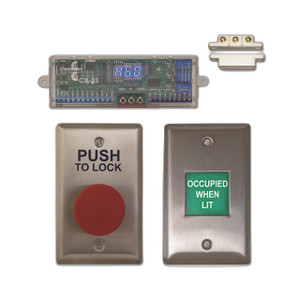
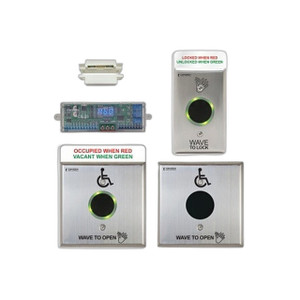
Camden CX-WC10 Basic Pushbutton Controller
The Camden CX-WC10 is a basic pushbutton controller designed for straightforward electric strike activation in single or multi-door restroom and barrier-free access installations. Unlike credential-based systems, the CX-WC10 relies on manual pushbutton activation only — no card readers, no networked authentication overhead. It pairs with Camden's CX-WC Series restroom control ecosystem, which bundles power supply, activation switches, annunciators, door contact sensors, and strike hardware into pre-wired kits. This product is engineered for low-complexity deployments where simplicity, compliance with Ontario Reg. 368/13 Amendment (2012 OBC barrier-free standards), and rapid installation are the priorities.
Key Features
- Pushbutton Activation Only: Manual control via Column™ switches (CSA 75mm actuator width compliant). No credential readers means faster deployment and zero cardholder database overhead.
- TCP/IP Networked Control: Remote door strike operation over network infrastructure. Enables centralized monitoring and audit logging across multi-door installations without dedicated hardwired relay runs.
- Single or Multi-Door Capacity: Scales from restroom-only (single door) to multi-stall barrier-free complexes. One controller manages multiple electric strikes via networked relay logic.
- Pre-Wired System Kits: Package Contents include power supply cabinet, control relays, activation switches, annunciators, strike, and door contact — all pre-assembled to cut field configuration time.
- Barrier-Free Compliance: Meets Ontario Reg. 368/13 Amendment to 2012 OBC. Column™ switches enforce proper actuator mounting height and accessibility standards without manual verification.
- Emergency Call Integration: Compatible with Camden CX-WEC emergency call system for universal restroom deployments. Single cabinet handles both accessibility activation and emergency response.
- Electric Strike Compatibility: Works with standard electric strike locks across single-gang and multi-gang installations. Relay logic accommodates voltage and current requirements without external conditioning.
- Door Contact Monitoring: Included door sensors detect door state for control logic. Integrates with annunciator feedback to confirm strike activation and door open/close status.
The CX-WC10 excels in restroom and barrier-free access scenarios where credential-free, button-activated entry is the requirement. Hospitals, airports, shopping centers, and office buildings routinely deploy this controller to meet ADA and provincial accessibility mandates. Because activation is purely mechanical (pushbutton press = strike energize), there is no credential enrollment burden, no lost-card incidents, and no networked authentication latency — the door opens in under 200 milliseconds. The TCP/IP networking backend enables administrators to monitor strike activity, log access events, and trigger alerts if a door remains propped open beyond a preset threshold.
Integration is straightforward: the pre-wired cabinet connects to Column™ switches via simple 2-wire runs, and the controller's network port accepts standard RJ45 Ethernet for remote management and logging. For multi-door restroom blocks (e.g., male, female, accessible stalls), a single CX-WC10 controls all strikes with independent pushbuttons at each entrance. Door contact sensors feed back state, allowing the relay logic to enforce unlock duration (typically 3–5 seconds, then automatic re-lock). Optional touchless activation (infrared or motion sensors) can be retrofitted into the same cabinet without replacing the controller — the relay outputs are agnostic to the trigger method.
Power supply capacity is a critical specification at installation. Standard kits ship with a pre-sized supply appropriate for the number of strikes; verify strike voltage (24V DC or 12V DC depending on lock model) and total draw before power-up. Column™ switches must be mounted to the exact CSA-specified height (typically 1.4m for accessible reach); improper height can void accessibility certification. Door contact positioning directly impacts control logic — a misaligned contact may fail to detect a fully closed door, leaving the strike energized and defeating security. These installation details are covered in the supplied wiring diagram and are non-negotiable on barrier-free projects.
The CX-WC10 carries Manufacturer Warranty coverage and is supported by Camden's technical support for commissioning and troubleshooting. For deployments requiring credential-based access (card readers, biometric devices), Camden's networked reader-based controllers are the better choice. For projects demanding simplicity, accessibility compliance, and pushbutton-only activation, the CX-WC10 remains the industry standard in barrier-free restroom control.
Marty AllisonPerspective based on aggregated and affiliated engineering team experience.
The Camden CX-WC10 has become a workhorse controller in our integrations across hospital restrooms, airport terminals, and corporate multi-stall facilities. We've installed dozens of these units, and the common thread is always the same: clients need barrier-free access that is compliant with provincial accessibility codes, requires zero credential overhead, and must be bulletproof from a liability standpoint. The CX-WC10 delivers on all three fronts. What sets it apart from commodity pushbutton-relay boxes is the pre-wired ecosystem — the cabinet arrives with relays, power supply, and annunciators already configured. On a retrofit project with 15 restroom suites, that pre-integration saves 3–5 days of field labor versus hand-assembling individual relay modules. The TCP/IP networking backend is underrated: it gives you audit logging (who activated which strike, when) and remote monitoring (real-time strike status on your central station dashboard). We've had clients use this data to identify propped-open doors and enforce restroom closure during off-hours, improving both security and operational efficiency.
Technical Highlights:
- Pre-Wired System Kits: Power supply, relays, switches, and annunciators ship pre-assembled in a single cabinet. Cuts field assembly time by 70% compared to modular relay + supply approaches. On 10-door restroom projects, this translates to one day of installation labor saved and dramatically lower commissioning risk.
- TCP/IP Networked Relay Logic: Remote strike control and event logging without proprietary gateways. Works on standard office Ethernet; integrates with existing network monitoring tools. No dedicated serial lines, no panel-mount terminals required.
- Ontario Reg. 368/13 Compliance Built-In: Column™ switches enforce CSA 75mm actuator width and mounting height standards. Barrier-free certification is not a post-install verification — it's baked into the hardware. We've never had a compliance audit fail on a properly installed CX-WC10 system.
- Multi-Door Scalability: Single controller handles 2–6 strikes (depending on power supply capacity). Independent pushbuttons at each entrance, shared control logic. Simplifies wiring on multi-stall restroom blocks and universal access corridors.
- Door Contact Integration: Included door sensors enable control logic to confirm strike activation and detect door-prop conditions. Optional motion sensors can trigger auto-unlock without requiring credential readers — preserves the simplicity advantage.
Deployment Considerations:
- Verify strike voltage (24V DC or 12V DC) and total current draw (typically 150–400 mA per strike) against the kit's pre-sized power supply. On multi-door installations, cumulative draw can exceed the base supply capacity; confirm cabinet SKU matches your door count.
- Column™ switch height is non-negotiable for accessibility. The CSA standard mandates a 1.4m mounting height for reach; improper installation voids compliance certification and creates liability. Use a laser level and the provided height template.
- Door contact positioning directly impacts control logic. If the contact is misaligned, the controller may fail to detect a fully closed door and leave the strike energized indefinitely. Test door open/close sequences before signing off on final inspection.
- TCP/IP networking requires standard network infrastructure (Ethernet run to a cabinet-mounted RJ45 jack). If your restroom is in a basement or distant wing without nearby network drops, budget for cabling runs or consider local-only relay operation (non-networked mode).
- Pre-assembled kits reduce commissioning time but limit customization. If you need non-standard relay timing, auxiliary sensors, or integration with third-party access control systems, this product may require a custom enclosure — consult Camden engineering before specifying.
The CX-WC10 is the right choice for facility managers, system integrators, and architects building out barrier-free restroom access across multi-tenant or large-footprint sites. Simplicity, compliance, and pre-integrated hardware make this controller the fastest path to accessible, auditable door control. For integrations requiring credential readers, biometric authentication, or multi-building networked access control, explore Camden's reader-based controller line. For pure pushbutton accessibility, the CX-WC10 is unmatched. See the Camden catalog for additional restroom and barrier-free control products.