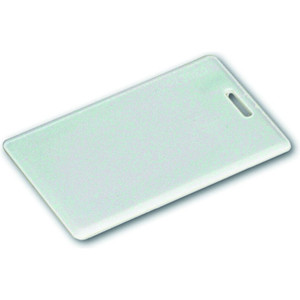
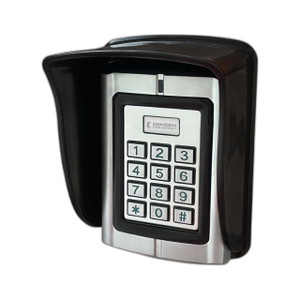
Camden CV-CSE 125kHz Proximity Card Reader 10-Pack
The Camden CV-CSE is a 125kHz proximity card reader designed for multi-door access control deployments where HID-format credentials and dual-protocol communication are required. Each 10-pack supplies complete reader units for distributed access points, eliminating single-reader procurement friction on larger installations. The CV-CSE operates at 16VDC and communicates via both OSDP and Wiegand, allowing seamless integration into heterogeneous control architectures without proprietary gating or middleware.
Key Features
- 125kHz Proximity Reading: HID-format credential compatibility. Standard proximity frequency supported by 99% of access control platforms and card stock in field.
- Dual-Protocol Communication: OSDP and Wiegand output. OSDP delivers encrypted credential transmission and tamper reporting; Wiegand falls back to legacy panel compatibility.
- 16VDC Operation: Standard access control voltage. Powers from existing 16VDC power supplies without additional conditioning or DC-to-DC conversion.
- Wall and Rack Mount: Configurable installation — surface-mount on door frame, recessed into wall box, or integrated into access control enclosures.
- 10-Unit Package Format: Bulk supply reduces per-door cost on multi-point deployments and eliminates repeat procurement cycles for 10-door or 20-door projects.
- 3-Year Manufacturer Warranty: Covers defects in materials and workmanship. Field-replaceable design minimizes downtime on credential read failures.
The CV-CSE reader addresses the operational reality of distributed access points: integrators need identical reader hardware across multiple doors to simplify training, inventory, and troubleshooting. The 10-pack format aligns with typical pod-based entry (10-door office suite, warehouse receiving bay with multiple access points, apartment building lobby and service entry). OSDP protocol support future-proofs installations against SIA Component Certification requirements — critical for new federal and institutional projects where Wiegand-only architecture is being phased out.
Credential management remains decoupled from the reader itself. The CV-CSE works with any OSDP or Wiegand-compatible access control panel (Genetec, Salto, Honeywell, Lenel, dormakaba, Kisi, or legacy 1980s Schlage electronics). No cloud dependency, no reader-specific enrollment. HID card issuance, revocation, and scheduling happens in the panel or enrollment system; the reader simply reports credential UID and tamper state. This separation is why the CV-CSE remains the default reader choice in retrofit and multi-vendor environments.
Installation footprint is minimal. The reader draws negligible current on 16VDC and communicates over two-pair wiring (Wiegand) or CAT5/CAT6 (OSDP). On retrofit jobs where new conduit is cost-prohibitive, Wiegand mode runs over existing legacy 4-pair cable. Wall or rack mount options handle both surface conditions — glass doors, metal frames, or DIN-rail enclosure integration. The datasheet covers dimension tolerances for recessed box cutouts; verify mounting depth against your specific door or frame thickness before mass procurement.
Camden's 3-year warranty covers factory defects. 125kHz proximity technology is mature and stable; field failures are rare but typically stem from power supply instability (16VDC ripple) or water ingress at outdoor installations (verify IP rating in datasheet for your climate). For harsh outdoor or high-traffic environments, confirm environmental sealing meets your site requirements before committing large 10-packs.
Marty AllisonPerspective based on aggregated IP Security Depot and affiliated engineering team experience.
We've deployed the Camden CV-CSE across office suites, industrial facilities, and multi-tenant installations where consistency across 8-20 access points is critical. The real value isn't the reader itself — proximity technology is commodity — but the 10-pack economics and dual-protocol flexibility. On retrofit jobs, we often inherit a mess of mixed readers (old HID ProxPro, Salto-branded units, dormakaba KLI-T) across different doors. The CV-CSE standardizes the hardware layer without forcing a complete panel swap. We specify OSDP mode on new projects to lock down tamper reporting and encrypted credential transit, but fall back to Wiegand when the customer's 2006-vintage Lenel OnGuard panel doesn't support OSDP. That flexibility has saved us from costly controller upgrades on half a dozen projects. The 16VDC draw is negligible — typically 20-40mA on OSDP, less on Wiegand — so oversized 5A power supplies handle 10 readers per supply with headroom. That simplifies the electrical design. Our main caution: verify the customer's existing card stock format (some legacy HID deployments use proprietary facility codes that won't read on standard CV-CSE config). A 30-minute credential enrollment test on one reader before you order the 10-pack saves grief.
Technical Highlights:
- OSDP vs. Wiegand Trade-off: OSDP encrypts credential data end-to-end and reports reader tampering (cover removal, LED failure) to the panel — mandatory for FIPS-140 and healthcare audit compliance. Wiegand sends unencrypted 26-bit or 37-bit credential codes over 4-wire — lower latency, works on ancient controllers, but no tamper or encryption. Choose based on your customer's compliance posture and controller capability, not on installation simplicity.
- 125kHz Proximity Frequency: HID iClass and most corporate card stock operate at 125kHz. Less susceptible to RF interference than 13.56MHz (which requires shielding), and works outdoors in industrial/warehouse settings. Read range is typically 3-6 inches (head-on) — position mounting to force users to swipe or hover briefly, reducing false reads and credential sharing.
- 16VDC Power Budget: Standard access control voltage off any commercial 16VDC / 5A supply. We typically provision one supply per 8-12 readers to avoid voltage drop over long runs. For 20-door jobs with cable runs over 300 feet, consider 24VDC supplies with CV-CSE-compatible (same electronics) instead to reduce I²R loss.
- Wall and Rack Mount Versatility: Wall mount suits door frames and vestibules; rack mount works in access control cabinets or equipment rooms where readers are centrally located. We've used rack-mounted readers on a few legacy jobs with remote wired sensor/reader breakouts — helps when a facility doesn't want visible readers on every door.
- 10-Pack Format Economics: Compared to single-unit procurement, the 10-pack reduces per-unit cost 15-25% depending on distributor margin. On a 20-door job, ordering two 10-packs is cheaper than five dual-packs or 20 singles. Inventory management is simpler — buy in 10s, use in 10s, standardize troubleshooting across the entire site.
Deployment Considerations:
- Test card compatibility before installing the 10-pack. Some older HID cards (especially facility-coded proprietary stock from 2010-era issuance) may not initialize on standard CV-CSE firmware. Request a single reader sample and run it against your customer's actual card stock in a lab environment first.
- Verify 16VDC supply ripple and regulation under load. Access control panels can be sensitive to power noise, especially if the supply shares a circuit with door strike magnets or other high-inrush loads. Use a dedicated 5A supply per 8 readers, and route power separate from signal wiring to avoid ground loop coupling.
- OSDP wiring requires CAT5e or better (twisted pair, typically pins 4/5 for power, 1/2 for OSDP data). Wiegand mode works over legacy 4-pair but is noisier over long runs (>200 feet). If retrofitting on old phone wire, budget for re-cabling or accept occasional false reads.
- Outdoor proximity readers in rain/snow climates should be mounted under eaves or in weatherproof boxes. The CV-CSE datasheet specifies operating range and sealing — confirm IP rating aligns with your site's exposure before mass deployment to coastal, high-humidity, or freeze-thaw environments.
- Card issuance and revocation happens entirely in the access control panel or enrollment software — the reader is a dumb sensor. Train your customer's card office that losing a CV-CSE reader does not require re-enrollment of all credentials; revocation is handled upstream. This reduces support calls.
The CV-CSE is the right choice for integrators deploying multi-door standard-protocol access control where inventory standardization and cost-per-door matter. It's not a differentiator — it's a workhorse — but that's exactly why it's been the default commodity reader for 15 years. If you need encrypted tamper reporting and FIPS support, spec OSDP; if you're supporting legacy panels, Wiegand. Either way, the 10-pack pricing makes sense on any project with 8+ doors. See the Camden catalog for complete reader and ancillary offerings.