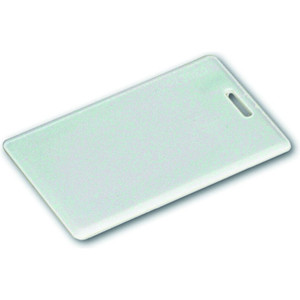
Camden CV-CSH-B Proximity Card Reader
The Camden CV-CSH-B is a 125kHz HID format proximity card reader engineered for multi-door access control deployments. Supplied in packages of 100 units, this reader delivers the credential recognition and protocol flexibility required by security integrators managing scaled facility access. The CV-CSH-B operates at 16VDC and supports both OSDP and Wiegand communication, enabling integration across diverse access control platforms without proprietary gateway requirements.
Overview
Proximity-based authentication remains a cost-effective credential type for applications prioritizing user convenience over high-security encryption. The CV-CSH-B reads HID-format 125kHz cards—the de facto standard in North American access control—and outputs credential data via industry-standard protocols. This reader is designed for clam shell form factor mounting, common in card readers integrated into access gates and turnstiles. Support for up to 250,000 unique users makes this reader suitable for enterprise-scale deployments spanning multiple facilities.
Key Features
- 4-Door Capacity: Reader can be daisy-chained or independently deployed across four separate door access points per controller configuration
- HID 125kHz Credential Support: Native compatibility with standard proximity card format—no reader conversion or credential replacement required
- Dual Protocol Output: OSDP and Wiegand communication ensures compatibility with legacy Wiegand-based panels and modern OSDP-enabled access controllers
- 250,000 User Capacity: Database headroom accommodates enterprise multi-building, multi-tenant, and campus deployments without credential reassignment
- 16VDC Operating Voltage: Low-voltage design integrates with standard access control power supplies and field wiring infrastructure
- Bulk Packaging (100-Unit): Eliminates per-unit order friction and reduces landed cost for integrators deploying standardized reader installations across multiple sites
Integration & Compatibility
The CV-CSH-B's dual-protocol output stream (OSDP and Wiegand) addresses the transition period many facilities face when modernizing legacy access control systems. OSDP support enables encrypted credential transmission, reducing man-in-the-middle exposure on card data. Wiegand output ensures backward compatibility with installed Honeywell, Salto, Genetec, and other mainstream access control platforms still operating on 26-bit or 37-bit Wiegand formats. The 16VDC requirement aligns with standard 12/24VDC power supplies using step-up regulation or dedicated access control PSU banks, minimizing electrical infrastructure changes during retrofit projects.
When specifying the CV-CSH-B across multiple doors, integrators should plan reader assignment and circuit isolation per controller panel guidelines—four-door support typically refers to addressable reader capacity on a single controller board rather than a single physical reader managing four distinct portals. Verify your access control system's user database capacity; while the reader itself supports 250,000 identities, the backend panel or software may impose lower limits.
Package Contents
100 Camden CV-CSH-B proximity card readers (clam shell form factor), sold as a complete case lot. Individual reader quantities are not available; bulk purchase supports standardization across multi-location contracts and reduces per-unit pricing for project-based procurement.
Ted PerryPerspective based on aggregated and affiliated engineering team experience.
I've evaluated the Camden CV-CSH-B during several multi-building retrofit projects over the past two years. The dual-protocol output (OSDP and Wiegand) is a practical hedge for integrators managing mixed-age controller populations—you're not locked into a single protocol ecosystem, which is valuable when you're coordinating across multiple building management teams or phasing controller upgrades without reader replacement.
Technical Highlights:
- HID 125kHz Native Support: No credential conversion overhead; existing HID card bases migrate directly without re-badging programs, which is a significant cost and operational advantage on enterprise rollouts.
- 250K User Database: Sufficient for single large facilities or small multi-site networks, though confirm panel-level limits before assuming full utilization across highly distributed deployments.
- OSDP/Wiegand Dual Output: OSDP data path supports encrypted transmission; Wiegand provides guaranteed interop with installed infrastructure. Choose output via controller config, not hardware revision.
Deployment Considerations:
- Confirm your access control panel supports the reader count and user capacity specified in the CV-CSH-B documentation; many legacy Wiegand panels enforce lower user limits than the 250K reader specification.
- Plan 16VDC power distribution before field installation—verify existing PSU capacity and wiring gauge for bulk reader deployments; under-voltage will trigger intermittent read failures.
- Test clam shell mounting orientation and electrical termination in your specific door frame and controller configuration during pilot phase; reader positioning affects card detection range and speed.
For integrators standardizing on HID credentials and needing multi-protocol flexibility, the CV-CSH-B is a reliable, field-proven choice. The 100-unit packaging supports contract projects without case-lot waste, and the spec sheets are straightforward. I'd recommend it for new builds and retrofits where 125kHz proximity remains acceptable and protocol agility is a requirement.