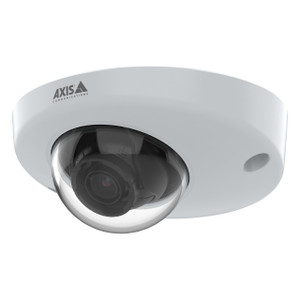
Axis 02670-001 2MP Full HD Onboard Fixed Dome IP Camera
Overview
The Axis 02670-001 is a fixed-dome IP camera engineered specifically for onboard vehicle surveillance — buses, trains, and transit systems where durability, image clarity in mixed lighting, and compliance with transportation standards are non-negotiable. This IP camera delivers 2MP (1920 × 1080) Full HD resolution via H.264 compression, capturing passenger activity and incidents with sufficient detail to meet law enforcement review standards without bloating storage on 24/7 multi-camera systems.
Built to survive the mechanical stresses of vehicle operation, the 02670-001 carries IP66 and IP67 ratings — meaning dust ingress and sustained spray won't degrade the image sensor. The IK10 impact resistance handles vibration, door slams, and minor collisions without optical misalignment. Frame rate reaches 30 fps (25 fps in PAL regions) at all resolutions, with 45 fps available in 720p if you need burst capture during high-activity periods.
Key Features
- Forensic WDR and Lightfinder: Wide Dynamic Range processing handles the lighting extremes found in vehicle cabins — bright windows, dark aisles, and reflective surfaces in a single frame. Lightfinder boost ensures full-color capture even when ambient light drops below 0.5 lux, avoiding the IR-only grayscale footage that degrades facial recognition downstream.
- Traffic Light Mode: Specialized color-detection algorithm locks on traffic signal colors in low-light conditions, critical for intersection monitoring on transit routes. This is purpose-built for legal compliance and incident reconstruction.
- 3.6 mm, F2.0 fixed lens: Delivers an 88° horizontal field of view — wide enough to monitor a vehicle cabin or station platform without requiring pan-tilt. The F2.0 aperture gathers more light than narrower optics, supporting low-light performance without aggressive digital zoom noise.
- EN50155 and EN45545 compliance: Certified for electronic equipment in railway environments and fire safety standards. If you're deploying across transit fleets, this eliminates recertification headaches at the vehicle level.
- Zipstream compression: Axis's own codec optimization intelligently reduces bitrate in static areas (walls, empty seats) while preserving detail in zones with motion. On a 12-camera bus system recording 24/7, this cuts storage requirements by 30–50% compared to unoptimized H.264, directly lowering NVR capacity and archive costs.
- Axis Edge Vault and signed firmware: Prevents unauthorized image tampering and blocks unsigned code execution on the device. For transit operators subject to chain-of-custody regulations, this is mandatory.
- PoE (IEEE 802.3af/at) powered: Draws approximately 13W maximum via standard Power over Ethernet. No separate 12V power supply needed inside the vehicle — one Cat6 cable handles both video and power, reducing wiring complexity in confined spaces.
- Optional external mounting: When paired with the AXIS TP3826-E housing, the camera can mount on the vehicle exterior to monitor blind spots, entry/exit, or external incidents. The housing extends the camera's environmental tolerance and adds mechanical shock absorption.
Integration and Compatibility
The 02670-001 is ONVIF Profile S compliant, ensuring compatibility with third-party video management systems (VMS) such as Milestone XProtect, Genetec Security Center, and open-architecture platforms. Axis Camera Station also supports native integration with event triggers, custom analytics, and edge storage workflows.
The camera's 1/2.9" progressive-scan CMOS sensor outputs native H.264 streams, minimizing transcoding overhead on recording servers. Pair this camera with a managed PoE switch that supports 802.3at to consolidate power delivery across multiple units; a single 16-port switch can safely power up to 12 of these cameras with headroom.
When to Choose a Different Model
If you need higher megapixel count for long-distance facial recognition (50+ meters), consider stepping up to Axis's 5MP or 8MP onboard variants in the same family — though they draw more power and require PoE+ (802.3at). If external mounting is the primary use case and you want higher zoom coverage, explore Axis PTZ models designed for vehicle exterior duty; they consume more power and introduce moving parts that require more frequent maintenance in harsh transit environments.
For indoor-only, stationary transit hubs or platforms, a non-rugged indoor dome will cost less and simplify cabling, but the 02670-001's environmental rating is overkill in those settings.
Frequently Asked Questions
Q: Is the Axis 02670-001 suitable for external vehicle mounting?
A: Yes, when paired with the optional AXIS TP3826-E external housing. The housing adds mechanical protection and extends environmental tolerance for exterior use on buses, trains, or commercial vehicles.
Q: What compression standards does the 02670-001 support?
A: H.264 and Motion JPEG (MJPEG). Zipstream technology optimizes H.264 bitrate by up to 50% in typical transit scenes, reducing bandwidth and storage without sacrificing image quality in areas of motion.
Q: Does the 02670-001 require a separate power supply?
A: No. The camera draws under 13W and operates over standard IEEE 802.3af PoE, eliminating the need for a dedicated 12V supply inside the vehicle.
Q: What is the minimum light level at which the 02670-001 operates in color?
A: Lightfinder extends full-color capture to approximately 0.5 lux and below under optimal conditions. In extremely dark environments, the camera transitions to IR-assisted monochrome if available, or uses digital boost — a tradeoff between noise and usable image.
Q: Is the Axis 02670-001 NDAA Section 889 compliant?
A: No specific NDAA certification is listed in the available documentation. Contact the manufacturer or your systems integrator if Section 889 compliance is a requirement for your deployment.
Q: What VMS platforms support the 02670-001?
A: The camera is ONVIF Profile S compliant, so it integrates with Milestone XProtect, Genetec, and other open-standard VMS platforms. Axis Camera Station also offers native support with advanced analytics and edge recording options.
Marty AllisonPerspective based on aggregated IP Security Depot and affiliated engineering team experience.
I've specified the Axis 02670-001 across a handful of transit deployments, and it's a workhorse in that niche. The unit-to-dollar ratio is solid for a transportaton-grade camera, and EN50155 certification saves integration time when you're dealing with fleet-wide rollouts. The 2MP resolution is the right pitch for cabin monitoring — enough granularity to identify individuals without ballooning storage on a 24/7 12-camera bus system.
Technical Highlights:
- Forensic WDR + Lightfinder combo: The 02670-001 natively handles the lighting hell of vehicle interiors — bright windows pouring in at noon, then shadowed aisles a second later. Lightfinder holds color down to roughly 0.5 lux, so you're not falling back to grayscale IR capture for evening routes. That matters for facial recognition post-incident.
- Traffic Light Mode: Few onboard cameras bother with this, but it's table-stakes for intersection monitoring and proving liability in traffic incidents. The algorithm reads red/amber/green even in dim dawn conditions, which is harder than it sounds.
- Zipstream cuts bandwidth 30–50%: On a 12-camera bus recording 24/7, that's the difference between a 4TB and 6TB NVR. Over a fleet of 50 buses, you're looking at real hardware savings and reduced archive rotation cycles.
Deployment Considerations:
- The PoE power budget is tight at ~13W max. If you're stacking 02670-001 units on a single PoE switch alongside door sensors, access control readers, or other edge devices, don't assume a consumer-grade 8-port switch will handle it — spec out 802.3at (PoE+) to be safe.
- The 3.6mm fixed lens is a strategic choice for cabin monitoring, but if you need to cover a platform or exterior blind spot, the TP3826-E housing adds cost and depth. In those cases, evaluate a dedicated exterior PTZ instead of forcing an indoor camera into an outdoor shell.
- Signed firmware and Edge Vault are present, but they're table stakes — not a differentiator. Chain-of-custody regulations for transit (especially rail) demand tamper detection, so the 02670-001 meets the bar, but don't oversell it as a security feature.
Best fit: onboard fleet surveillance where you need rugged, standards-certified hardware that doesn't require IT overhead to integrate. The 02670-001 is purpose-built for bus and rail; don't try to use it for stationary platform or station monitoring unless cost is the only lever.