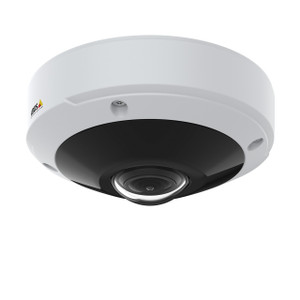
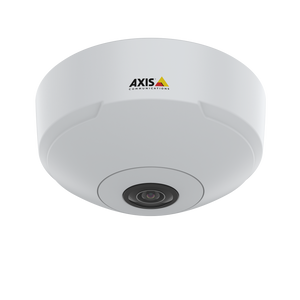
Features:
360° Panoramic View
Features:
Built-in Cybersecurity
Frame Rate:
25/30 fps
Type:
Dome
Sensor Type:
CMOS
Image Sensor Size:
1/2.3"
Lightfinder:
Lightfinder
Wide Dynamic Range:
Forensic WDR
Min illumination/ light sensitivity (Color:
0.19 lux
Min Illumination:
0.19 lux
Max Resolution:
2992x2992
Max frames per second:
25/30
Day and Night:
PoE
Focal Length:
1.2 mm
Horizontal Field of View:
182°
Vertical Field of View:
182°
Zipstream:
Yes
Video Compression:
H.264
Signed Firmware:
PoE
Secure Boot:
PoE
Built-in IR:
Yes
OptimizedIR:
Yes
Local Storage:
PoE
Operating Temperature:
-40 to 50 °C
Outdoor Ready:
Yes
Vandal Rating:
IK10
IP Rating:
IP66
Sustainability:
BFR/CFR free, PVC free
Product Type:
Dome
Connectivity:
Wired
Power Type:
PoE
Resolution:
12MP
Night Vision:
IR
Housing Color:
White
Warranty:
5-year warranty
H.264:
Baseline, High, Main
H.265:
Yes
Audio Support:
Yes
Signed OS:
Yes
Minimum Illumination Color:
0.19 lux at 50 IRE, F2.2
Minimum Illumination B/W:
0.04 lux at 50 IRE, F2.2 0 lux with IR illumination on
Shutter Speed:
1/8100 s to 0.5 s
Camera Adjustment Digital Roll:
± 180°
Model:
ARTPEC-8
Memory:
2048 MB RAM, 8192 MB Flash
Compute Capabilities:
Deep learning processing unit (DLPU)
Double Panorama:
3584x2688 to 512x288
Corner Right And Left:
3200x1200 to 192x72
Video Streaming:
Multiple, individually configurable streams in H.264, H.265 and Motion JPEG Axis Zipstream technology in H.264 and H.265 Controllable frame rate and bandwidth VBR/ABR/MBR H.264/H.265 Video streaming indicator
Noise Reduction:
Spatial filter (2D noise reduction) Temporal filter (3D noise reduction)
Image Settings:
Saturation, contrast, brightness, sharpness, local contrast, tone mapping, white balance, day/night threshold, exposure mode, exposure zones, compression, mirroring, dynamic text and image overlay, polygon privacy mask
Image Processing:
Axis Zipstream, Forensic WDR, Lightfinder, OptimizedIR
Pan/Tilt/Zoom:
Digital PTZ of view areas, digital PT of panorama, corner, corridor and quad views, preset positions, guard tours
Audio Input/output:
Audio features through portcast technology: two-way audio connectivity, voice enhancer
Network Protocols:
IPv4, IPv6 USGv6, ICMPv4/ICMPv6, HTTP, HTTPS , HTTP/ 2, TLS , QoS Layer 3 DiffServ, FTP, SFTP, CIFS/SMB, SMTP, mDNS (Bonjour), UPnP , SNMP v1/v2c/v3 (MIB- II), DNS/DNSv6, DDNS, NTP, PTP, NTS, RTSP, RTP, SRTP/ RTSPS, TCP, UDP, IGMPv1/v2/v3, RTCP, DHCP
Application Programming Interface:
Open API for software integration, including VAPIX®, metadata and AXIS Camera Application Platform (ACAP); specifications at axis.com/developer- community . One-click cloud connection ONVIF® Profile G, ONVIF® Profile M, ONVIF® Profile S, and ONVIF®
Video Management Systems:
Compatible with AXIS Camera Station Edge, AXIS Camera Station Pro, AXIS Camera Station 5, and video management software from Axis’ partners available at axis.com/vms .
Onscreen Controls:
Privacy masks IR illumination Media clip
Edge-to-edge:
Siren and light pairing
Event Conditions Device Status:
above operating temperature, above or below operating temperature, below operating temperature, casing open, IP address removed, live stream active, network lost, new IP address, system ready, within operating temperature
Event Conditions Edge Storage:
recording ongoing, storage disruption, storage health issues detected
Event Conditions I/O:
digital input is active, digital output is active, manual trigger, virtual input is active
Event Conditions MQTT:
stateless
Scheduled And Recurring:
schedule
Event Conditions Video:
average bitrate degradation, day-night mode, tampering
Event Actions I/O:
toggle once, toggle while the rule is active
Event Actions Illumination:
use lights, use lights while the rule is active
Event Actions Images:
FTP, HTTP, HTTPS, SFTP, email and network share
Event Actions MQTT:
publish
Event Actions Notification:
HTTP, HTTPS, TCP and email
Event Actions Overlay Text:
use, use while the rule is active
Event Actions Recordings:
record video, record video while the rule is active
SNMP Trap Messages:
send, send while the rule is active
Event Actions Status LED:
flash, flash while the rule is active
Event Actions Video Clips:
FTP, HTTP, HTTPS, SFTP, email and network share
Built-in Installation Aids:
Pixel counter, level grid, digital roll
Included:
AXIS Object Analytics, AXIS Image Health Analytics, AXIS Scene Metadata, AXIS Video Motion Detection, active tampering alarm
Supported:
Support for AXIS Camera Application Platform enabling installation of third-party applications, see axis.com/ acap
AXIS Object Analytics Object Classes:
humans, vehicles (types: cars, buses, trucks, bikes)
AXIS Object Analytics Scenarios:
line crossing, object in area, crossline counting, occupancy in area Up to 10 scenarios
AXIS Image Health Analytics Tampering:
blocked image, redirected image
Image Degradation:
blurred image, underexposed image
AXIS Scene Metadata Object Classes:
humans, faces, vehicles (types: cars, buses, trucks, bikes)
Object Attributes:
vehicle color, confidence, position
Product Markings:
CSA, UL/cUL, BIS, UKCA, CE, KC
Supply Chain:
TAA compliant
Australia/New Zealand:
RCM AS/NZS CISPR 32 Class A
EMC Canada:
ICES-3(A)/NMB-3(A)
EMC Japan:
VCCI Class A
EMC Korea:
KS C 9835, KS C 9832 Class A
EMC USA:
FCC Part 15 Subpart B Class A
EMC Railway:
IEC 62236-4
Safety:
IEC/EN/UL 62368-1 ed. 3, CAN/CSA C22.2 No. 62368-1 ed. 3, IEC/EN 62471 risk group exempt, UN ECE R118, IS 13252
Environment:
IEC 60068-2-1, IEC 60068-2-2, IEC 60068-2-6, IEC 60068-2-14, IEC 60068-2-27, IEC 60068-2-78, IEC TR 60721-4-5 Class 5M3 (Vibration, Shock), IEC/EN 62262 IK10, IEC/EN 60529 IP66, ISO 4892-2, NEMA 250 Type 4X, NEMA TS 2 (2.2.7-2.2.9), IEC/EN 61373 Cate
Cybersecurity:
ETSI EN 303 645, BSI IT Security Label, FIPS-140
Edge Security Software:
Signed OS, brute force delay protection, digest authentication and OAuth 2.0 RFC6749 Client Credential Flow/OpenID Authorization Code Flow for centralized ADFS account management, password protection, Axis Cryptographic Module (FIPS 140-2 level 1), A
Edge Security Hardware:
Axis Edge Vault cybersecurity platform Secure element (CC EAL 6+), system-on-chip security (TEE), Axis device ID, secure keystore, signed video, secure boot, encrypted filesystem (AES-XTS-Plain64 256bit)
Network Security:
IEEE 802.1X (EAP-TLS, PEAP-MSCHAPv2) , IEEE 802.1AE (MACsec PSK/EAP-TLS), IEEE 802.1AR, HTTPS/HSTS , TLS v1.2/v1.3 , Network Time Security (NTS), X.509 Certificate PKI, host-based firewall
Documentation:
AXIS OS Hardening Guide Axis Vulnerability Management Policy Axis Security Development Model AXIS OS Software Bill of Material (SBOM) To download documents, go to axis.com/support/ cybersecurity/resources To read more about Axis cybersecurity suppor
Casing Color:
white NCS S 1002-B Repaintable skin cover accessory
Mounting:
Mounting bracket with junction box holes (double- gang, single-gang, and 4” octagon) ¼”-20 UNC tripod screw thread
Connectors Network:
Shielded RJ45 10BASE-T/100BASE-TX PoE
Connectors I/O:
Terminal block for 1 supervised alarm input and 1 output (12 VDC output, max. load 25 mA)
Connectors Audio:
Audio and I/O connectivity via portcast technology
IR Illumination:
OptimizedIR with power-efficient, long-life 850 nm IR LEDs Range of reach 15 m (49.2 ft) depending on the scene
Start-up Temperature:
-30 °C Humidity 10-100% RH (condensing)
Operating Conditions:
-40 °C to 50 °C (-40 °F to 122 °F)
Dimensions Height:
70 mm (2.7 in) ø 149 mm (5.9 in)
Effective Projected Area (epa:
0.0076 m (0.025 ft )
Weight:
860 g (1.9 lb)
Box Content:
Camera, installation guide, terminal block connector, connector guard, cable gaskets, cable hole lid, owner authentication key
Optional Accessories:
AXIS T8415 Wireless Installation Tool, AXIS T94T02D Pendant kit, AXIS TM3814 Skin Cover Black, AXIS TM3204 Recessed Mount, AXIS TM3206 Recessed Mount, AXIS Mounts and Cabinets, AXIS Surveillance Cards For more accessories, go to axis.com/products/ax
System Tools:
AXIS Site Designer, AXIS Device Manager, product selector, accessory selector, lens calculator Available at axis.com
Languages:
English, German, French, Spanish, Italian, Russian, Simplified Chinese, Japanese, Korean, Portuguese, Polish, Traditional Chinese
Part Numbers:
Available at axis.com/products/axis-m4318-plr#part- numbers
Substance Control:
PVC free, BFR/CFR free in accordance with JEDEC/ECA Standard JS709 RoHS in accordance with EU RoHS Directive 2011/65/ EU/ and EN 63000:2018 REACH in accordance with (EC) No 1907/2006. For SCIP UUID, see axis.com/partner.
Renewable Carbon-based Plastic Content:
29.6% (bio- based) Screened for conflict minerals in accordance with OECD guidelines To read more about sustainability at Axis, go to axis. com/about-axis/sustainability
Environmental Responsibility:
axis.com/environmental-responsibility Axis Communications is a signatory of the UN Global Compact, read more at unglobalcompact.org
Camera Resolution:
6 MP
Ingress Protection:
IP66
Impact Protection:
IK10
Connector Type:
RJ45
Shipping Weight:
2.450 lb
Country Of Origin:
MX
UNSPSC:
46171610