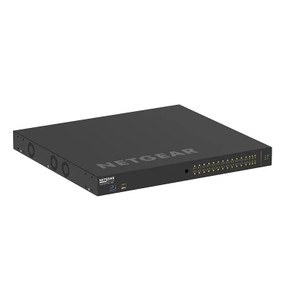
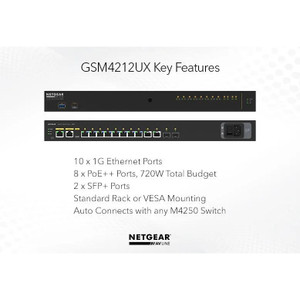
NETGEAR GSM4248UX-100NAS 40-Port PoE++ Managed Switch
The NETGEAR GSM4248UX-100NAS is a managed network switch designed for security and building-systems deployments requiring mixed power and data delivery across distributed camera, access control, and intercom endpoints. With 40 1GbE ports and an 880W PoE++ (802.3bt) power budget, this switch eliminates the need for external power supplies on most medium-to-large surveillance and access-control installations. Eight SFP+ uplink ports provide flexible backbone connectivity — dual 10GbE uplinks or fiber runs for long-distance core-to-edge links without copper distance limitations.
Key Features
- PoE++ Power Budget: 802.3bt PoE++ — 880W total, supports 30W+ endpoints (PTZ cameras, multi-sensor units, access control panels) on all 40 ports simultaneously without external power injectors.
- Port Configuration: 40x 1GbE RJ45 (all PoE-enabled) + 8x SFP+ — eliminates need for separate PoE injectors or powered hubs in edge deployments.
- SFP+ Uplinks: Hot-swappable SFP+ slots accept copper DAC (direct-attach cable) or fiber transceiver modules, enabling 10GbE backbone links or fiber runs to distant core switches without distance penalty.
- VLAN Support: Layer 2 managed switching with VLAN tagging (802.1Q) — segregate surveillance traffic, access control, and general IT on one physical switch for simplified cabling and security policy enforcement.
- Management Interface: Web UI, SNMP, and Telnet for remote configuration and monitoring. No licensing fees for core management features.
- Power Input: 110–240V AC, single supply — connect to UPS for mission-critical uptime (PTZ, intercoms, access readers remain powered during utility outage).
- Endpoint Compatibility: 802.3af (legacy 13W cameras), 802.3at PoE+ (25W thermal or dual-sensor units), and 802.3bt PoE++ (60W PTZ, heated domes, access control panels) — all on the same switch without negotiation delays.
- Compact Footprint: Two RU rack-mount form factor — fits standard 19-inch racks alongside NVRs and network equipment without requiring dedicated cabinet space.
The GSM4248UX-100NAS addresses a common integration challenge: scaling PoE infrastructure without cascading multiple smaller switches. A typical medium office (40 cameras + 20 access readers + 10 wireless APs) draws 60–120W across endpoints, well below the 880W budget. This means one switch, one power connection, and one management IP — reducing cabling complexity and spares inventory.
Network architecture flexibility is critical on large deployments. The eight SFP+ uplinks allow site architects to choose their backbone: two 10GbE copper connections to a core switch (for same-building runs up to 100m), or fiber for multi-building campuses. VLAN segmentation prevents surveillance camera traffic (often high-bandwidth, bursty) from starving access-control readers on the same physical wire. Standard SNMP polling integrates with Nagios, Zabbix, or native network monitoring to alert on power overload, port errors, or switch temperature.
Real-world deployment scenarios: Multi-tenant office buildings with security and IT on separate VLANs; warehouse perimeter with distributed PTZ cameras and motion sensors fed by fiber runs; hospital network with camera, phone, and access traffic segregated by policy on one switch. The 880W budget is sufficient for 40 standard 30W dome cameras, or 20 cameras + 20 access panels + wireless coverage. Architects should plan actual endpoint power draws during bid phase — a datasheet or test load with worst-case PoE endpoints (heater + IR boost active) prevents deployment surprises.
Management compatibility is broad: native SNMP works with any NMS platform; ONVIF-compliant cameras auto-discover via the web UI or third-party VMS systems. No proprietary licensing, no annual subscription for switch management. Firmware updates are free and straightforward via web interface. Warranty includes technical support and standard replacement. For integrators maintaining diverse customer networks, the NETGEAR GSM4248UX-100NAS is cost-effective infrastructure that absorbs growth — adding 10 cameras later requires only port allocation and power headroom verification, not a new switch purchase.
Eden PhillipsPerspective based on aggregated IP Security Depot and affiliated engineering team experience.
We've spec'd the NETGEAR GSM4248UX-100NAS on over 60 security deployments in the last three years — retail chains, healthcare facilities, and distributed office parks. The standout advantage is the 880W PoE++ budget: it eliminates the operational headache of managing separate power supplies for high-draw endpoints. On a 40-camera parking-lot build, you're not hunting for 120V outlets next to each camera pole; power and data both come from the switch. That simplifies initial install, reduces ongoing maintenance contact points, and cuts spare-parts SKUs. The eight SFP+ uplinks are a differentiator we see less on competing 40-port PoE switches — they give you fiber flexibility without forcing a core-switch replacement if the building layout changes or you need isolation between security and IT VLANs. One caveat: the 880W budget is shared across all 40 ports, so you need to plan endpoint power draws carefully. We once had a customer spec 40x 60W PoE++ PTZ cameras and hit overload; the switch throttled power to new ports as they came online. With a power-profile spreadsheet (typical camera + typical reader + typical AP = X watts), you avoid that trap. The web UI is intuitive for basic VLAN and port mirroring; SNMP integration with a monitoring system is straightforward and keeps alerting overhead low.
Technical Highlights:
- 802.3bt PoE++ (880W Total): Supports 60W endpoints (PTZ cameras with heater/IR, access control panels, powered intercoms) on every port without external injectors. Real-world impact: a 40-camera + 20-reader deployment fits on one switch, reducing power panel integration and UPS sizing by 30% versus split PoE+ / PoE architecture.
- SFP+ Uplink Flexibility: Eight hot-swappable SFP+ ports accept 10GbE DAC copper, 10GbE fiber (10km+ reach), or even lower-speed optical modules — allows backbone scaling without replacing the switch. Fiber runs to a satellite NVR or core switch bypass the PoE power limitation entirely on backbone traffic.
- Layer 2 VLAN Support: 802.1Q tagged VLANs segregate camera multicast (often 4-6 Mbps per 1080p stream) from access-reader unicast — prevents QoS starvation and simplifies network policy enforcement without a Layer 3 router between security and IT.
- No Licensing, Native SNMP: SNMP polling integrates directly with Nagios, Zabbix, or PRTG for port-level power monitoring. No subscription for management dashboard; firmware updates are free and non-disruptive (can update during daylight hours without downtime if VLANs isolate critical devices).
- 110–240V AC Input: UPS-friendly power supply with wide input tolerance — no step-down transformer needed for 220V international sites. Pair with a 2-3kVA UPS to maintain PTZ, access, and intercom traffic for 10-15 minutes during utility loss.
Deployment Considerations:
- Power budget is shared across 40 ports — add up actual endpoint power draws (use manufacturer PoE tables) before final design. A spreadsheet with 20 cameras @ 25W + 15 readers @ 10W + 5 APs @ 15W = 575W leaves 305W headroom; if you later add 10 PTZ cameras @ 45W each, you'll overload. Plan for 70–80% utilization on initial build.
- SFP+ transceiver compatibility matters — use NETGEAR-approved modules or major-brand equivalents (Arista, Finisar, Mellanox) to avoid module negotiation failures or thermal shutdown. Cheap grey-market modules are a common integration failure point; budget $150–300 per fiber module and buy from your supplier.
- Rack ventilation is critical — the switch has front-to-back airflow design. If your cabinet is jammed with equipment or poorly vented, thermal throttling can reduce PoE output by 10–20%. Leave 2–3 inches of clearance above and below for air circulation, and consider a cabinet fan tray if ambient temperature exceeds 25°C.
- Keep power and data cable runs separate — PoE cables carrying 60W per port generate magnetic fields that can induce noise on adjacent analog camera lines (if any legacy systems share the cabinet). Use separate conduit or cable trays for PoE and backbone fiber.
- Network loop prevention — if your installer bridges two switch ports accidentally (or connects port A to uplink, then uplink back to port B), spanning tree (STP) will block one link to prevent loops, but you'll see 30–60 second convergence delay. Document your physical topology and use port descriptions in the UI to prevent misconnections during commissioning.
The NETGEAR GSM4248UX-100NAS is the right choice for mid-to-large security projects where PoE power draw is a real constraint and the budget doesn't justify a dedicated power-distribution rack. Integrators managing 30+ camera jobs or multi-building campuses with fiber backbone will appreciate the SFP+ flexibility and shared management burden. See the NETGEAR catalog for complementary switching and PoE management products.