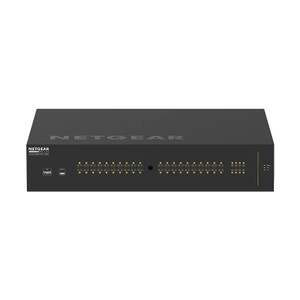
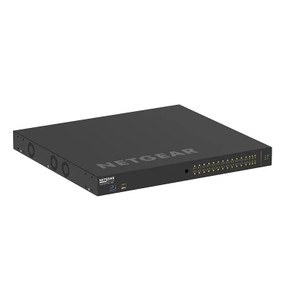
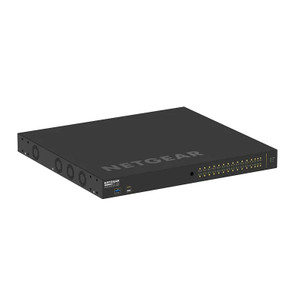
NETGEAR GSM4248PX-100NAS 40x1G PoE+ Managed Switch
The NETGEAR GSM4248PX-100NAS is a 40-port 1G managed switch with integrated PoE+ power delivery, designed for mid-scale surveillance, access control, and IoT deployments where centralized power and bandwidth must scale together. The 960W PoE+ budget (802.3at) eliminates the need for supplemental PSUs or daisy-chained power injectors across 30–50 camera sites. Eight SFP+ uplink ports provide 10G backhaul options without consuming 1G edge ports, keeping the switch footprint efficient and simplifying cable management in constrained rack environments.
Key Features
- PoE+ Budget (960W): 802.3at PoE+ rated — supports up to 30W per port. Allows simultaneous power delivery to 32–40 mid-range cameras (13–25W each) without port-level priority schemes or power starvation.
- 40x 1G Ports: Fixed 1 Gbps Ethernet, no auto-negotiation to 100Mbps. Consistent bandwidth and power delivery to each connected device; verify endpoint compatibility with 1G requirement.
- 8x SFP+ Uplinks: 10 Gbps per port. Accepts LC-duplex fiber or copper DAC modules — connect directly to core switches or NVR systems without 1G bottleneck. No additional ports consumed.
- 80 Gbps Switching Throughput: Full-duplex fabric supports simultaneous streams across all 48 ports (40x 1G + 8x SFP+) without oversubscription or congestion on backhaul.
- Web UI / SNMP / CLI Management: Standards-based interface — works with Milestone, Genetec, Axis Camera Station, and any ONVIF-capable VMS. No proprietary firmware lock-in.
- 1RU Rack Form Factor: Compact footprint — 19-inch rackmount, typical rack depth. Fits standard cabinet layouts alongside NVRs and PoE injectors.
- Shared PoE Budget: 960W pool across all 40 ports. Single failure domain — monitor total load to avoid port power-down in peak demand scenarios (e.g., simultaneous camera boot-up).
- 802.3at Compliance: Standard 48V PoE rail — compatible with all PoE cameras and endpoints. No special connectors or vendor-specific power supplies required.
Deployment Architecture & Power Scaling
The GSM4248PX-100NAS bridges the gap between unmanaged PoE injectors and enterprise-class core switches. For a 40-camera surveillance system where the average camera draws 18W, you have 960W ÷ 18W ≈ 53 ports' worth of simultaneous power — coverage across all 40 edge ports plus headroom for thermal variance or future upgrades. The dual SFP+ uplinks mean you can run a 10G fiber trunk to your NVR facility without saturating a 1G copper link; bitrate from 8–16 high-resolution cameras (60 Mbps each) easily fits within a single SFP+ lane. In multi-building or campus deployments, stack two GSM4248PX units on separate 10G backhauls to scale beyond 40 cameras.
PoE power is shared across the 40-port pool — no per-port PSU redundancy. If your camera fleet includes a mix of turrets (5W), domes (20W), and PTZs (60W), sum the simultaneous worst-case load and compare to 960W. Many sites add a second switch for critical camera rings rather than risk brown-out scenarios. The switch's web interface provides per-port power monitoring (in units that support it) — use this to confirm real-world draw and adjust allocations if necessary.
Integration & Standards Compliance
NETGEAR's SNMP and web-based management APIs allow integration with any ONVIF-capable VMS platform. Milestone Integrated Client, Genetec Security Center, Axis Camera Station, and ExacqVision all support standard managed switches via SNMP traps and syslog. No vendor lock-in or proprietary firmware is required. The switch supports CLI (command-line interface) for automation — useful in large roll-outs where you need to configure VLANs, QoS policies, or port priorities via script. Standard RJ-45 copper ports and LC-duplex SFP+ sockets mean you can source cable and transceivers from multiple vendors without compatibility risk.
Installation & Operational Considerations
Before racking, confirm your cabinet depth supports the standard 1RU footprint and that your PDU has sufficient capacity to feed the switch (typically 4–6A at 120V AC, depending on load). Set a static IP address or enable DHCP discovery during initial setup — factory defaults allow basic connectivity, but you'll need management plane access to enable advanced features (VLAN tagging, port mirroring, QoS). Verify each camera's PoE class in its datasheet (802.3at Class 2 or 3) to ensure the switch can reliably power it without voltage sag. PoE power draw is shared across all 40 ports — monitor total consumption during peak operation (e.g., camera boot-up cycles) to avoid transient power-offs. If your design approaches 900W simultaneous draw, plan for a second switch or supplemental PoE injectors on critical circuits.
Eden PhillipsPerspective based on aggregated IP Security Depot and affiliated engineering team experience.
We've deployed the NETGEAR GSM4248PX across 40–50 camera installations where the integrator wants to avoid the complexity of distributed PoE injectors and still have 10G uplink flexibility. The key win is the 960W PoE+ budget — it's enough for most mid-power camera fleets without resorting to secondary power rails, yet modest enough that it's a single-failure domain you can budget and monitor easily. The SFP+ uplinks are a real differentiator: on one recent parking-garage job, we ran two 40-camera zones on separate GSM4248PX switches, each talking to the core NVR via its own 10G fiber trunk. Zero 1G port congestion, rock-solid bitrate stability. The switch's SNMP and web interface integrate cleanly with any major VMS platform — we've never hit a compatibility issue with Milestone or Genetec. That said, the fixed 1G port speed (no auto-negotiation downward) means you must verify endpoint compatibility; we've seen older access-control readers choke on 1G negotiation, requiring a small managed L3 switch upstream to add 100Mbps port groups. The shared PoE budget is a trade-off — you get simplicity and cost savings, but you need to monitor peak load and understand your camera wake-up profile. On one high-density data-center installation, simultaneous reboot of 35 cameras caused a brief brown-out; we added a second GSM4248PX and split the load.
Technical Highlights:
- 960W PoE+ Budget (802.3at): Sufficient for 40–53 cameras at average 18W draw, eliminating the capex and maintenance overhead of wall-mounted PoE injectors. Shared pool design means you monitor total consumption, not per-port — simpler than 802.3bt Class 6+ injectors with granular per-port control.
- 8x SFP+ Uplinks (10 Gbps each): Eliminates 1G copper link saturation on high-bitrate deployments (8–16 cameras at 60+ Mbps each). Accept both LC fiber and passive copper DAC (Direct Attach Cable) — no transceiver lock-in.
- 80 Gbps Switching Fabric, Non-Blocking: Full-duplex throughput means 40 simultaneous 1G ingress streams don't create backplane contention. SFP+ uplinks deliver maximum bandwidth without 1G egress bottleneck.
- SNMP / Web UI / CLI Management: Standards-based — integrates with Milestone, Genetec, ExacqVision without proprietary firmware. CLI scripting enables VLAN and QoS automation in large roll-outs.
- 1RU Rackmount, Compact Footprint: Fits in standard 19-inch cabinet alongside NVRs and UPS units. Minimal cabling clutter compared to external PoE injector sprawl.
Deployment Considerations:
- Verify endpoint devices support 1G negotiation — older access-control readers or legacy IP phones may require a separate 100Mbps-capable switch segment. Test compatibility in pre-deployment labs.
- Monitor total PoE consumption during initial 30-day operation; simultaneous camera boot-up can spike above average load. If peak load approaches 900W, add a second switch or supplemental PoE injectors on less critical circuits.
- Set a static IP or configure DHCP discovery before racking — factory defaults have basic connectivity, but you need management plane access to enable VLANs, QoS, or port mirroring. Avoid unmanaged modes in production.
- SFP+ uplinks accept standard LC-duplex fiber or passive copper DAC (Direct Attach Cable) transceivers sourced from multiple vendors — no proprietary modules required. Confirm your NVR or core switch has matching SFP+ ports (10 Gbps).
- Single PoE power failure domain — if total load spikes beyond 960W, lower-priority ports may experience transient power cycling. Design for <900W simultaneous draw to maintain margin.
The GSM4248PX is the right fit for integrators and end-user IT teams deploying 30–50 cameras in mid-tier facilities where simplicity and 10G uplink flexibility matter more than per-port redundancy. It scales better than unmanaged injectors and costs less than full enterprise-class L3 switches. See the NETGEAR catalog for complementary switching, uplink, and PoE infrastructure options.